It’s been more than an a year now since I started this website. I want to express my thanks to everyone who has been reading. Your site visits, likes, and comments mean a lot. This site has been a powerful venue for me to share my own nonfiction writing while documenting the rich and beautiful showpieces of nature, living their simple lives, uncensored. One thing I love about flowering is the element of discovery. Every time we check out a trail or visit a new park, I encounter something of curiosity. Flowering has enabled me to build a collection of memories. I also have a collection of drawings and photographs, poems and essays, fragments of stories: discovering flowers has inspired me to spend more time on creative activities. I’m a happier person, knowing the names of flowers.
We went on our annual June vacation, this year to Michigan’s Upper Peninsula. In 2021, we made our first visit to Michigan, taking a day trip from Ashland, Wisconsin to Ontonagon and the Porcupine Mountains Wilderness Area. This year, we decide to return, wanting to explore more of the UP. Spending about a week on the road, we visited Marquette and Munising, going as far east as Grand Marais, Michigan. Driving toward Michigan, we check out Jay Cooke State Park, walking across the swinging bridge that crosses the St. Louis River. Our hound puts a lot of miles on his paws. He’s popular out in nature, attracting attention from adventurers of all ages. It’s fun to see the variety of dogs out on the trails: some large, sporty and confident–some tiny or old, riding in a dog stroller.
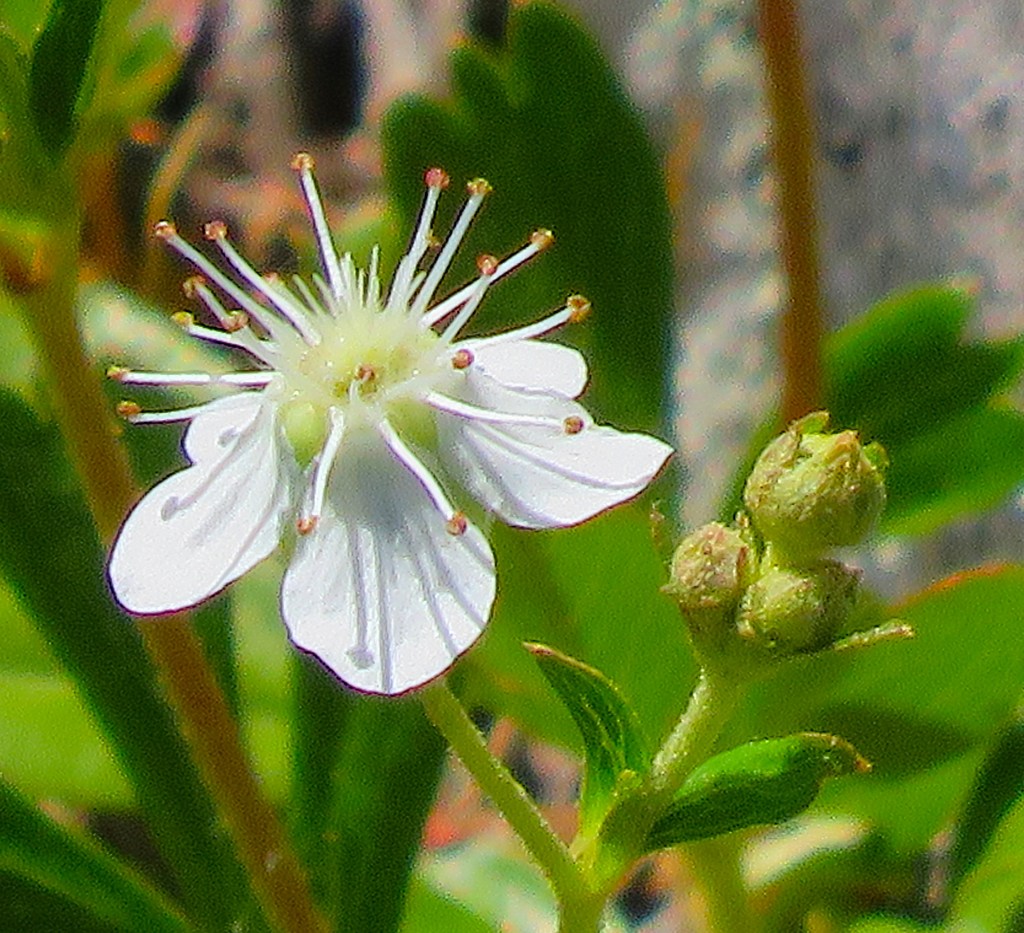
Three-toothed Cinquefoil, Sibbaldiopsis tridenta, Jay Cooke State Park, MN. Photo by Danielle, June 2026.
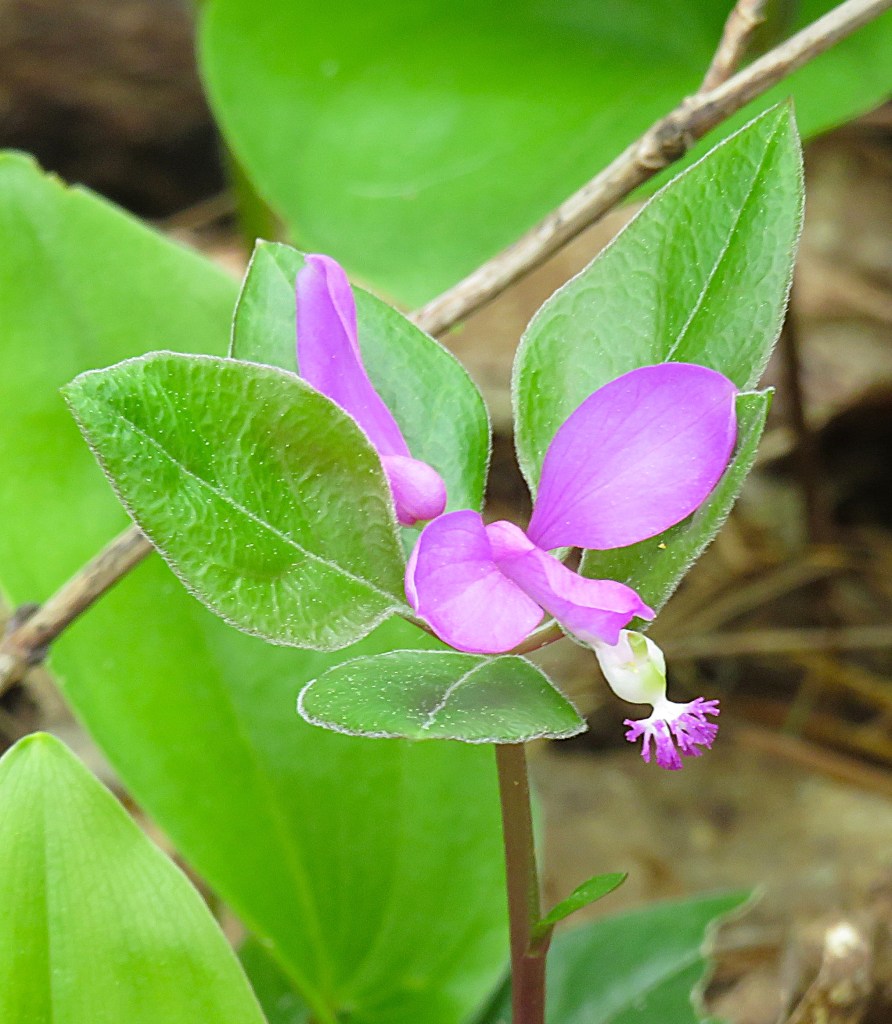
Gaywings, Polygaloides paucifolia, Big Bay, MI. Photo by Danielle, June 2026.
The incredible stretches of forest along the sandy beaches of Lake Superior prove colorful for flower hunting. It’s been almost two years since my daydream moment in Lake of the Woods county, where we came upon a field of blue flax that looked like water. Reality merged with an optical illusion, and I saw something truly phenomenal, undulating under the sun, bisected by a two-lane highway. Finding something new in the forests of the Upper Peninsula gives me a similar feeling. Along the cliffs of the lake, we see a few unusual flowers. They’re a vibrant shade of fuchsia with a fringed sepal extending out from the rest of the flower like a luxurious handheld fan. I’ve never seen these before. Later, I learn that they’re Gaywings, Polygaloides paucifolia, a member of the Milkwort family. From some angles, the flowers look like upside down butterflies. I learn that the name, Gaywings, comes from the way the flowers resemble birds, pink wings outstretched, flying. I also see little pink airplanes. Viewed from the front, the fringed sepal looks like a propeller. I imagine a bee at the controls and write a haiku:
Gaywings like airplanes,
fuschia with fringed propellers–
bumbling pilots, fly!
Every new flower instantly feels like a favorite. Trying to capture its essence in words forces me to think about concepts like image and metaphor. The haiku form of 5-7-5 syllables per line works as a perfect template for nature snapshots rendered in imaginative language. Around Munising, I’m speechless on a forest road lined with thousands of Large-flowered trillium, Trillium grandiflorum. I’ve seen these flowers before, at Itasca State Park. These are enormous and colorful. I’ve never seen them in pink. Some have stripes and remind me of lilies. Minnesota Wildflowers explains that Trillium was once part of the Lily (Liliaceae) family. Most Trillium native to North America grow in the eastern part of the continent. The flowers of Trillium have three leaves, just as the word “trillium” has three syllables.
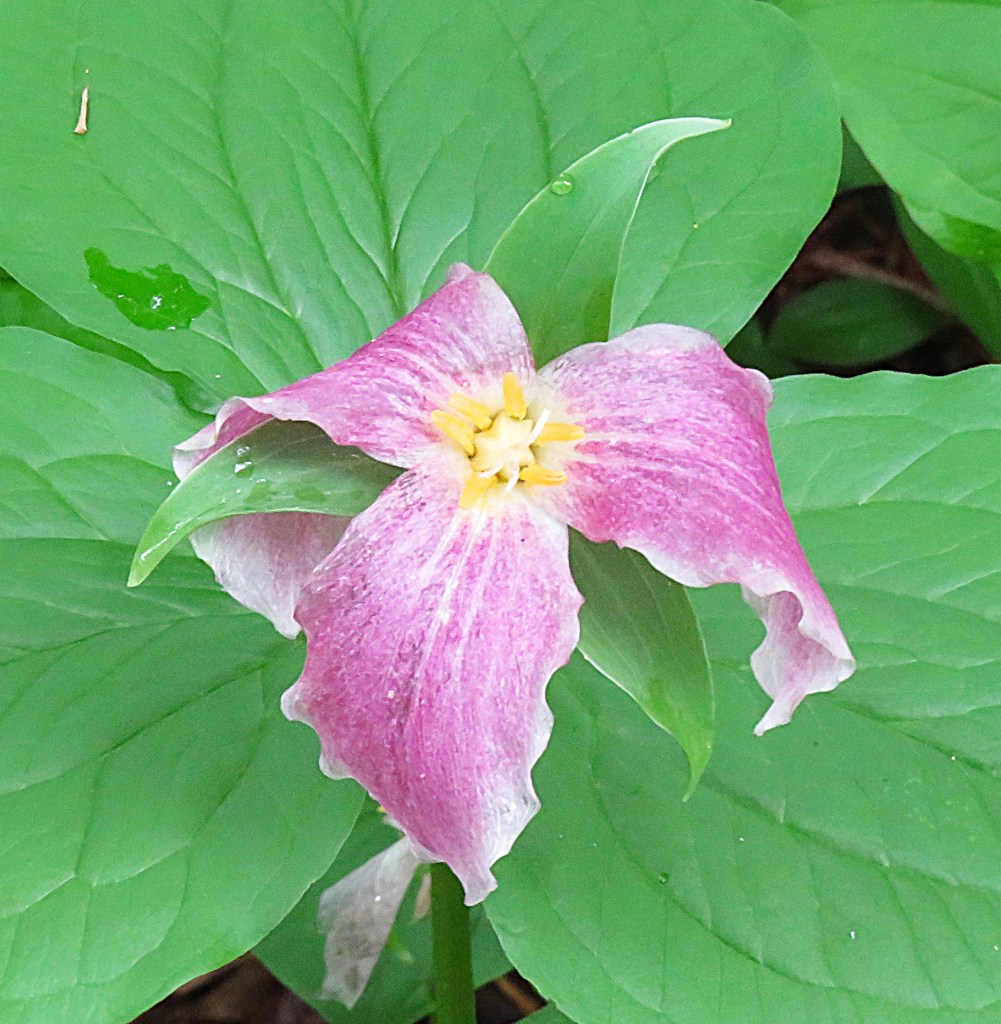
Large-flowered trillium, Trillium grandiflorum, Pictured Rocks National Lakeshore, Michigan. Photo by Danielle, June 2026.
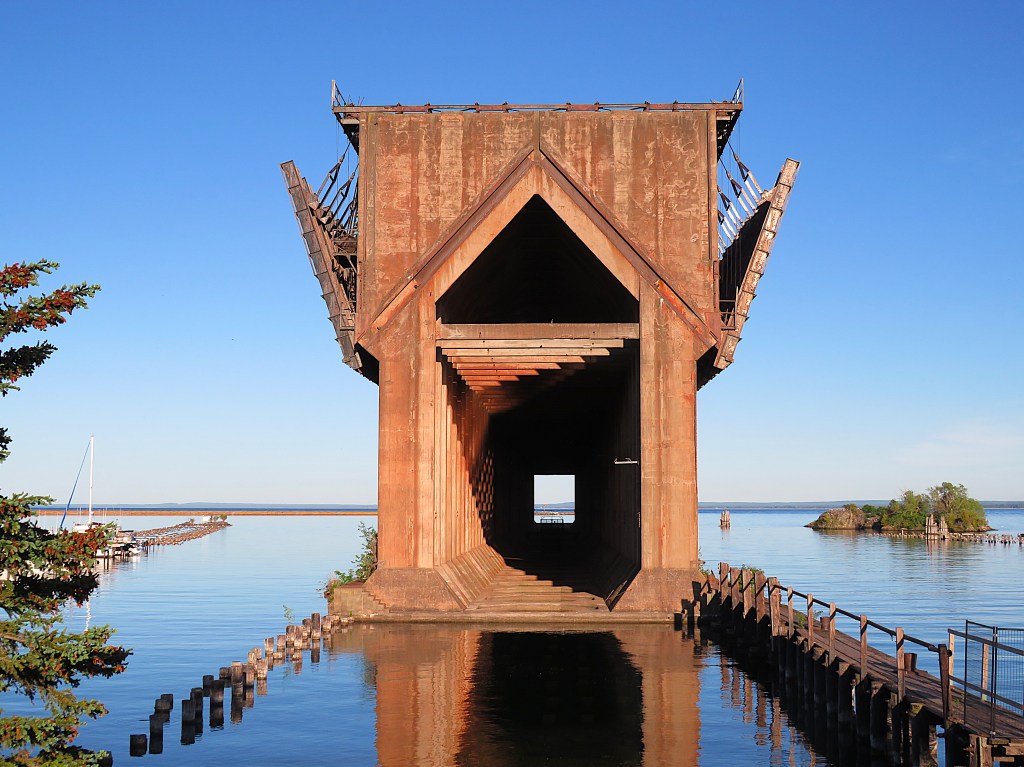
Marquette, MI. Photo by Danielle, June 2026.
Most of the formations along Pictured Rocks National Lakeshore are visible only by boat. Stretching thirteen miles along the coast of the lake, the Pictured Rocks have formed over 500 million years, with glacial activity, erosion, and interactions between water and stone resulting in striking cliffs and exposed layers of striated rock. The area remains a significant spiritual place for the Anishinaabe. The sandstone cliffs are prominent in Henry Wadsworth Longfellow’s “The Song of Hiawatha” (1855), with the Pictured Rocks area forming the setting for much of the narrative. The source material for Longfellow’s work is complex, revealing how indigenous figures and stories were often transformed for popular audiences through a European perspective. I recall our trip last summer to Minnehaha Falls in Minneapolis, where a statue of Longfellow’s Hiawatha and Minnehaha emerges from the greenery.
We take a short, hound-friendly hike to Miner’s Castle, an iconic rock formation just outside Munising. The cliffs along the Lake Superior shores are made of sandstone, with the colorful layers recording the passage of time. The castle itself rises up from a point extending into the lake. The water below the overlook forms a little bay; on the day of our visit, the water is still and turquoise. The history-dyed cliffs contrast with the water. The shades are those of the finest gems.
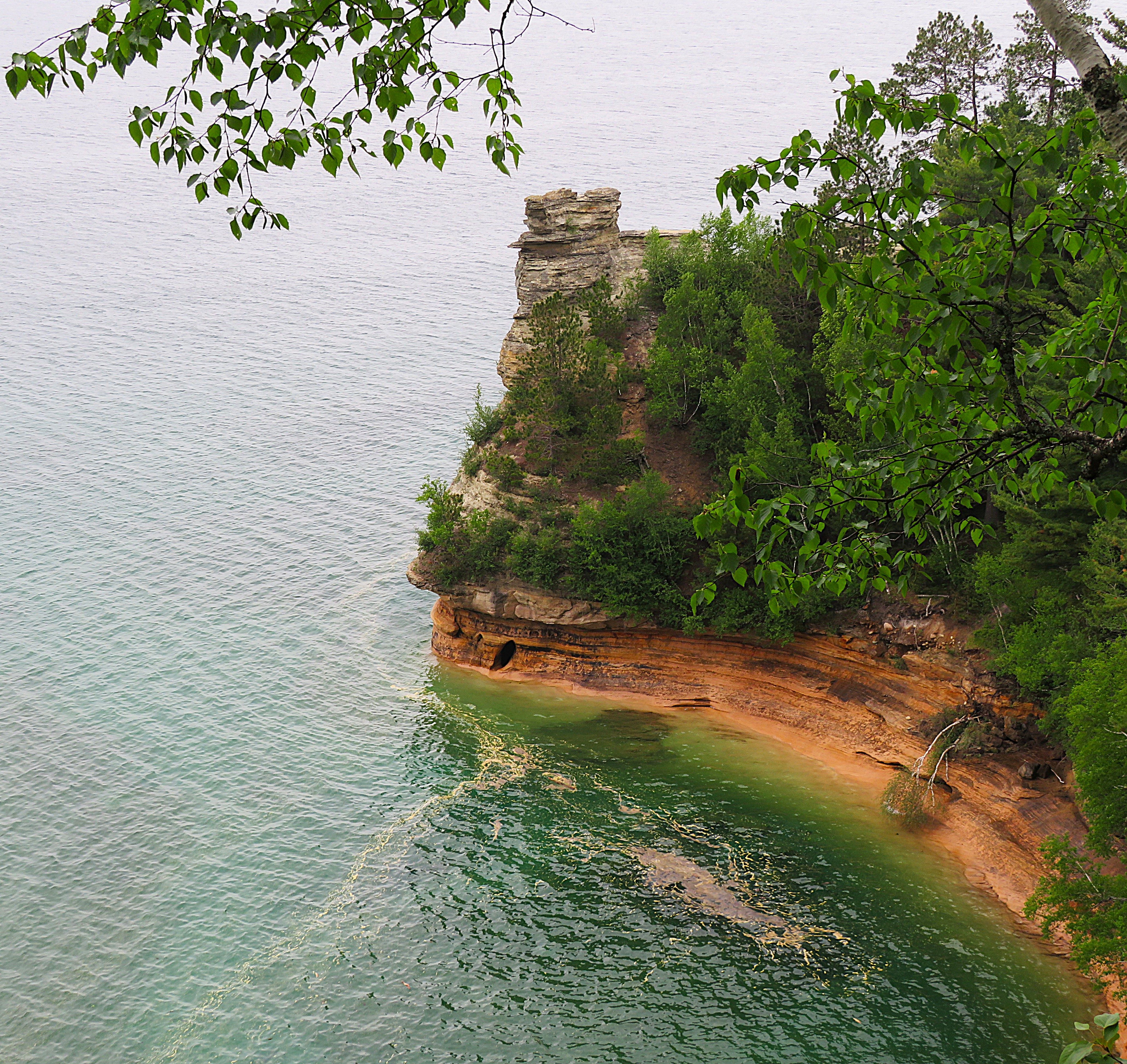
Miner’s Castle, Pictured Rocks National Lakeshore, Michigan. Photo by Danielle, June 2026.
We take Miner’s Castle Road to a dreamy trail toward Miner’s Falls, the most powerful waterfall in the National Lakeshore. The path toward the waterfall is lined with Forget-me-Nots, Myosotis, and the delicate blue flowers contribute to the tranquil aura of Hiawatha National Forest. Unfortunately, the plants are invasive. It can be difficult to know how to write about invasive species, which often steal resources from native plants, threatening those plants and changing the natural ecosystem. I try not to draw attention to invasive plants, but like the invasive Large-leaved lupine (Lupinus polyphyllus) growing along the Minnesota North Shore, the Forget-me-Nots remain in my memory as part of the place. Often beautiful and bold, the flowers of invasive plants seem to exist in harmony with their surroundings. Instead, they’ve invaded, like another artist interfering with a rival’s unfinished masterpiece.
Approaching Miner’s Falls, I discover what looks like an orchid. I see only one: it’s a deep red color, perhaps a foot tall, near the base of a tree. Its flowers are just starting to bloom in the shapes of striped bells. The plant is just a few feet from the trail, and I’m able to spend some time with it, taking pictures. Mosquitos swarm and I have to keep moving. Reaching the waterfall, it’s marvelous, with a roaring drop of at least forty feet. Walking back, I re-visit the orchid, attempting more photographs. I later confirm my suspicion that the plant is a type of coralroot: Striped Coralroot, Corallorhiza striata, an orchid whose flowers grow from an inflorescence called a raceme. I learn that the plant doesn’t have roots; instead, it participates in a parasitic relationship with nearby fungi. This parasitic relationship is typical of other coralroot orchids.
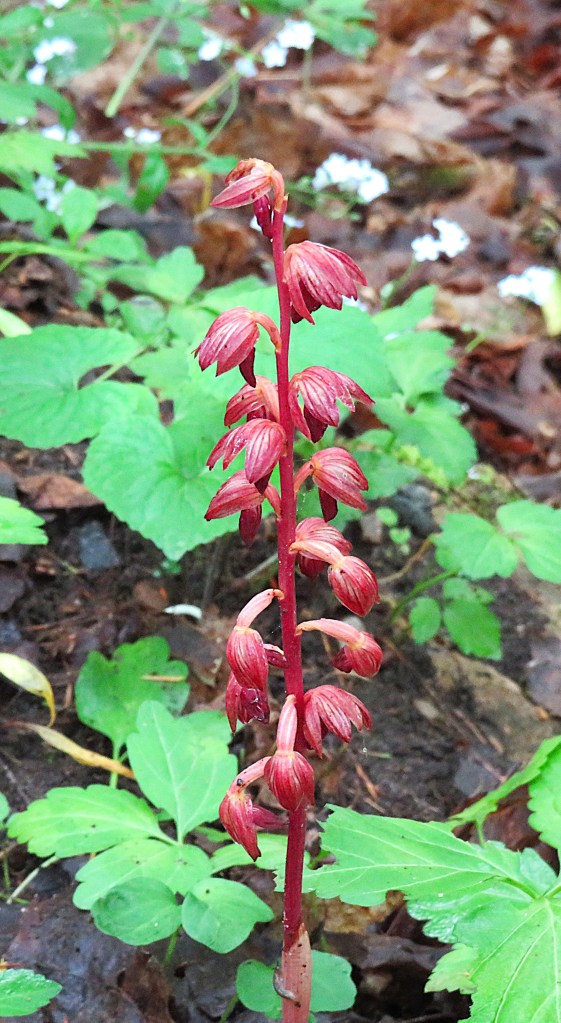
Striped Coralroot, Corallorhiza striata, Hiawatha National Forest, Michigan. Photo by Danielle, June 2026.
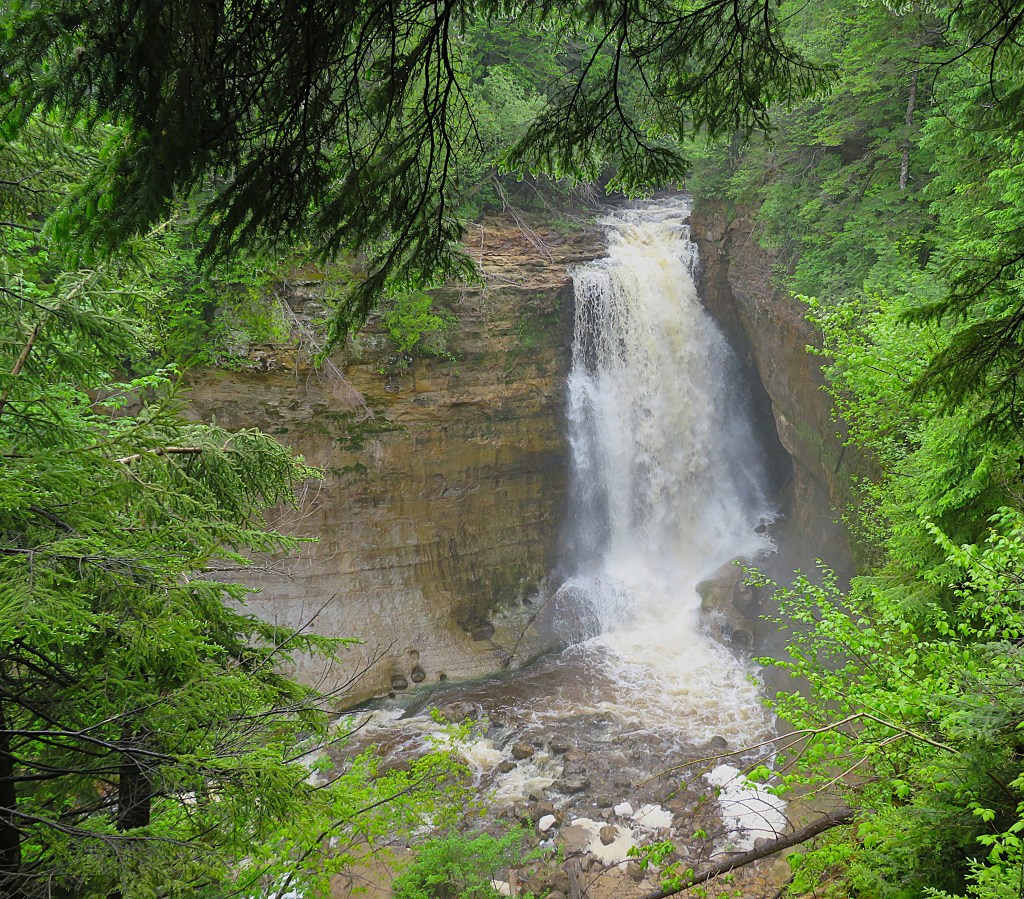
Miner’s Falls, Pictured Rocks National Lakeshore, Michigan. Photo by Danielle, June 2026.
Sometimes I wonder whether I’ll tire of flowers. I encounter the concept of “bioenchantment,” described by Richard Louv as a kind of magical relationship with nature informed by both culture and science. I like the word “bioenchantment.” It reminds me of magical realism, the Latin American literary style where magic is part of reality. Real life is enchanted. I’ve never tired of art, or writing, or books; in those forms, I’ve searched for magic. But only recently have I discovered the necessary role of nature in opening up that elusive, enchanted portal. I’ve made space in my head for striped petals and words like corolla. Loading up our hound to head west toward the Porcupine Mountains, I’m content, seeing his freckled snout in the rearview mirror. The names of new flowers bloom in my head, and I count off their syllables on my fingers, scanning the ditch for something alive and spectacular.
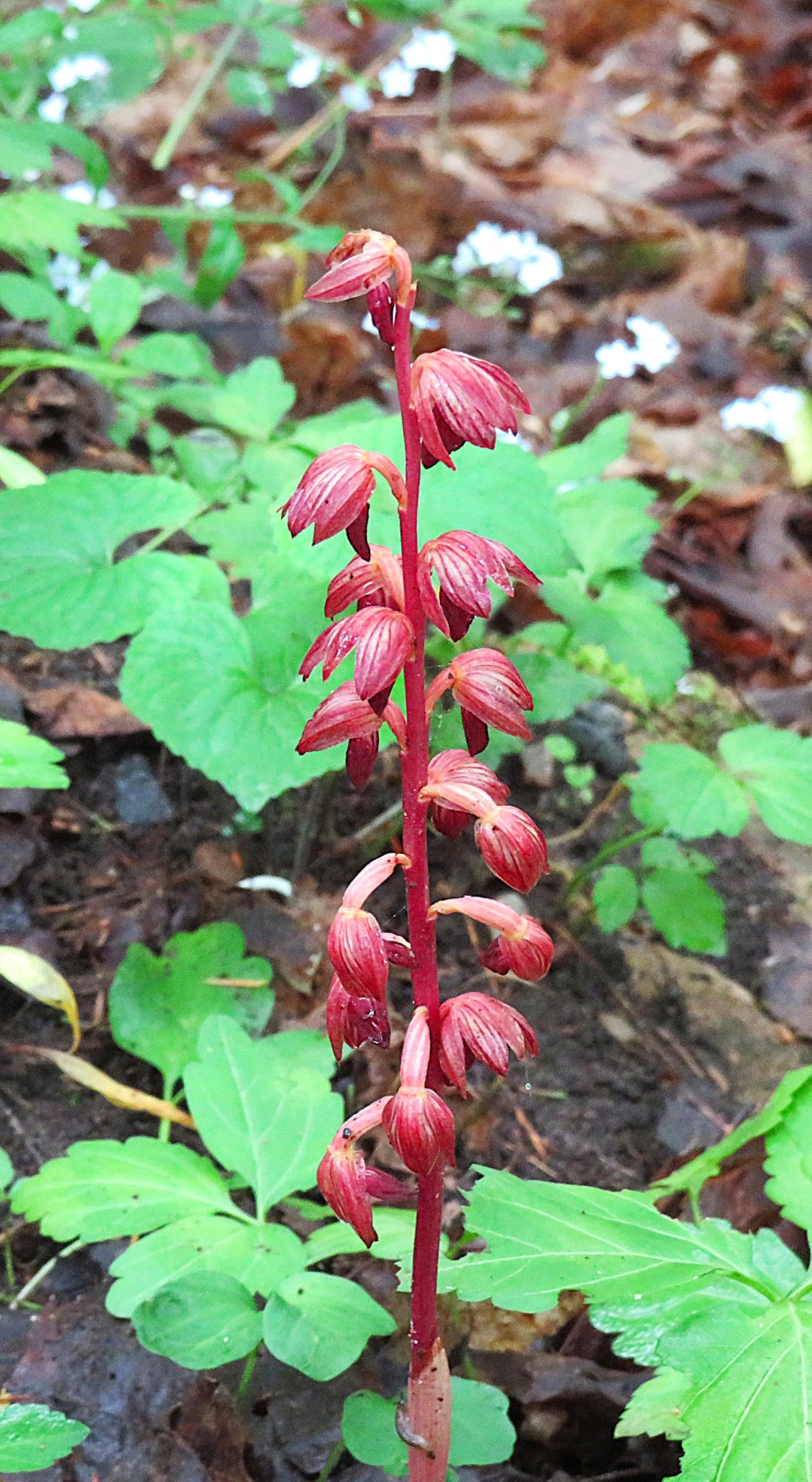
 Danielle Dreams in Wildflowers
Leave a comment