William Wordsworth’s poem “She Dwelt among the Untrodden Ways” describes a young woman, Lucy, as “A violet by a mossy stone/Half hidden from the eye!” Lucy appears in many of Wordsworth’s Lyrical Ballads (1800) poems, characterized as a girl no one notices, as if existing in secret. Like a violet blooming near a mossy stone, deep in the woods, Lucy is nevertheless special and beautiful. Although the violet is beautiful, it remains “half hidden,” and eternally mysterious. I love Wordsworth’s simple image of the violet and the mossy stone. Lucy-as-violet is the only metaphor in the brief poem. We don’t need to know what kind of violet, or how big the stone is, or whether the moss is lime or forest green. The image is powerful and unadorned.
I like words that begin with “v”: Venus, victory, vintage, volcano. Violet. With roots in the Latin term “viola,” the English word “violet” comes from the Old French “violete” (OED). Technically having three syllables, it’s a lovely word to pronounce: vi-o-let. Sometimes the first two syllables merge into one: vial-it. As a noun, “violet” refers to the flower. As an adjective, “violet” means the bluepurple color characteristic of many types of violets. But not all violets are violet. Some violets are white, or yellow, or even green. Visiting the greenhouse, I’ve always noticed the flowers I want to call “violets” are labeled as “pansies.” I learn that pansies are garden plants bred by humans from different species of Viola.
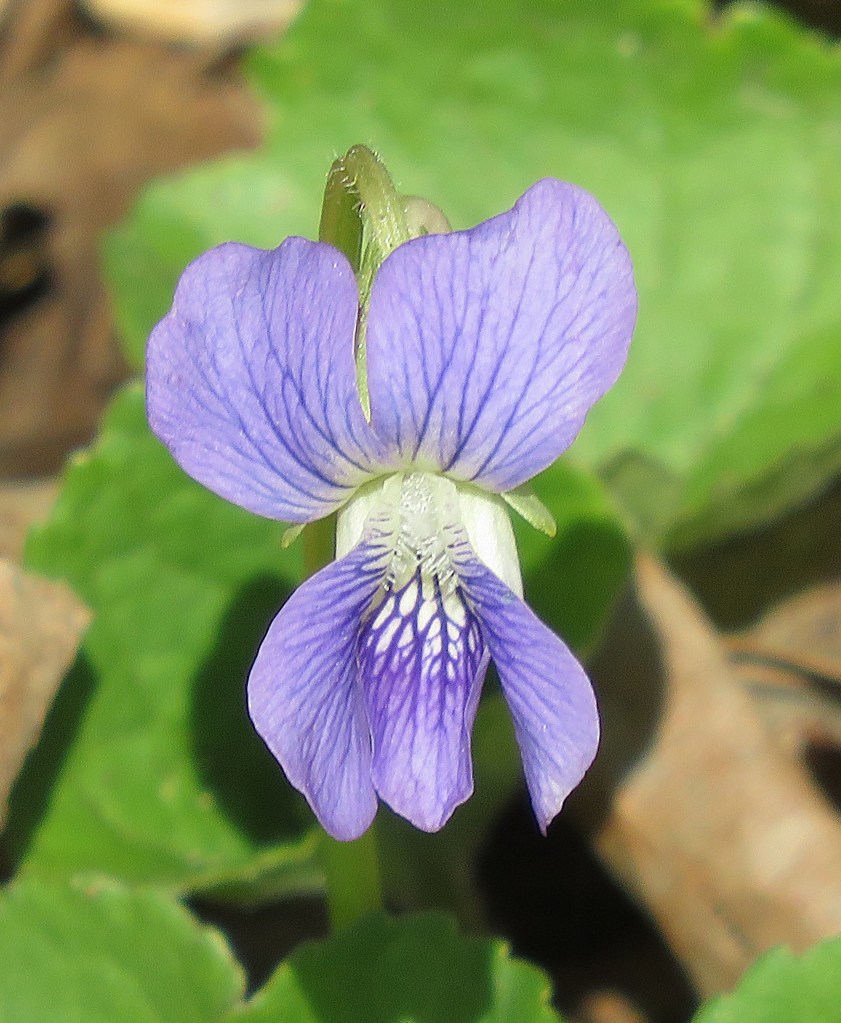
Common Blue Violet, Viola sororia, Afton State Park, MN. Photo by Danielle, May 2026.
Many types of native violets grow throughout Minnesota. The Minnesota Wildflowers website remains my “go-to” source for flower identification. The site lists twenty types of wild violets known to grow in Minnesota. Some are common–like the Common Blue Violet, Viola sororia. I picture Wordsworth’s Lucy as a Common Blue Violet. Other wild violets are rare. Minnesota Wildflowers explains that the Eastern Green Violet, Cubelium concolor, is “one of the rarest species in Minnesota.” The Yellow Prairie Violet, Viola nuttallii, is a state threatened plant found in a few prairie ecosystems on the western edge of Minnesota.
I’ve learned that the shapes of the leaves and the height of the flowers help distinguish different types of violets from one another. Smooth Yellow Violet, Viola eriocarpa, has large, wide leaves shaped like hearts. Seeing certain flowers has started to conjure memories. Last summer, on our trip to Grand Portage State Park, I saw a perfect Smooth Yellow Violet in bloom as we walked through the woods with our hound. I imagine cutting its leaf from paper using a wavy-edged scissors. Maybe I’d score its intricate veins with my bone folder.
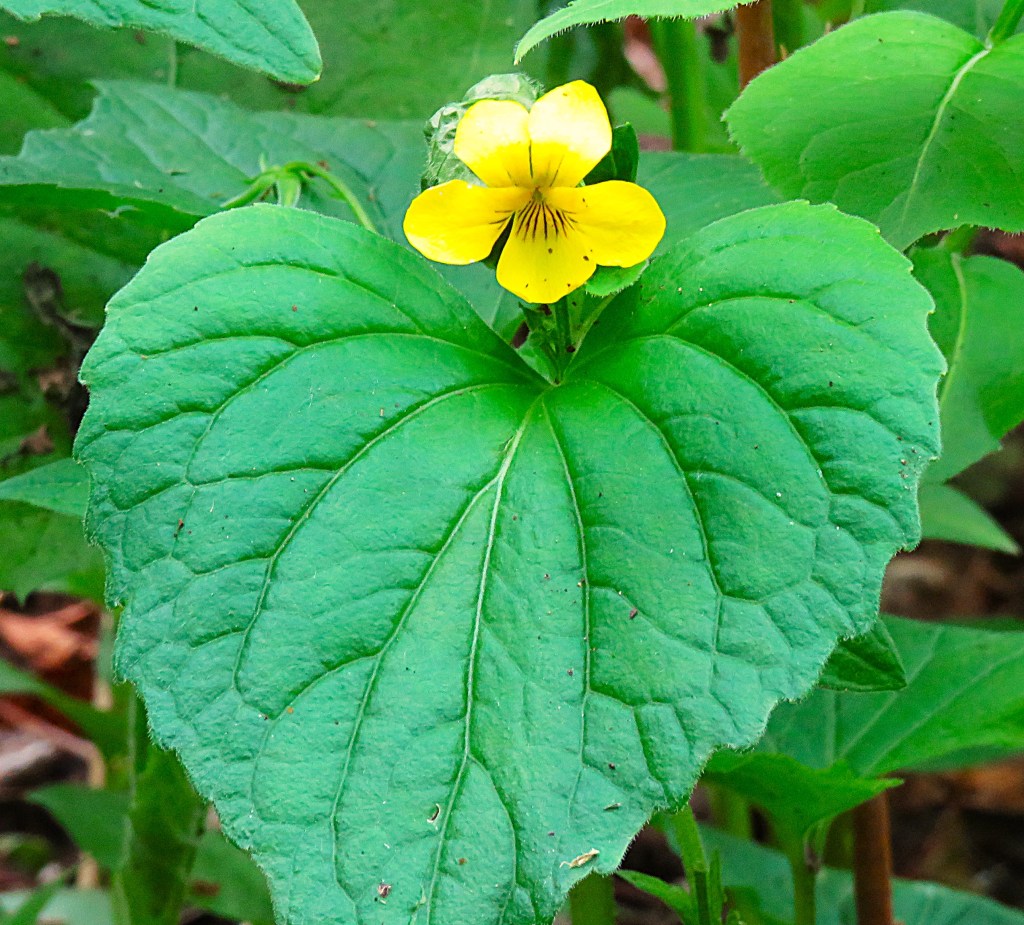
Smooth Yellow Violet, Viola eriocarpa, Grand Portage State Park, MN. Photo by Danielle, June 2025.
Figures from Greek mythology often encounter violets. In one story, Hera is jealous of Zeus’s lover, Io. Zeus transforms Io into a white heifer, disguising her from his wife. He makes violets for Io, giving her something pleasant to eat. Persephone wandered a field of wildflowers, picking violets, when she was kidnapped by Hades. Violets emerged as a symbol of Athens. The flowers were worn during festivals, used as a sign of remembrance, and referenced in poetry capturing the civic identity of the ancient city. For Shakespeare, violets were often linked to the transience of youth and life in general. Emily Dickinson noticed the subtle beauty of violets. Dickinson too was like Wordsworth’s Lucy: mysterious and unseen, blooming in secret. I often return to “The Waste Land,” where Eliot describes blind Tiresias being able to see “at the violet hour.” Lines from that poem always seem to sneak into my world.
One of my recent photos, taken at Lake Maria State Park, looks like a Great Lakes Violet, Viola grisea. I notice the leaves are more narrow than those of a Common Blue Violet. But the Great Lakes Violet doesn’t typically grow in this part of Minnesota. My best guess is a Sand Violet, Viola adunca, whose leaves are “triangular to egg-shaped.” Sometimes I feel a bud of disappointment forming when I get confused about flowers. Like a Magic 8 Ball, my sources say hybridization among violets is common. This violet might be a hybrid. I’m okay with not knowing or making mistakes. At least I’m out there, giving it a try and telling my story.
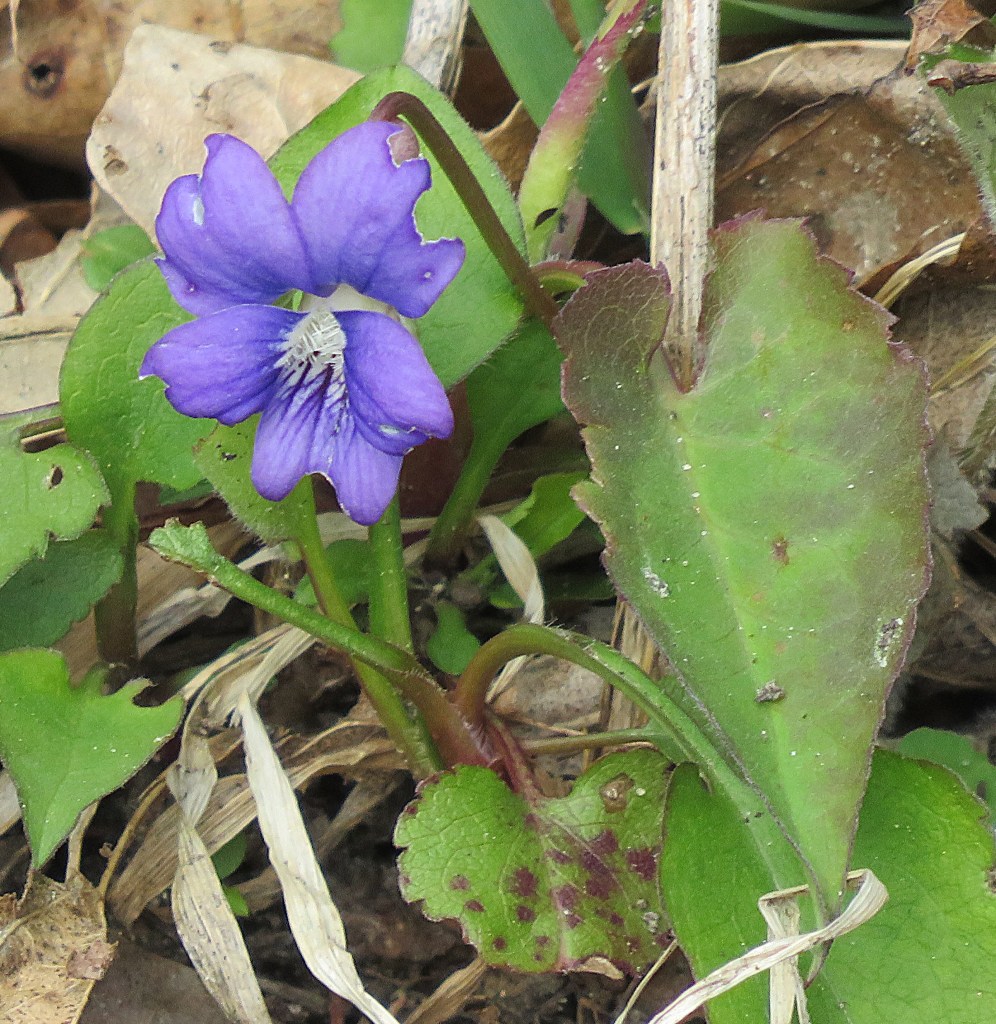
Sand Violet*, Viola adunca, Lake Maria State Park, MN. Photo by Danielle, May 2026. *Tentative identification
I reflect on whether I meet the criteria for a “shrinking violet.” “Shrinking violet” is a label for someone shy, perhaps like Lucy, who prefers to be out of the limelight. Growing up, I was often described as quiet or shy, needing to “come out of my shell.” I’ve always been told I should smile more. I gained more confidence partway through high school. A lot of it came from speech and debate. I started writing more speeches and papers. My lifelong feeling for books set me on a career path where I worked hard to thrive in the shade: a dark little grad student office or a study carrel at the library. I was always drawn to the boxy carrels. During finals week, I could hide in a carrel for hours, cranking out papers or studying for an exam. I needed a simple, comfortable place with no distractions.
I’ve been reading an incredible book: American Wildflowers: A Literary Field Guide edited by Susan Barba. The book includes a curated selection of literary works inspired by wildflowers. One of my favorite pieces so far is an essay by Robin Wall Kimmerer titled “Asters and Goldenrod.” Author of Braiding Sweetgrass, Kimmerer describes enrolling in college, explaining to her advisor that she wants to study botany out of a desire to know why New England Asters mix so beautifully with Goldenrod. Her advisor tells her the question is not a question of science. Kimmerer continues her journey as a student of science, but refuses to give up on the question of Asters and Goldenrod. She reflects on how indigenous knowledge is often separated from science, concluding the essay with observations about how the two worlds can converse with each other just as the Asters mix so remarkably with the Goldenrods.
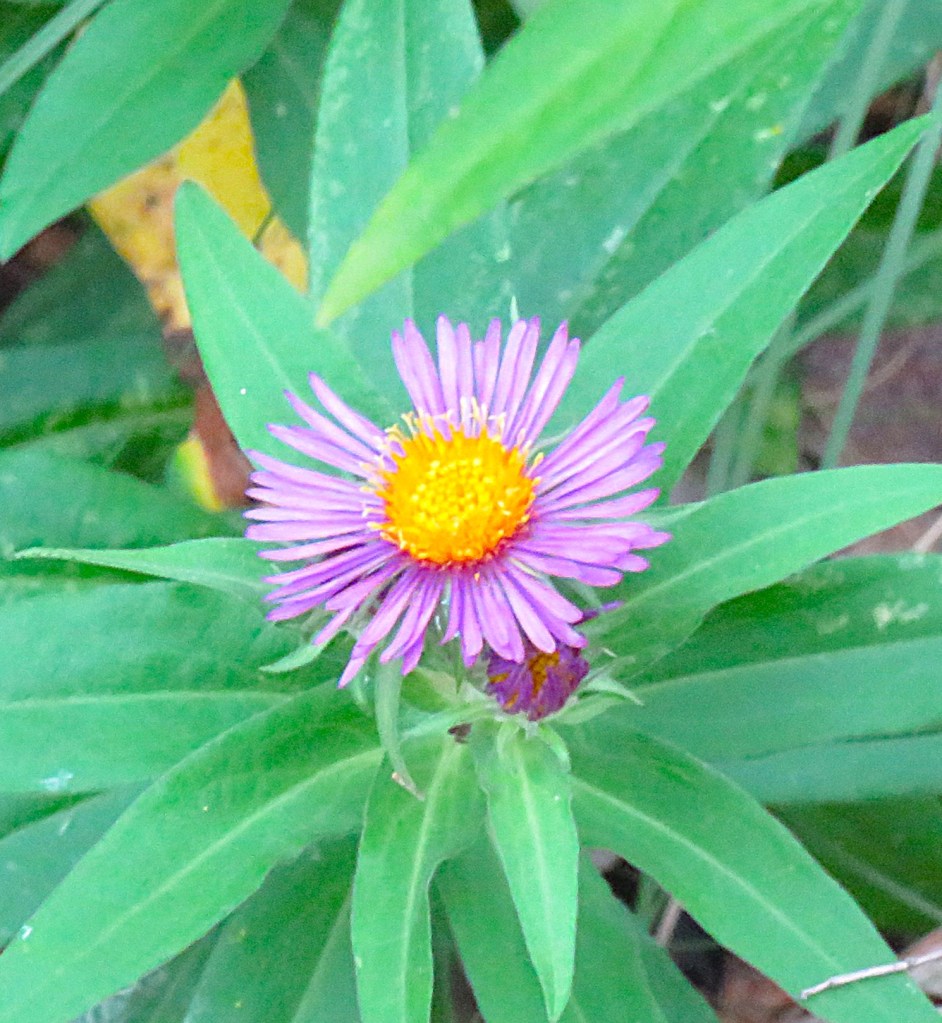
New England Aster, Symphyotrichum novae-angliae, Polk County, MN. Photo by Danielle, September 2025.
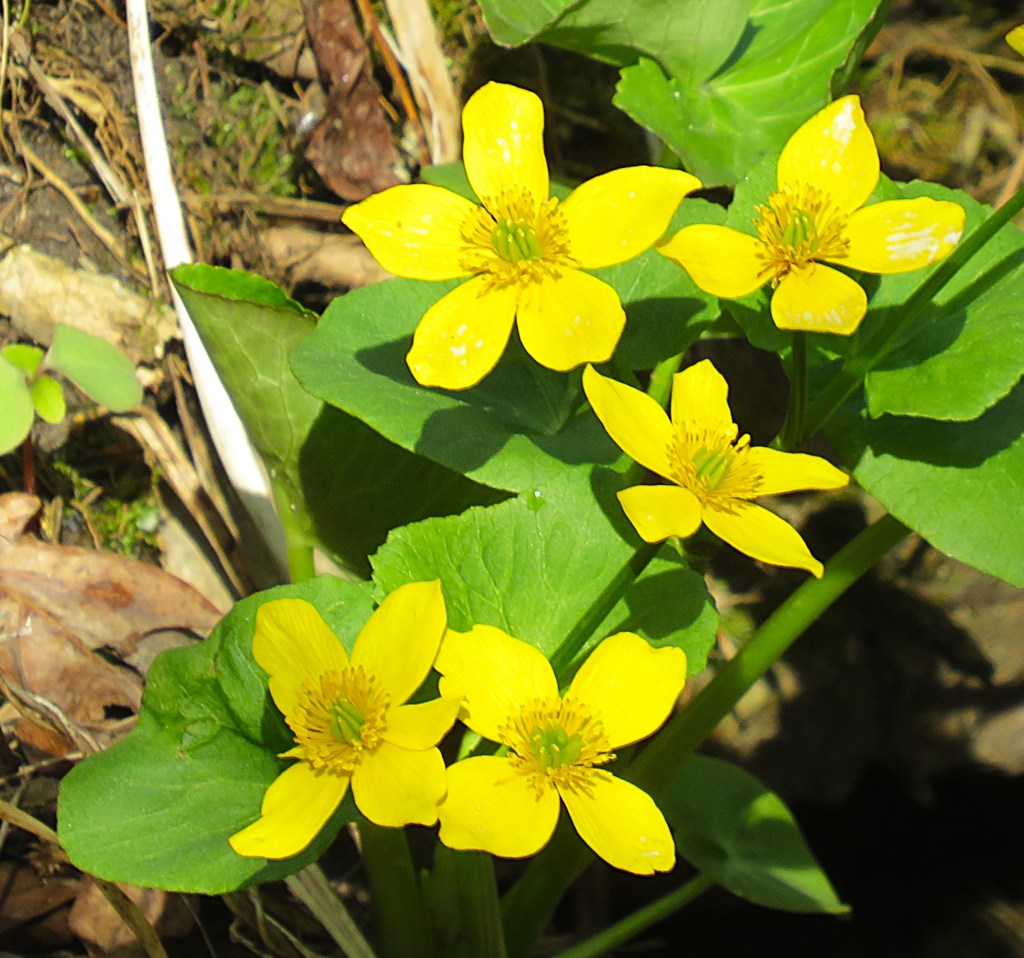
Marsh Marigold, Caltha palustris, Nerstrand-Big Woods State Park, MN. Photo by Danielle, May 2026.
I’m enchanted by the Northern Bog Violet, Viola nephrophylla. It’s taller than other types of violets and grows in wet soil throughout most of North America. I start reading more about wetlands. Researching the scientific definition of “wetlands,” I discover a lot of diversity in the language. Wikipedia offers a simple summary: “an area of land that is usually saturated with water.” Northern Bog Violets grow in wetlands, but they also grow in any wet soil. Often described as “transitional” areas where land and water merge into a unique ecosystem, wetlands exist throughout the world and feature diverse species of plants and animals.
I think I’ve known violets most of my life. It feels like I’ve always known what a violet looks like. Most other plants I now know by name were once simply “beautiful flowers.” Violets seem hidden, yet we know them with ease. My photographs of Northern Bog Violets show deep purple flowers growing in clusters near the drop of a waterfall. It’s a cool, shady place. I wonder what it might feel like at night, in total darkness, with the trickling of the gentle falls providing a sensory anchor. Would the woods smell more fragrant at night? I imagine shivering in fear as something brushes against my leg, only to shine a flashlight on the petals of a bold Marsh Marigold, Caltha palustris.
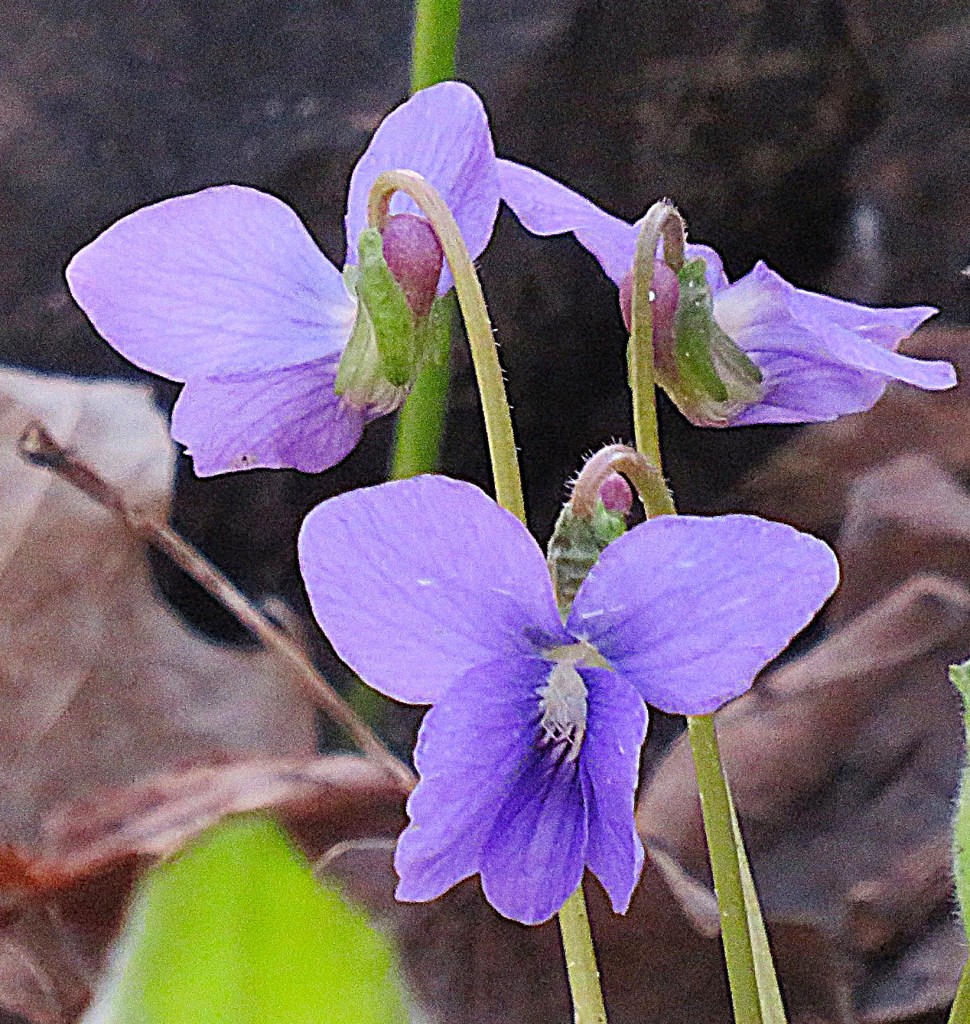
Northern Bog Violet, Viola nephrophylla, Nerstrand-Big Woods State Park, MN. Photo by Danielle, May 2026.
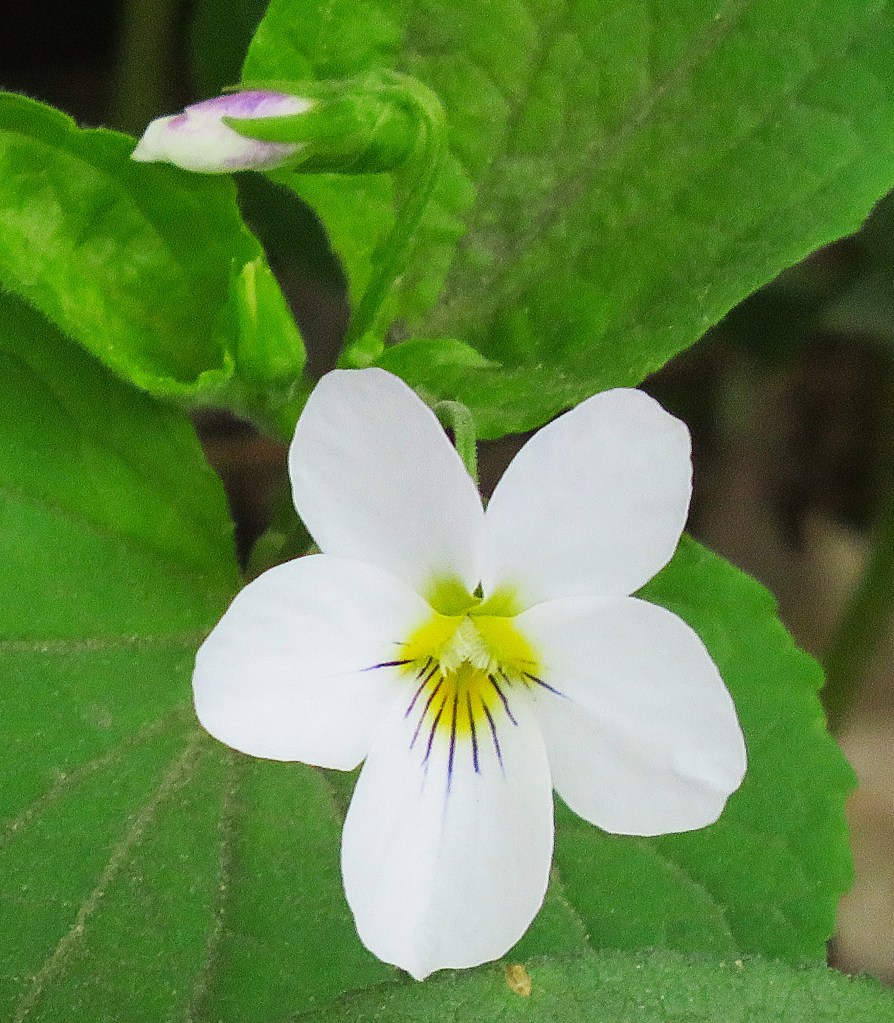
Western Canada White Violet, Viola rugulosa, Polk County, MN. Photo by Danielle, May 2026.
Outside, it’s finally raining. Minnesota needs rain. Fires have broken out all over the state. In our backyard, the patch of Western Canada White Violets, Viola rugulosa, is peaking. More plants appear every year, in the space along our fence, under the shade of the trees where the neighborhood squirrels stay busy. Calling something a “weed” is a question of whether the plant is wanted or not. When I started looking for wildflowers, more of them started appearing. Like wish fulfillment. Viola rugulosa loves the Sunday afternoon rain. I like it too. Inside my shell, I’m usually smiling. Humans can choose when to hide and when to take center stage. Working through big ideas from a library desk carrel, I grew in silence, when no one was watching, except for the clock on the wall as it ticked toward the violet hour.
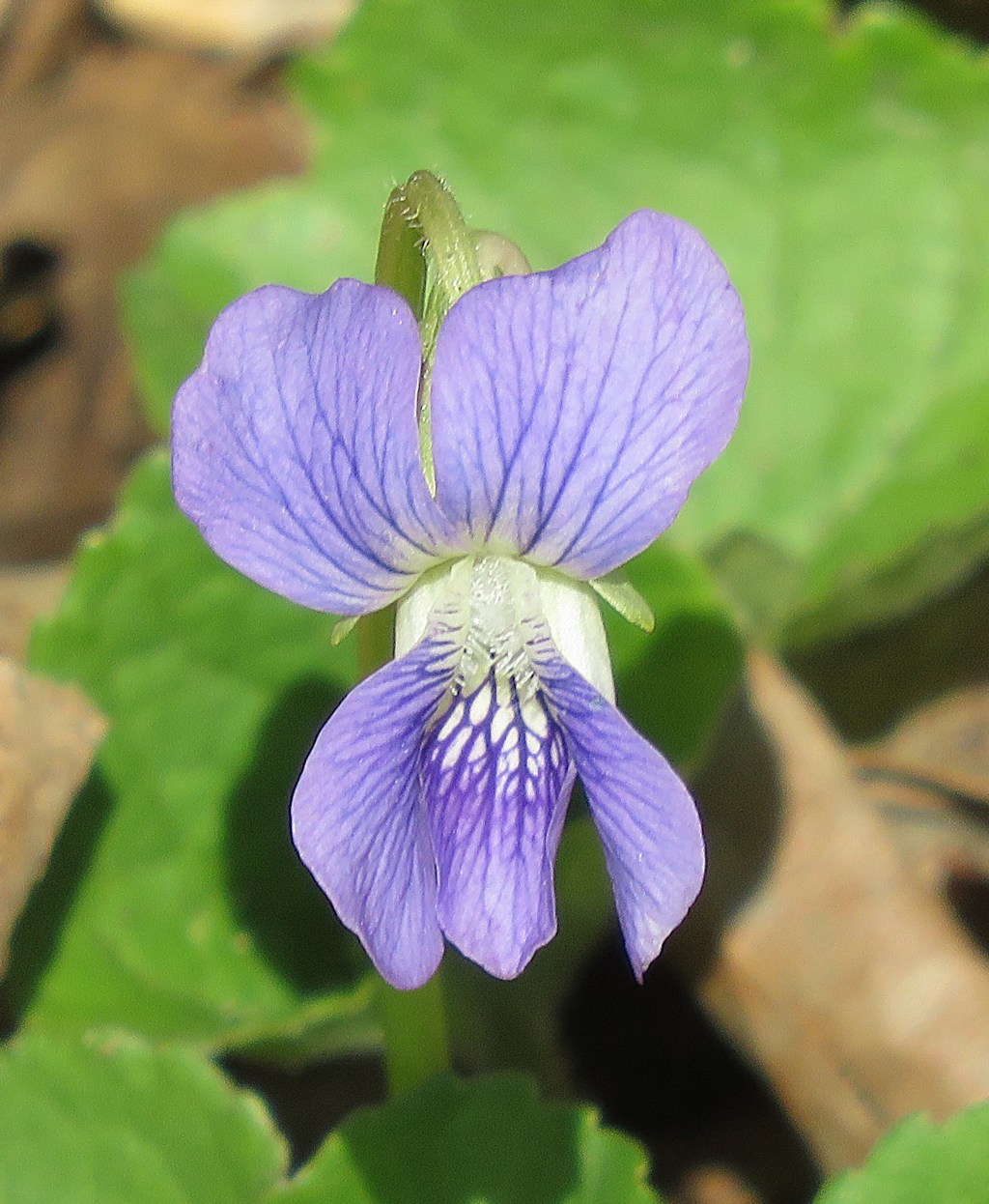
 Danielle Dreams in Wildflowers
Leave a comment