Sun and Moon, day and night: essential phenomena experienced by all of humanity. Spring and summer are seasons of sun, when light lasts longer than time. During the winter, I fantasize about sun, mentally transporting myself to a warm day in the yard: the pleasant heat of the Sun on my bare shoulders, chubby white clouds like cartoons in a happy, blue sky. I’ve been spending hours in the backyard with our hound. A few weeks ago, our apple trees blossomed. We watched the delicate petals drop and float down to the lawn. A single violet or escaped garden pansy has appeared alone, near our shed, a purple surprise I admire each day from my lawn chair. I drink coffee, black, watching and listening to morning.

Nodding Trillium, Trillium cernuum, Rydell National Wildlife Refuge, MN. Photo by Danielle, June 2026.
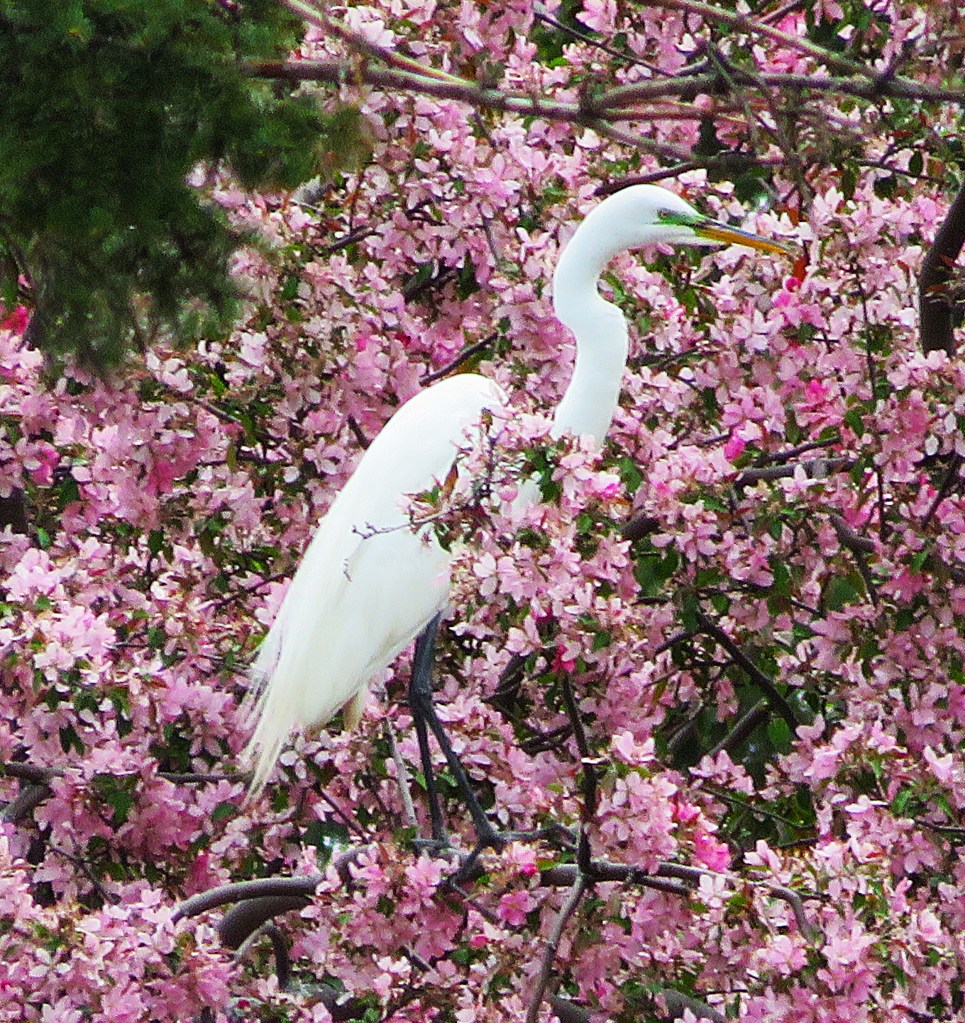
Great Egret, Ardea alba, Fergus Falls, MN. Photo by Danielle, May 2026.
Most of my life, I’ve been more of a nighttime person. I always loved school but hated getting up early. Long teenage summers were spent sleeping past noon and staying up late, unable to sleep on a normal cycle, chatting with friends on the desktop computer we kept in the basement. I drank a lot of Mr. Pibb and ate popsicles. Partway through college, I discovered coffee. The warm, nutty elixir made early mornings enjoyable. Now I mostly work and write in the morning. I’m no longer as active at night. But I feel a connection to darkness. Growing up in the 90s, I painted my nails black and wore Airwalks, listening to Alanis Morrissette and Nirvana. I’ve always liked wearing black. But one of my favorite garments from my youth was the blue-and-yellow print flannel shirt I wore nearly every day, over t-shirts and jeans. It was a simple, comforting flannel, impossible to replace.
The Sun and Moon are always there, even when unseen. Both represent uninhabitable celestial objects. The Sun enables our lives, yet we cannot look at it directly. The lifeless Moon has existed for 50 million years, an eternal piece of our cosmic gallery that we might stare at for hours. Humans have always looked at the Moon. Asking basic questions like, “what is it?” and “what does it mean?” reflects the human impulse toward discovery and storytelling. Especially in ancient times, the big questions found answers in stories. In Norse mythology, the Sun was a goddess named Sól. The Moon was a god named Máni. The myths suggest that the Moon’s movement across the sky can be explained as Máni trying to flee from wolves. One of my favorite Greek myths describes Selene, the Moon. Like Máni, Selene moves across the sky. Selene is the Moon. Everything we observe in the Moon reflects something about Selene.
A couple of decades ago, a trendy topic among academics was the concept of “liminal spaces.” As a graduate student in English, I remember seeing calls for papers on liminality. A liminal space is a transitional zone or an “in between” place of some kind. For a while, I studied Foucault‘s “heterotopia”–a kind of “different” or “other” place. Back then, I wondered about things like whether corn palaces could be considered heterotopias. Sometimes I think about crop circles. The cornfield in the 1989 film Field of Dreams, which was inspired by W.P. Kinsella’s 1982 novel Shoeless Joe, is one of my favorite settings from American storytelling. Growing up, I watched the film countless times. We had a VHS tape that we’d scored through a promotion at the local McDonald’s. Scenes from the film, with the baseball field lit up at night, gave me chills. Decades later, we visited Chisholm, MN, where Ray Kinsella (Kevin Costner) and Terence Mann (James Earl Jones) encounter the ghost of Archibald “Moonlight” Graham.
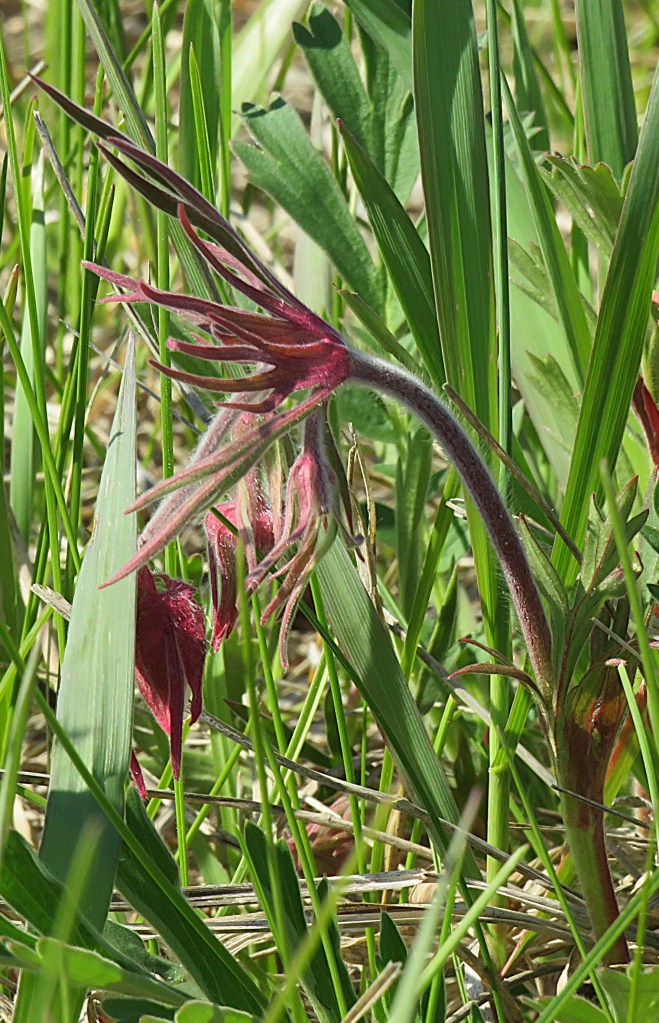
Prairie Smoke, Geum triflorum, Otter Tail County, MN. Photo by Danielle, May 2026.
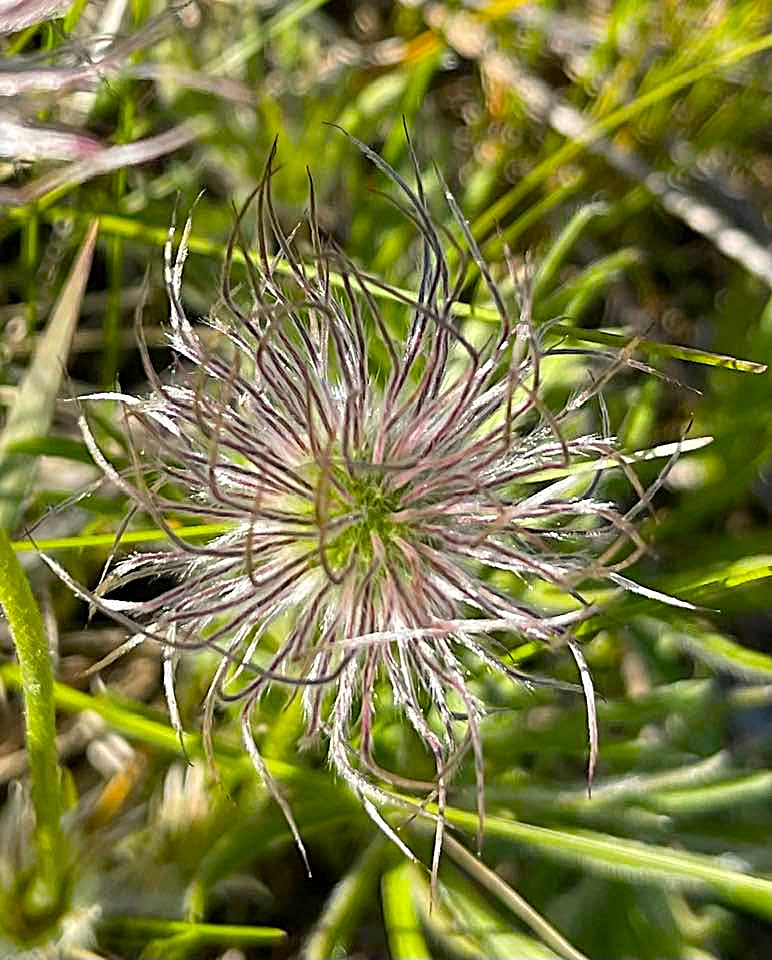
Prairie Smoke, Geum triflorum, Otter Tail County, MN. Photo by Danielle, May 2026.
The baseball field and the mysterious corn field fence represent liminal spaces. Near the end of the film the writer Terence Mann is invited to visit the afterlife, or whatever exists “out there” in the corn. As he walks into the thick cornfield, his body disappears, like smoke in the wind. I like Prairie Smoke, Geum triflorum. It’s a rosy, prairie flower with seed heads resembling the tendrils of smoke. We follow Prairie Smoke up a hill in Otter Tail County. It’s a grassy path I wouldn’t have attempted two years ago. The allure of new flowers is like an antidote to my fear of snakes. I see my first Fringed Puccoon, Lithospermum incisum, a buttery flower with wavy-edged petals. I recognize Hoary Puccoon, Lithospermum canescens, one of a few orange wildflowers. Otter Tail County is a region rich in agricultural history. One of our favorite places, Phelps Mill County Park, occupies the site of a preserved flour mill on the Otter Tail River. Cornfields will sprout and flourish all summer, vast worlds of their own. The tall stalks of corn create wondrous conditions for mystery.
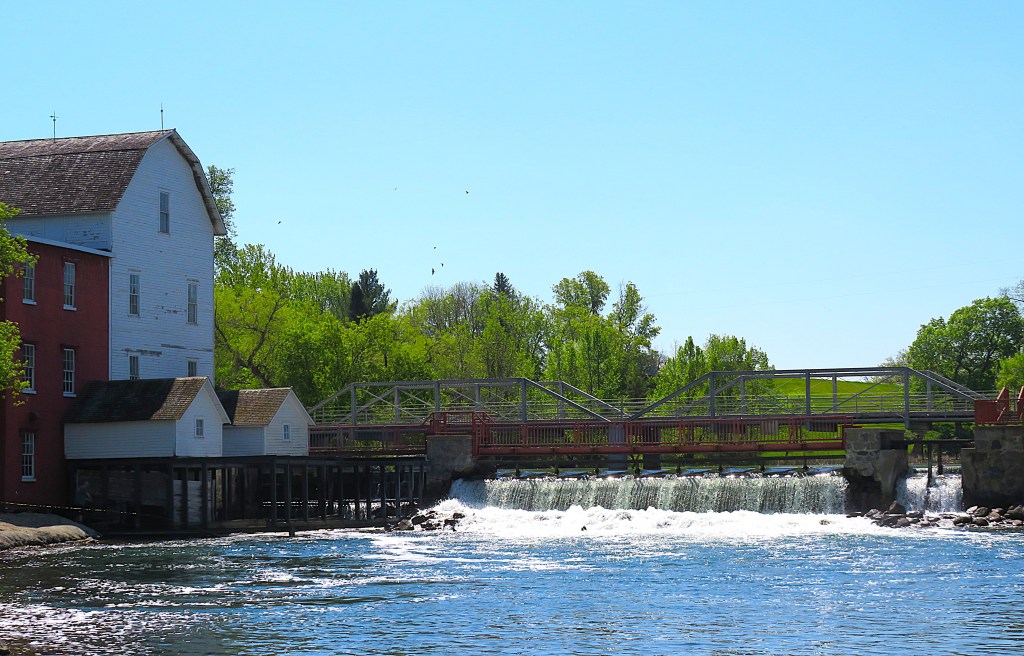
Phelps Mill County Park, Otter Tail County, MN. Photo by Danielle, May 2026.
A graveyard is a kind of in-between space. We often visit cemeteries, looking for birds. I saw my first owl–a Great Horned Owl (Bubo virginianus)–at the local cemetery. I remember the ear tufts. Cemeteries are interesting places that occupy a space between the world of the living and the world of the dead. Many years ago, we saw a mysterious bird at a cemetery. The bird had some hawk-like features, with long, dark feathers. It sat on a tree branch, blending in. A few blurry photos revealed a tiny beak and little eye slits. The bird never moved or acknowledged us. Later, our bird book helped us make an identification: Common Nighthawk, Chordeiles minor, a member of the nightjar family. Visiting a cemetery, I often find something intellectually or visually dazzling. On a recent visit to Park Cemetery in Marquette, Michigan, I noticed a lovely stained-glass window in a mausoleum near a pond. It was a smaller tomb, something personal. On a bright day, the colors inside the tomb must be spellbinding.
Last month, we made our first trip to Glendalough State Park, where we saw another Common Nighthawk. I noticed a bird-shaped lump on a tree branch. Zooming in with the camera confirmed it: I’ve never forgotten the first bird, or the word “nightjar.” This time, I was able to capture some detailed photographs. Reflected in names of bands like The Nighthawks and in the title of Edward Hopper’s 1942 painting Nighthawks, the allure of the bird as a largely nocturnal creature with a cool-sounding name has inspired musicians and artists. In Hopper’s Nighthawks, three patrons sit at a diner counter at night, perhaps chatting with the diner employee depicted behind the counter. It’s nighttime in the painting, inspired by a restaurant in Greenwich Village. Outside the diner, the streets are empty. The store windows are deserted.
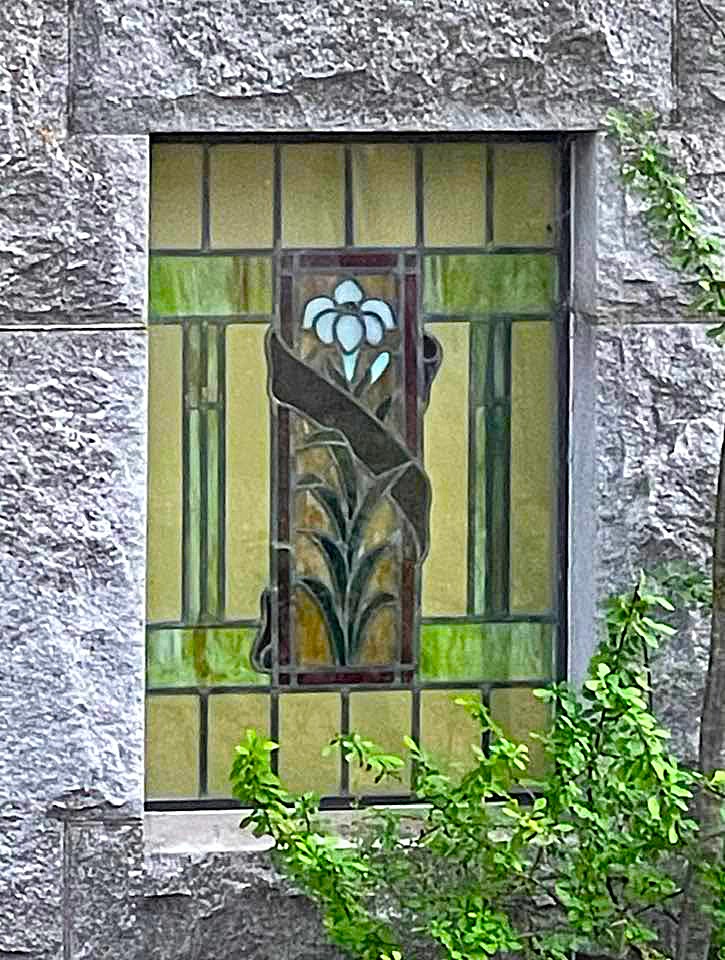
Park Cemetery, Marquette, MI. Photo by Danielle, June 2026.
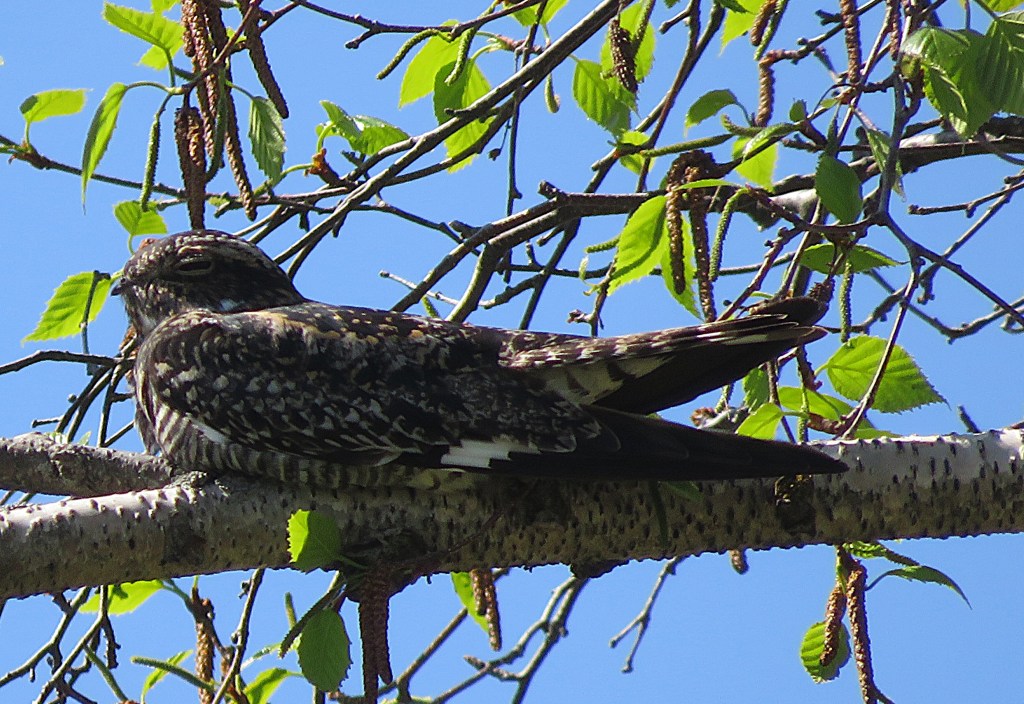
Common nighthawk, Chordeiles minor, Glendalough State Park, MN. Photo by Danielle, May 2026.
Many have seen the 1984 painting by Gottfried Helnwein, Boulevard of Broken Dreams, a reimagining of Nighthawks featuring Humphrey Bogart, James Dean, and Marilyn Monroe as the diner customers. In Helnwein’s version, the diner worker is Elvis. I sense something scary and sad in both works. Helnwein replaced Hopper’s everyday people with dead celebrities. But the setting is the same. The diner seems like an in-between place: a city somewhere, deserted, where only a few souls remain. Outside the diner, there’s no life at all. The diner might as well be on the Moon. It’s one of those in-between spaces, like a birdwatcher’s favorite graveyard.
Night sometimes makes us feel frightened and vulnerable. I remember arriving home after my senior prom. I walked across our front lawn to the concrete steps, wearing my baby blue platform heels with the tiny, rhinestone bows. I looked down at the base of the stairs. A snake was basking there, on the warm concrete. I saw only its shape, and it slithered off under the staircase. I avoided my usual freakout. Something about the colors and stripes of a garter snake makes me panic. That night I stayed calm. The darkness mitigated the shock I normally feel. But it also reminded me that snakes come out at night, to get warm, and that at least one was living right outside the door of my own home.
Spending more time in nature, I’ve started paying attention to the most basic aspects of life. The obvious parts of the universe, like the Moon, the Sun, and the stars have been reference points for billions of humans. I’ve always felt comforted looking to the heavens, seeing the Big Dipper. The heavens cross boundaries: everyone, everywhere experiences the Moon and the Sun. Earth itself exists in-between, as if squeezed into the perfect parking spot: the only spot we can reach capable of keeping us alive. Somehow we belong here, among the incomprehensible landscapes and seas. It’s a world where “all the cosmic tumblers clicked into place,” to quote the incredible speech by Terence Mann in Field of Dreams. I imagine his character walking into the diner from Nighthawks, a place beyond time, yet familiar. He orders a cup of black coffee and asks for directions, not knowing where he is or how he arrived there. He’s entered an immortal picture. He prefers the feel of midnight corn to the bright lights of living forever.

 Danielle Dreams in Wildflowers
Leave a comment