I’ve been thinking a lot about Emily Dickinson. Last month, I took an eight-hour Zoom class through the Minnesota Center for Book Arts. The class focused on visual and poetic journaling inspired by Emily Dickinson. I remember reading Final Harvest in one of my undergraduate English classes. Back then, it didn’t resonate with me. But I’ve always kept the pink volume of the book. It still has the “USED” sticker from the SD State bookstore stuck to the spine.
The class transformed how I think about Emily. Flowers shaped her poetry in profound ways. Emily was inspired by flowers to a point where flowers became part of her identity. The gardens and birds on the grounds of her family’s Amherst, MA estate were her imaginative portal. Later in life, she became reclusive, rarely leaving her bedroom, the walls of which were papered in roses. I now see how her retreat from society worked as a kind of silent rebellion. Isolation inspired a quiet, mysterious independence that enabled Emily to immerse herself in her craft.
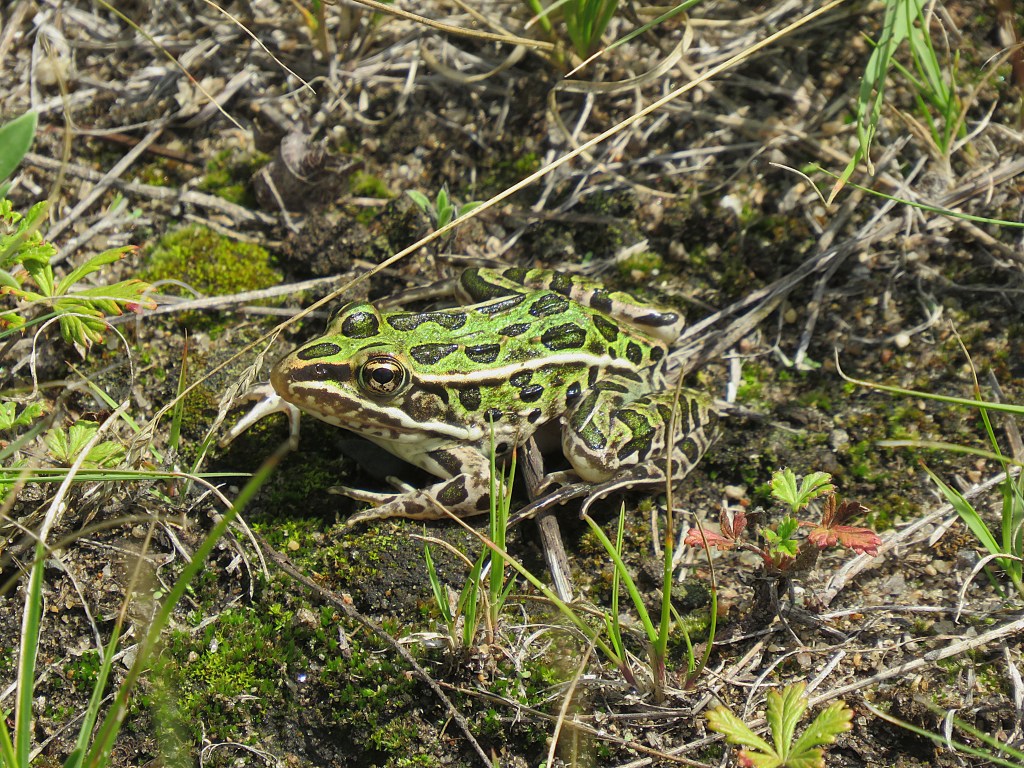
Northern Leopard Frog, Lithobates pipiens, Glacial Ridge National Wildlife Refuge, Polk County, MN. Photo by Danielle, July 2025.
I think I’ve discovered that achieving a sense of contentment is linked to finding peace and beauty in my immediate surroundings. Looking out the window and yearning for something else only leads to suffering. But the worst kind of suffering is failing to look out the window at all. Sustaining a sense of contentment is difficult. In Tolkien’s The Hobbit (1937), Bilbo Baggins enjoys all the comforts of life in his cozy home in The Shire. He loves it there, but he still longs for adventure.
As a teenager, I wanted to leave the Midwest as quickly as possible. It seemed like a boring place compared to my visions of cities and deserts. A Prairie Pasqueflower, Pulsatilla nuttalliana, was no dream come true. I spent a lot of time in my room, watching television, movies, and sports. I wrote in my journals and imagined writing a book someday. I’d sit at my desk, my happy place, with a new spiral notebook opened to a blank page. My walls were papered with abstract flourishes. Later, I covered the flourishes with posters and magazine photos of my heroes. I wanted to live in Arizona, so I had a little cactus. I was a kid who didn’t know what to write about.

Glacial Ridge National Wildlife Refuge, Polk County, MN. Photo by Danielle, July 2025.
Last month, we made several trips to Glacial Ridge National Wildlife Refuge, looking for birds and fringed orchids. The Refuge is vast and unstaffed, with a few primitive parking areas and informational kiosks. At the edge of a gravel road, we pull over to watch an Eastern Chipmunk, Tamias striatus, eating a leaf. In the extreme summer heat, we walk a ways through the prairie. Our hound remains home in the comfort of air conditioning. For the first time, I feel like I’m truly out on the prairie and not just looking at it from a distance. Puffy white clouds float overhead, like those in a Harvey Dunn painting my grandma displayed in her dining room.

Dotted Blazing Star, Liatris punctata, Glacial Ridge National Wildlife Refuge, Polk County, MN. Photo by Danielle, July 2025.
The Harvey Dunn painting is burned into my memory, and yet I don’t even know its title. I remember the clouds and a woman walking through the grass. A humble house in the background. I learn the title is “The Prairie is My Garden.” It was finished in 1950 and is Dunn’s most famous work. The South Dakota Art Museum shares that the original painting hung in the South Dakota State University Student Union until 1970. The painting is meaningful to many South Dakotans. Dunn was born in Manchester, in Kingsbury County, the same county where my grandma lived. The remains of tiny Manchester were destroyed in a 2003 tornado, and it’s now considered a ghost town.
At Glacial Ridge, I get close to coneflowers and inspect blazing stars. The Prairie Blazing Star, Liatris pycnostachya, is one of my favorite flowers. In The Sun, My Heart (1988), Thich Nhat Hanh says that the source of flowers and plants is the same source we all come from (9). If reincarnated as a wildflower, I might choose to become Prairie Blazing Star. It’s tall, thin, and a shade of hot pink. Drawing closer, the flowers become more interesting. We find other stars too. For the first time, I photograph Dotted Blazing Star, Liatris punctata, burning in a bright shade of my favorite color. Right away, I see how it differs from Liatris pycnostachya. The Dotted Blazing Star plant is shorter and looks more like a bush with multiple blossoms shooting up toward the sun.
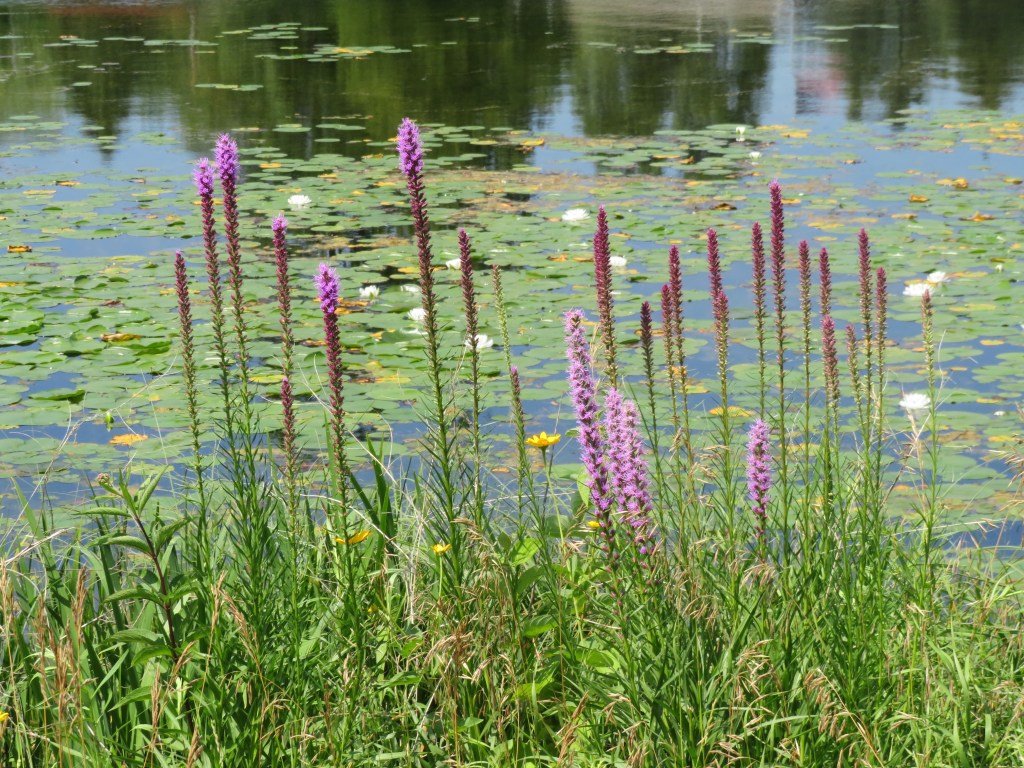
Prairie Blazing Star, Liatris pycnostachia, Park Rapids, MN. Photo by Danielle, July 2024.
Glacial Ridge is home to one of the most revered wildflowers in Minnesota: the Western Prairie Fringed Orchid, Platanthera praeclara. In our hours and hours of searching, we don’t see one this year. We’ve never seen one. The state endangered and federally threatened beauty blooms white in July. We pull over to photograph Showy Blue Lettuce, Mulgedium pulchellum. I get out of the car to take pictures. I saw a few of these flowers last summer, but they were past peak bloom. Now I see bunches. The tip of each petal is toothed, like a Muppet hair-do.
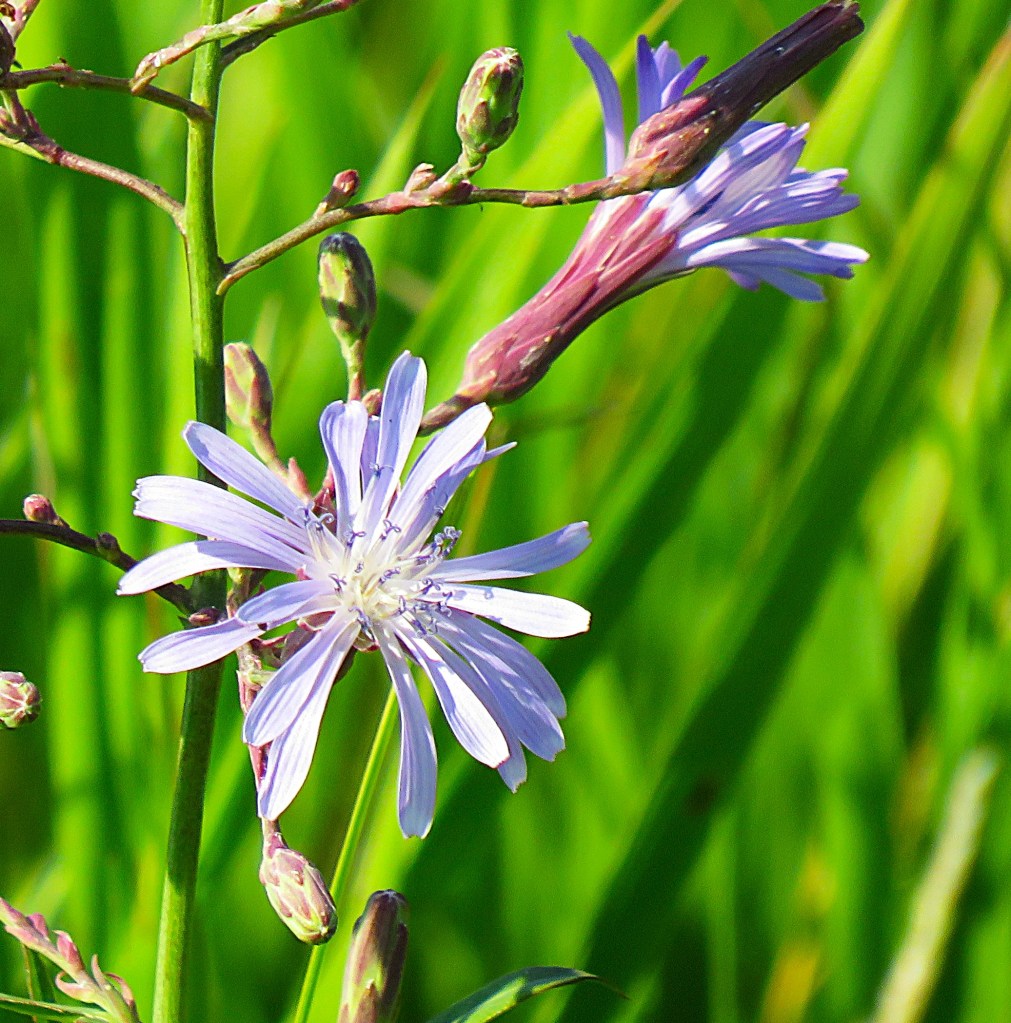
Showy Blue Lettuce, Mulgedium pulchellum, Glacial Ridge National Wildlife Refuge, Polk County, MN. Photo by Danielle, July 2025.
We keep flowering. Driving onto the grounds of Hayes Lake State Park near Roseau, I see a snake basking at the edge of a paved road. I shiver and look away. My body tenses, my hands make fists. Even from the car, I struggle with the sight of a coiled reptile. Disembarking our vehicle, I timidly wander the parking lot, looking for flowers. Our hound drags my husband out toward the lake. There’s no path through the grass. I consider remaining behind, but I follow, trying not to look at the ground. It feels like gathering courage to walk on hot coals. The picnicking people must wonder what’s wrong with me.
At the boggy edge of Hayes Lake, I see some flowers. I feel more free and more fearless. Bell-shaped, white flowers snake out from the cattails. They look like some kind of bellflower, and later I learn that I’m right: Marsh Bellflower, Campanula aparinoides, grows throughout Minnesota and features white blossoms that remind me of Harebells. I creep toward a flower that looks like a foxglove. Its flowers are tubular pink with lighter interiors, spotted like stains from the tip of a marker. I see only one at the edge of Hayes Lake, but we discover a colony near the dam where some people are fishing. Obedient Plant, Physostegia virginiana, is also known as False Dragonhead. Indeed, the single plant at the edge of the lake reminds me of an orchid.
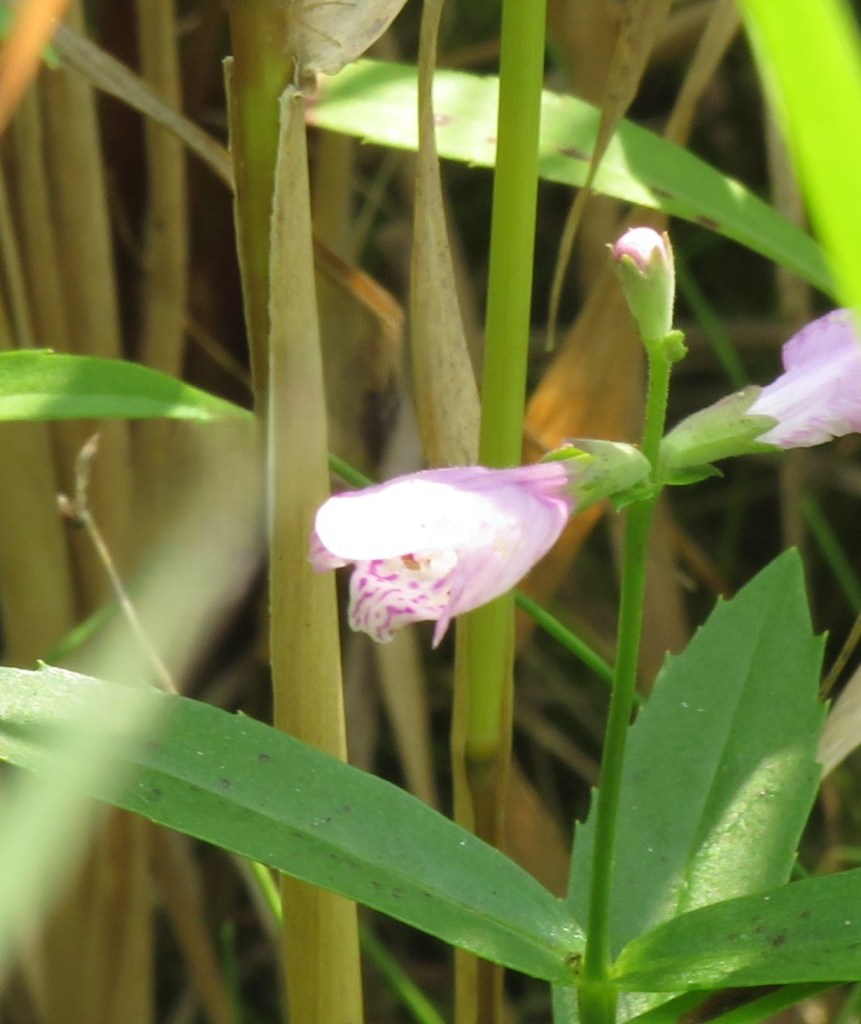
Obedient Plant, Physostegia virginiana, Hayes Lake State Park, MN. Photo by Danielle, August 2025.
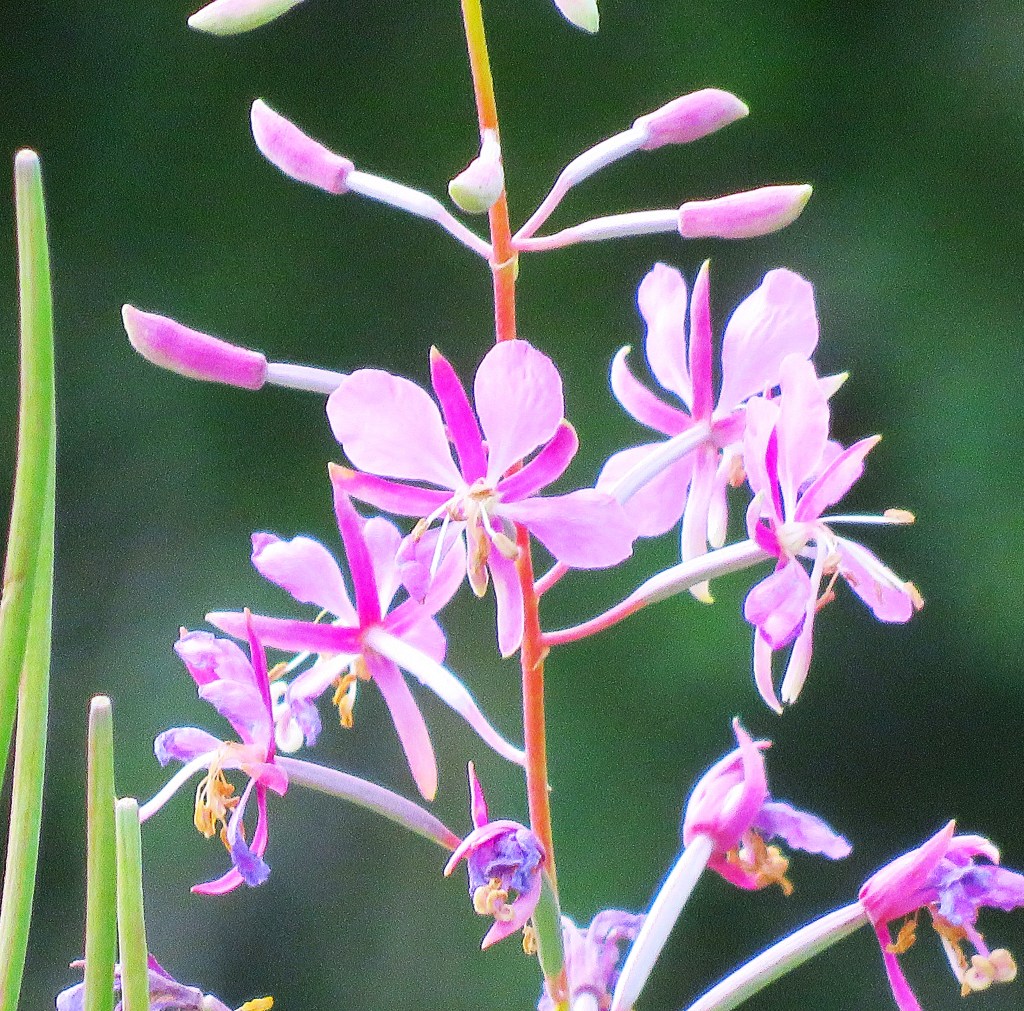
Fireweed, Chamaenerion angustifolium, Hayes Lake State Park, MN. Photo by Danielle, August 2025.
I mingle with Fireweed, Chamaenerion angustifolium, a late summer friend I typically see at Big Bog State Recreation Area. Like other evening primrose plants, Fireweed is a member of the willowherb family, Onagraceae. I like the name “Fireweed.” It’s a poetic word that conveys and image, engages the senses, and suggests something “wild.” I can identify some things on my own now. Countless bumblebees bumble on Blue Giant Hyssop, Agastache foeniculum, another plant with a tall, flowering spike. I think of our hound interacting with bumblebees in our backyard. He often watches the buzzing, miniature blimps, wanting to chase and to sniff. He could use a sniff of Obedient Plant.
Back at the car, we check ourselves for ticks and water our hound. It’s a three-hour drive back home through old, small towns and some road construction. Roads in and out of state parks have revealed so many treasures this summer. I remember the thrill of Round-lobed Hepatica, Anemone americana, as we arrived at Lake Itasca State Park in the spring. I scan as many plants as I can from my passenger window. In the shallow ditch, I see something purple. It looks a lot like Blue Giant Hyssop. Briefly, I let it go. An instant later I ask my husband to turn back. The flash of the purple flowers stuck with me, like something different. We go back and find it. I zoom in with the camera and see the purple fringed petals. It’s the incredible Platanthera psycodes, Lesser Purple Fringed Orchid. I’m mesmerized.
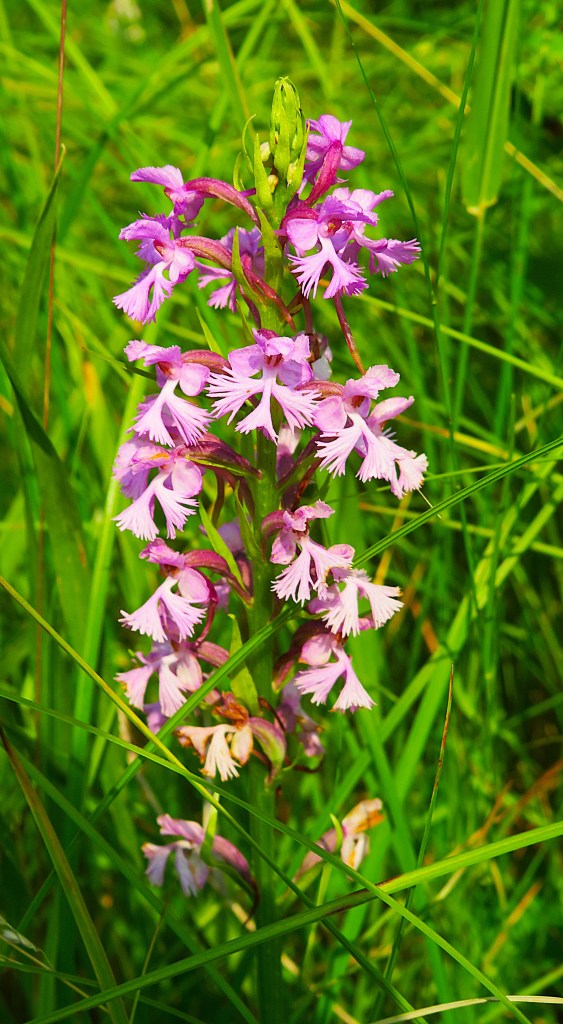
Lesser Purple Fringed Orchid, Platanthera psycodes, Hayes Lake State Park, MN. Photo by Danielle, August 2025.

Lesser Purple Fringed Orchid, Platanthera psycodes, Hayes Lake State Park, MN. Photo by Danielle, August 2025.
We get out of the car and approach the flowers. They’re close–only a few feet from the road. The fringed petals are often compared to the wings of butterflies. They also remind me of a fan I might wave in front of my face on a hot, sticky day. I’m not thinking about the snake from earlier as I venture into the grass. Unlike birds, flowers are silent and stationary. The winged petals can’t fly away. I spend time admiring the plant, living its simple life in a shape and shade from a fantasy. Admiring a flower feels like standing in front of a masterpiece at a museum.
It’s a three hour drive back home. Our hound is tired and ready to relax on his couch. One of the first movies my husband and I watched together, almost twenty years ago now, was the Coen Brothers’ film Barton Fink (1991). At the end of the movie, Barton, a writer, finds himself inside the painting he’s been distracted by in his hotel room. In the painting, a blonde on a beach towel gazes out at the ocean, shielding her eyes from the sun. In some ways, I feel like Barton, except I’m in the Harvey Dunn painting. The woman in the Dunn painting carries a pair of scissors in one hand and a bouquet in the other; she’s collecting flowers too, like me with my camera.
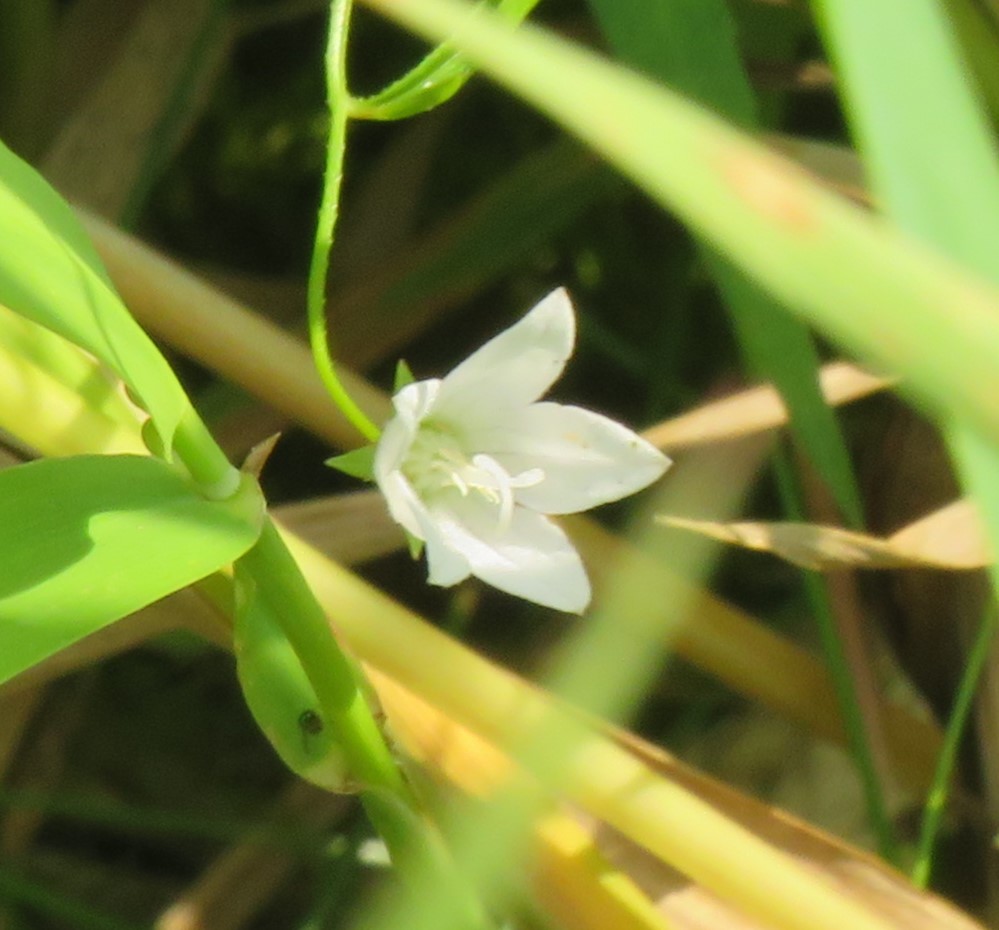
Marsh Bellflower, Campanula aparinoides, Hayes Lake State Park, MN. Photo by Danielle, August 2025.
In poem 466, Emily Dickinson wrote one of her most recognizable lines, “I dwell in Possibility.” Before she went into near-total isolation, Emily went for walks, looking for wildflowers. She also spent time gardening at her Amherst estate, compiling an herbarium now housed in the archives at Harvard. Her tiny desk is there too. She’s gained fame for how she channeled the simple act of looking out the window into some of the most unforgettable lines in the history of American poetry. I think my teenage room and the blank page of my open notebook. I had a potted cactus, but nothing to say. Filling the page felt like an impossibility. Like Barton, I was trying too hard to be clever. I needed to go for a walk or to look out my bedroom window. Somewhere, we still have the Harvey Dunn print. If I wish deeply enough, I might dream myself into the fields of flowers. I still have my grandma’s pair of old scissors. I see a shape in the clouds that reminds me of home.


 Danielle Dreams in Wildflowers
Leave a reply to Michael Watson PhD Cancel reply