Twenty-four years after the 11 September 2001 attacks on the United States, I remember the shocking day in detail. I was a senior in high school. The weather was warm and that day I wore a simple black t-shirt from the GAP with slits on the tops of the sleeves, revealing the tops of my shoulders. I like wearing black, more than ever back then, and the slits made me feel like a badass. That afternoon, after school, I operated the clock for a junior high football game. I sat up in the press box alone, thinking about what had happened.
In June, we were driving home from the North Shore when we heard that Minnesota lawmaker Melissa Hortman, her husband, and their dog had been assassinated. A couple of weeks ago, the start of the school year in Minneapolis met with incomprehensible tragedy at the Annunciation school. This week, another assassination. More violence in schools. The emotions and images caught up in these events influence us psychologically. Finding a place of solace and reflection is one way to cope and to process. But even in that place, the sense of senselessness can be disorienting. We’ve seen how solace can shatter at any time, without warning.
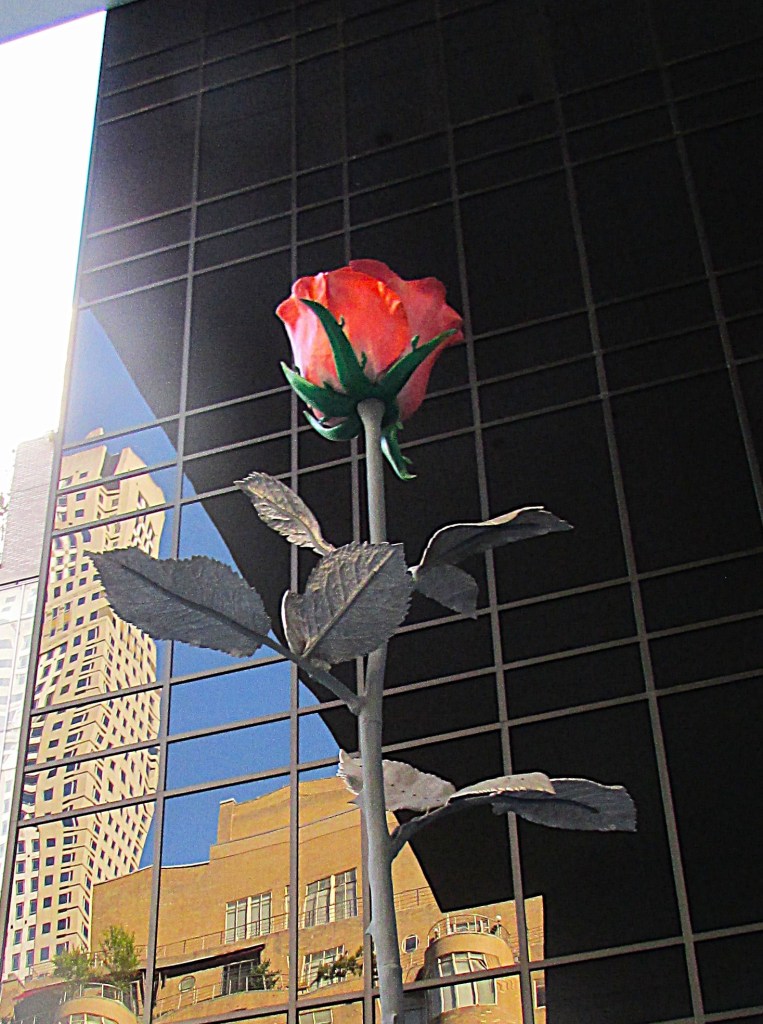
Isa Genzkin, Rose II, Museum of Modern Art Sculpture Garden, New York City. Photo by Danielle, July 2015.
Humans have always found ways to mark and pay tribute in the wake of tragic events. Grief is a part of everyone’s life. In a scholarly book I often reach for, Places of Public Memory (2010), Dickinson, Blair, and Ott discuss how museums and memorial sites communicate with and influence audiences. A simple gravestone serves as a humble monument to a person’s life and memory. I’ve always felt curious about graveyards. Like a photograph, a gravestone serves as proof of someone’s existence. During my first year of college, I visited Abraham Lincoln’s tomb at Oak Ridge Cemetery in Springfield, Illinois. The spirit of history haunted the place. Wandering in the presence of Lincoln’s remains made an impact, shaped in part by the reverent tone of the tomb in a quiet, Midwestern cemetery. Imagine sharing a cemetery with President Lincoln. It’s a complex thing to think about.
In cases of tragedy, where collective grief becomes part of a group’s shared history, public monuments are sometimes erected to educate future generations about the events. Dickinson, Blair, and Ott explain that written information, like interpretive signs or placards, often shapes a public memorial. Telling the story enables catharsis and also propels the story into the consciousness of young people. Memorials immortalize the spirits and names of those lost, often through dramatic architecture or transformations of the sites into tributes borne from trauma. Experiencing a memorial that tastefully captures the power of a deeply sad event can become its own kind of memory.

Milford Mine Memorial Park, Crow Wing County, MN. Photo by Danielle, October 2024.
Minnesota’s worst mining tragedy happened near Crosby, MN on 5 February 1924. Crosby is part of Minnesota’s Cuyuna Range, a stretch of area in central Minnesota known historically for iron ore mining. In the Milford Mine tragedy, a shaft in the Milford Mine collapsed, and forty-one men subsequently died. They were trapped underground as water inundated the mine. Seven miners escaped with their lives. The Crow Wing County website provides a top-notch history of the catastrophe and the memorial park, Milford Mine Memorial Park, established in honor of the lost miners. A four-part series written by Connie Pettersen tells the stories of victims, family members, and the long-term impacts of the accident.
The Park is a place of peace and tranquility. We’ve visited twice: once, in October 2024, under the sorcery of autumn’s paintbrush. We took selfies with our hound, against the incredible backdrop of colors, hoping for a family picture. That day I recall the remains of some wildflowers, withered and brown, drying to dust. Last month we returned August floral encounters. A boardwalk engraved with the names of the miners killed in the accident traverses still water. The remains of all the men were recovered and returned to their families, but as Pettersen writes, the recovery was a long, challenging process. The site itself will always be tied to the men and their fates.

Milford Mine Memorial Park, Crow Wing County, MN. The boardwalk extends into Milford Lake, directly over the site of the tragic 1924 mine accident. Photo by Danielle, August 2025.
At the time of the accident, the Mine site was located between Island Lake and Foley Pond, in a watery part of the state that made mining challenging. The Mine collapse altered the landscape of the area, and the body of water known as Foley Pond is now Milford Lake (“Milford Lake: Then & Now“). The boardwalk extends into the water, directly over the site of the collapse. Thousands of American White Water Lilies, Nymphaea odorata, and Yellow Pond-lilies, Nuphar variegata, bloom on the sunlit pond. It’s hard to identify my favorite flowers, but through the shades through which I see the universe, these lilies are among the most lovely. Their leaves–lily pads–float on top of the water like props at a pond-themed pool party.
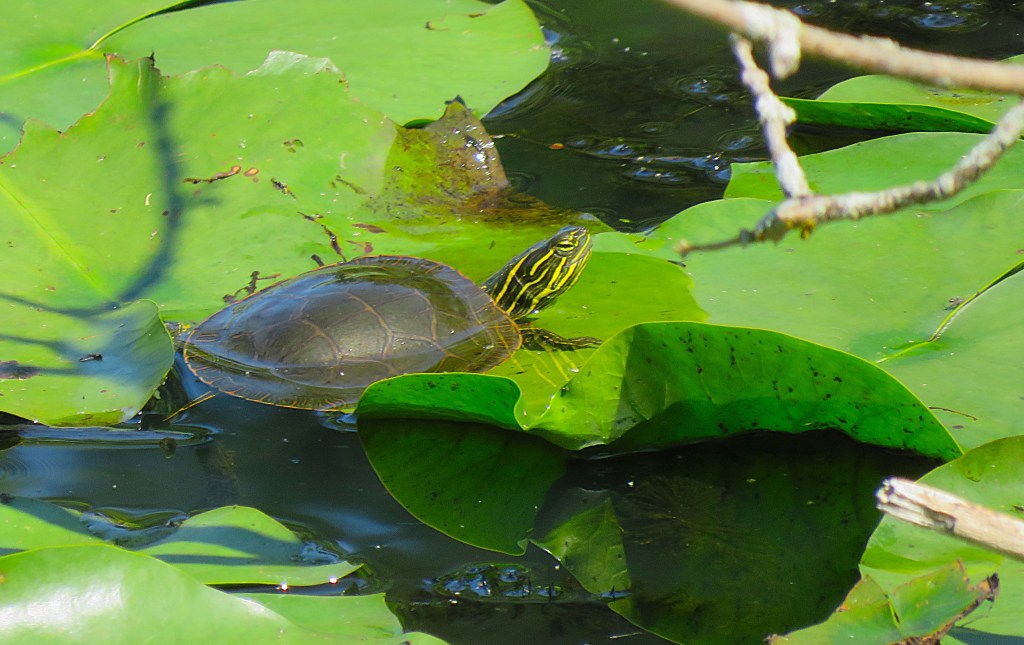
Painted Turtle, Chrysemys picta, Milford Mine Memorial Park, Crow Wing County, MN. Photo by Danielle, August 2025.

Milford Mine Memorial Park, Crow Wing County, MN. Photo by Danielle, August 2025.
Like the sacred Lotus flower, Nelumbo nucifera, in Eastern thought, the American White Water Lily symbolizes growth and beauty emerging from mud. I’m always looking for a perfect water lily: symmetrical, milky-white petals in full bloom, encircling the buttery stamens. Something about the stamens reminds me of frozen French Fries. The relationship between flower and leaf achieves the same kind of harmony I appreciate in Wild Sarsaparilla, Aralia nudicaulis. The flower expresses a simple, profound sense of beauty while the leaves, in their range of spectacular greens, exist like a subtle melody to the flower’s lyric. We see creatures basking on pads. Walking over the water via the boardwalk feels like stepping into a dreamy terrarium. Our hounds is in the terrarium too, wagging his tail at canine mysteries.
A few years ago, one of my students wanted to study “serenity.” I was reminded of Frank Costanza’s “serenity now” mantra on Seinfeld. I showed the students a brief clip of some of Frank’s best “serenity now” moments. We laughed at Frank’s desperate attempts for serenity. The word itself–serene–is poetic, like the cool, floating lily. This doesn’t describe Frank Costanza. My BFF dictionary, the Oxford English Dictionary, includes many entries on “serene.” Most of the definitions focus on nature. Serene weather. Tranquil seas. Clarity. I think of the Moon and its lifeless Sea of Tranquility, Mare Tranquillitatis.

American White Water Lily, Nymphaea odorata, Milford Mine Memorial Park, Crow Wing County, MN. Photo by Danielle, August 2025.

Yellow Pond-lily, Nuphar lutea, Milford Mine Memorial Park, Crow Wing County, MN. Photo by Danielle, August 2025.
A single yellow flower sprouts up from the water on a stem the shade of rhubarb. Aquatic plants are so fascinating. I learn on the Minnesota Department of Natural Resources website that four groups of aquatic plants grow in Minnesota: algae, emergent plants, floating leaf plants, and submerged plants. Water lilies and others, like aquatic Swamp Smartweed, Persicaria amphibia, are floating-leaf plants with roots anchored at the bottom of the body of water where the plant grows. Their flowers and leaves float on the surface. The yellow flower I see at the Milford Mine site is Common Bladderwort, Utricularia vulgaris, one of several types of bladderwort growing in Minnesota. I’m surprised to learn it’s carnivorous: the bladder parts of the plant trap food and also keep the plant floating on the surface while the plant flowers (Minnesota Wildflowers website). I can’t see the bladders or the leaves, only the stem rising among the lily pads. And the yellow blossoms, like so many other wildflowers: the color of sunshine.

Common Bladderwort, Utricularia vulgaris, Milford Mine Memorial Park, Crow Wing County, MN. Photo by Danielle, August 2025.
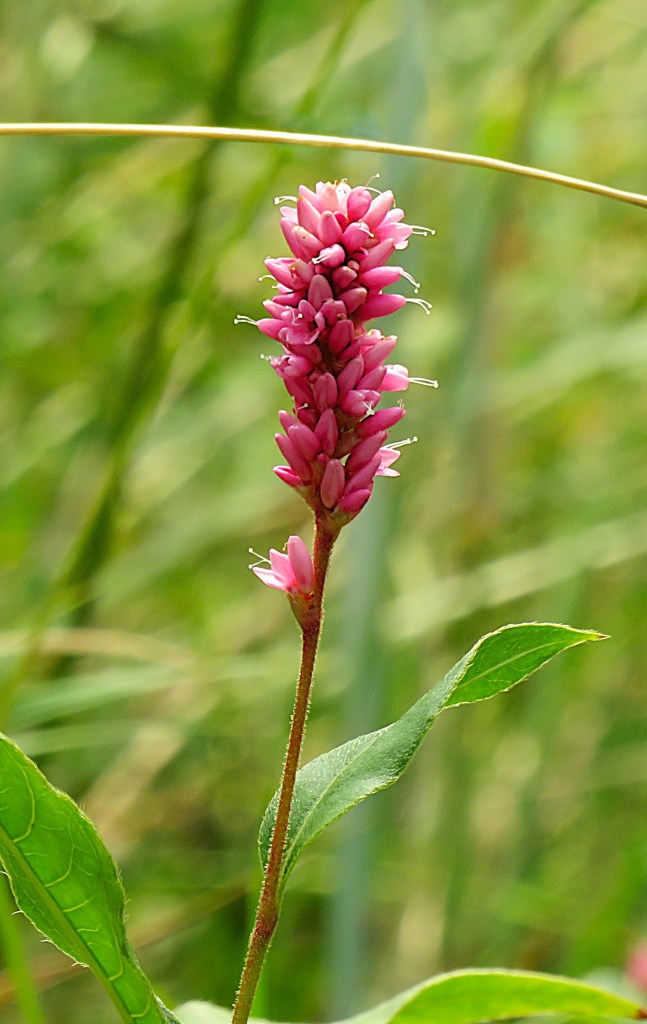
Terrestrial Swamp Smartweed, Persicaria amphibia, Sertoma Park, Grand Forks, ND. Photo by Danielle, September 2024.
I daydream of Claude Monet’s water lilies. Monet painted flowers from his own garden, on his property in Giverny, France. I wonder if he sensed the French Fries I see at the heart of the water lilies. One thing I love about Monet is how his work captures the multihued palette of subtle variations in color that enliven aesthetic, natural places. Looking out at the ponds of the Mine site, I see fantastical greens: the chartreuse shade of the lily pads, the pear tint of the Yellow Pond-Lily’s stem. One by one, we count Painted Turtles, Chrysemys picta. Close-up, their skin patterns look like inked line drawings, colored with alcohol markers in stripes of cadmium green and habanero. I imagine writing a short story about a person hired to name the colors of markers and crayons. For Monet, the water lilies transcended mere subject matter. They shaped Monet as an artist, with the floating flowers anchoring dreamy, moody paintings that busied him for decades.
We take the boardwalk through the park, observing the remains of the mine shaft. I see more plants, including Spotted Joe-pye Weed, Eutrochium maculatum, which I recognize from last summer. Nearby, I notice a similar flower in white, with blossoms that look like fringe. I later learn from Minnesota Wildflowers that the fringe-like effect I see is a white style that looks like a string. Common Boneset, Eupatorium perfoliatum, features little bursts of tiny flowers with five petals each. The Spotted Touch-me-nots, Impatiens capensis, I saw at Mille Lacs are here too, popular among bumblebees. I see Allegheny Monkeyflower, Mimulus ringens, and Showy Tick-trefoil, Desmodium canadense.

Common Boneset, Eupatorium perfoliatum, Milford Mine Memorial Park, Crow Wing County, MN. Photo by Danielle, August 2025.
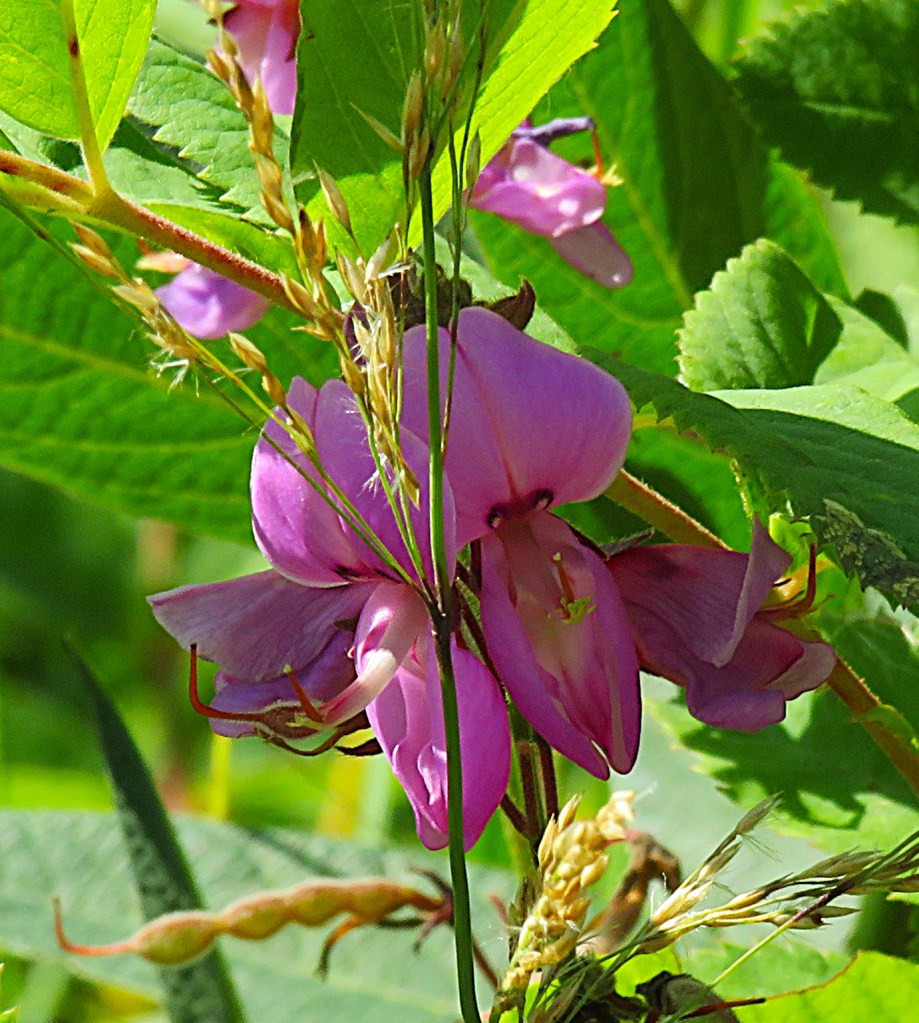
Showy Tick-trefoil, Desmodium canadense, Milford Mine Memorial Park, Crow Wing County, MN. Photo by Danielle, August 2025.
In times of despair, we turn to art and to beauty. We seem to find art and beauty in flowers. Flowers bloom in brief, memorable ways, like our own Earthly journeys. We hope we’re remembered for the right reasons. Somehow, I want to be silent and colorful. Wordless, nature persists. A plant pops up in a bog, blooming at daybreak. I imagine Monet, in his French beret, walking the Milford Mine boardwalk and speaking in French to our hound. Monet endured loss in his personal life. He struggled with eyesight. He painted nature as he perceived it. We perceive our environments using one or more of our senses: taste, touch, sight, sound, smell. They are instinctual, like the way our hound’s nostrils excitedly flare when he catches the whiff of a dog friend. When life overwhelms me or poisons my happy place, I just need to see flowers.
Even when we are senseless, or blind, we have flowers. I imagine the scent of an aquatic blossom in bloom. In the dead of cold winter, forgetting the sun, I will visualize the turtle slip off its log, groping and swimming in the dark water, tangling with the stems of the water lilies. Tethered to beauty like a balloon. I dream of a mylar flower, wild and fat, watered with helium. I tie its lime, sinewy thread to my wrist. Ten years ago, I flew over lower Manhattan in the evening, on my first visit to New York City. Out the window, I saw the two memorial pools marking the prints of the old World Trade Center towers. Flying. Gone one day, like the dinosaurs. The watch on my wrist turns to the lime, sinewy thread. I see a second mylar balloon, tied to a bearded artist in a beret. He’s floating too, eyes open, holding a paintbrush.
 Danielle Dreams in Wildflowers
Leave a comment