My interest in wildflowers started with birdwatching. While living in Vermillion, SD my husband and I started noticing more Northern Cardinals and various woodpeckers. One morning, a male Cardinal landed in a little tree outside our apartment. I got my basic camera and took a few pictures. They weren’t good pictures, but the Cardinal was visible, and that was enough for me. When we moved to Minnesota and into our first home, we set up several birdfeeders. Then we saw a Great Horned Owl at the local cemetery. I got a camera with a powerful zoom for Christmas. The camera changed everything.
I’ve always attached meaning to photographs. As a teenager, I wanted to get photographed with my heroes. I dreamed of meeting my favorite athletes, and many of those dreams came true, eternalized in photographs. Those pictures felt like a kind of evidence and a critical part of my identity. I mostly used cheap disposable cameras, which I got developed at the Lewis Drug one-hour photo in my hometown. Back then, I didn’t care much about whether the photo was close-up or perfect; I just needed a visual record of memories. The new camera enabled me to see animals in color and detail. Trying to get a good picture was fun. I looked forward to clicking through the hundreds of photos I’d uploaded to my computer.

Dickcissel, Spiza americana, Great River Bluffs State Park, MN. Photo by Danielle, July 2025.
Birds are some of the most fascinating creatures on Earth. Described by Wikipedia as “feathered dinosaurs,” birds are found all over the world. Written by David K. Elliott, EBSCO’s overview on the “Evolution of Birds” explains that birds evolved from theropods: small, carnivorous dinosaurs. One of my favorite birds, the Great Blue Heron, Ardea herodias, has always reminded me of Pterodactylus, the flying dinosaur. The heron’s long beak, massive wingspan, towering height, and long, spindly legs remind me of a creature from a different time. Last spring, I watched a random television show about alien and UFO encounters. One of the contributors discussed how sometimes large birds, including Great Blue Herons, can be mistaken for extra-planetary life, especially at night. The literary concept of “the uncanny” captures how I feel when I see a Great Blue Heron. A sense of the familiar mixes with something unusual. Seeing the bird is like glimpsing a time traveler.
I learn more about feathers, a defining characteristic of birds. The EBSCO article explains that the scales of reptiles may have evolved over time into what are now feathers of birds. I understand why feathers hold significance for my people and cultures. Not only are feathers beautiful in their color and ephemeral qualities, but their origins trace back to the earliest forms of life on Earth. In terms of life on Earth, birds are adaptable and ubiquitous. One of my favorite things about birds is that they live everywhere. Watching an American Robin, Turdus migratorius, take a bath in a mud puddle can be pretty entertaining. Other birds are so rare and eccentric that simply hearing their song or catching the flash of a feather can make for a memory, even if the action of the camera misses it.
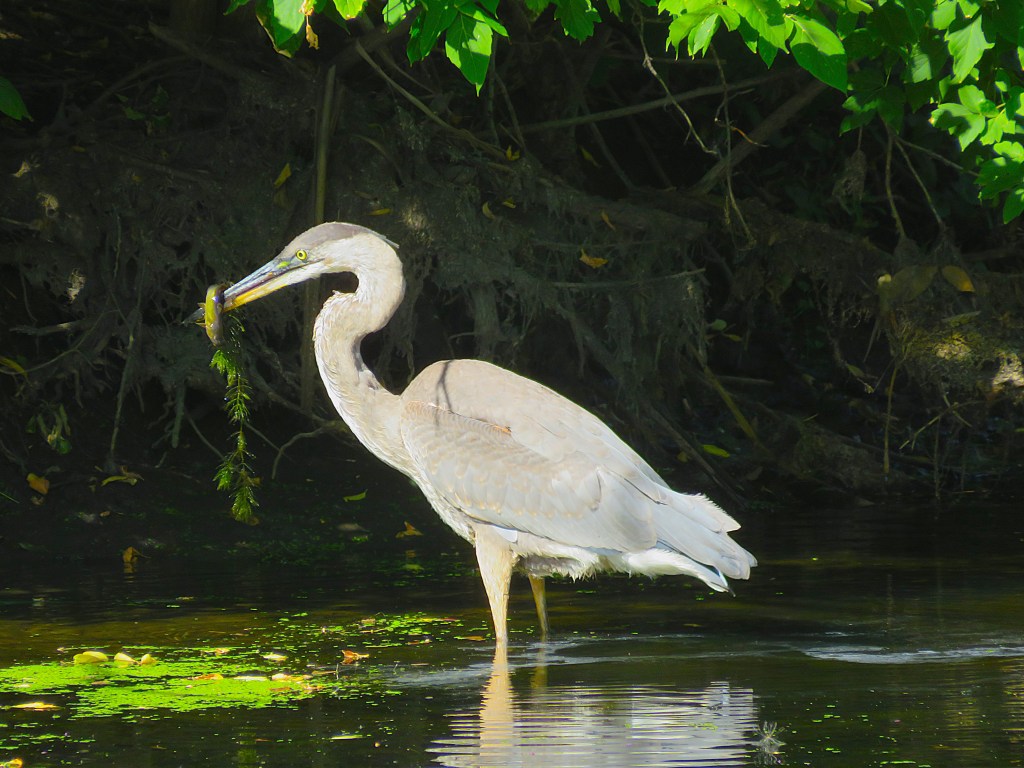
Great Blue Heron, Ardea herodias, fishing for Bullheads, Ameiurus. Sertoma Park, Grand Forks, ND. Photo by Danielle, August 2025.
A window view of a birdfeeder becomes a lively stage where an unexpected guest might appear. The feeder is a social place where birds interact and assert themselves. Drama plays out. We enable rabbits and squirrels, providing a picnic bench for yard critters unable to fly. I remember our first Brown Thrasher, Toxostoma rufum, with its striking golden eyes. Now we see them regularly. They like to thrash in the leaves we leave for the pollinators. I can still see my first Snowy Owl, Bubo scandiacus, on Highway 14 near Iroquois, SD, right after Christmas. I pulled over to take a few pictures. Seeing the owl through the lens of the camera felt like a once-in-a-lifetime moment.
We’ve observed some spectacular birds this summer. My springtime post, “Fertile Imaginations,” features some photos of our first Scarlet Tanager, Piranga olivacea. We’ve seen Sandhill Cranes with colts, Common Loons, American White Pelicans, Great Egrets, Belted Kingfishers, Yellow Warblers, Gray Catbirds, American Goldfinches, Red-winged Blackbirds, American Bald Eagles, Golden Eagles, American Kestrels, and so many hawks and songbirds. There’s a wetland area near our home where Trumpeter Swans regularly nest. This year I collected some photos of the family and the cygnets. As with flowers, the cycles of nature bring certain things back every year, if we’re lucky. The first sight of the swans each spring makes me happy. The pink beaks of the baby swans contrast with the bold adult look of their parents. I treasure a rubber stamp from my collection that features a swan and “La Cygne” in elaborate script.

Trumpeter Swan, Cygnus buccinator, with cygnets, Polk County, MN. Photo by Danielle, July 2025.

Green Heron, Butorides virescens, Sertoma Park, Grand Forks, ND. Photo by Danielle, September 2024.
We often visit Sertoma Park in Grand Forks, ND, looking for Green Herons, Butorides virescens. We like shore birds. For years we wished for a cool encounter with a Green Heron. Then we got close to one at the park, where the birds seem to nest. Now we see several on every visit. Their facial expressions remind me of cartoon characters. There’s a competitive aspect to birdwatching, as in Mark Obmascik’s 2004 book The Big Year: A Tale of Man, Nature, and Fowl Obsession. Although we don’t compete against other birders, there’s a sense of “victory” in encountering a dream bird or finally getting a photo of something strange or elusive. Every time I see a bird, I remember my first encounter with its type–different individuals in different times, recognizing each other.
In August we made it to our twentieth Minnesota state park of the year: Charles A. Lindbergh State Park near Little Falls, MN. Charles A. Lindbergh is a smaller park with a lot of old trees and a scenic footbridge over the Mississippi. Wandering the park, my husband sees what we think is a Western Bluebird, Sialia mexicana. The bright little bird flies and sings, hopping along a path, twittering up to a tree branch. Through the camera lens and the binoculars, we notice its beak is more like a grosbeak. It lacks the brown coloring we’d expect to see in a Western Bluebird. Indeed, it’s one of our dream birds: our first sighting of an Indigo Bunting, Passerina cyanea. His spectacular colors amaze me–the deep, nearly purple shades of the delicate feathers reveal hints of turquoise and grape. Seeing new colors in nature, firsthand, can be awe-inspiring. Observing the Indigo Bunting, my soul comes alive.
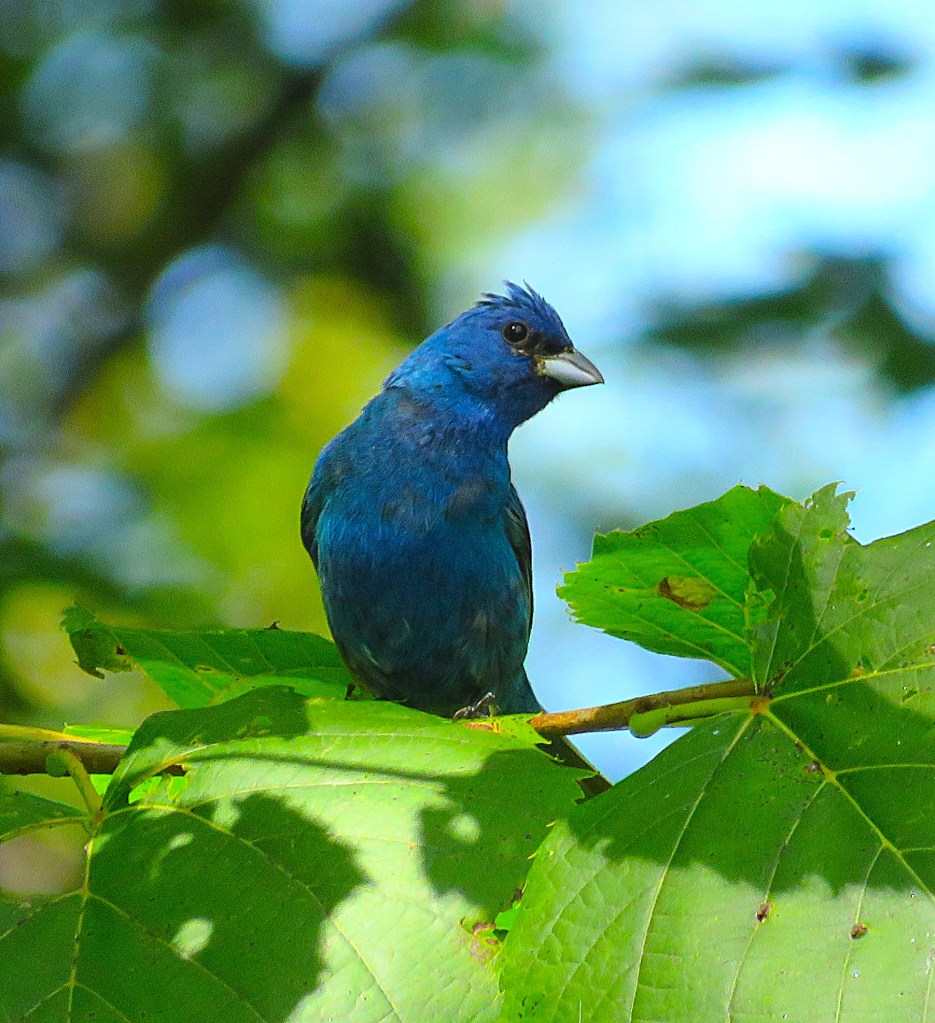
Indigo Bunting, Passerina cyanea, Charles A. Lindbergh State Park, MN. Photo by Danielle, August 2025.
That same day, we visit two more state parks: Mille-Lacs-Kathio and Crow Wing. On the shores of Mille Lacs Lake, we see huge Common Evening Primrose plants, Oenothera biennis, blooming in the overcast weather. This is a flower I recognize now. It’s becoming one of my favorites in yellow. Something new, in a shade of orange, attracts my attention. It’s popular among bumblebees. I photograph Spotted Touch-me-not, Impatiens capensis, not far from the primrose plants. Its flower reminds me of orchids, with the tubular shape and the spots. Also called Jewelweed, Impatiens capensis grows throughout most of Minnesota. I discovered another orange flower earlier this summer: Orange Hawkweed, Hieracium aurantiacum, an invasive species also known as Devil’s Paintbrush. Orange is a rare color among native Minnesota wildflowers.
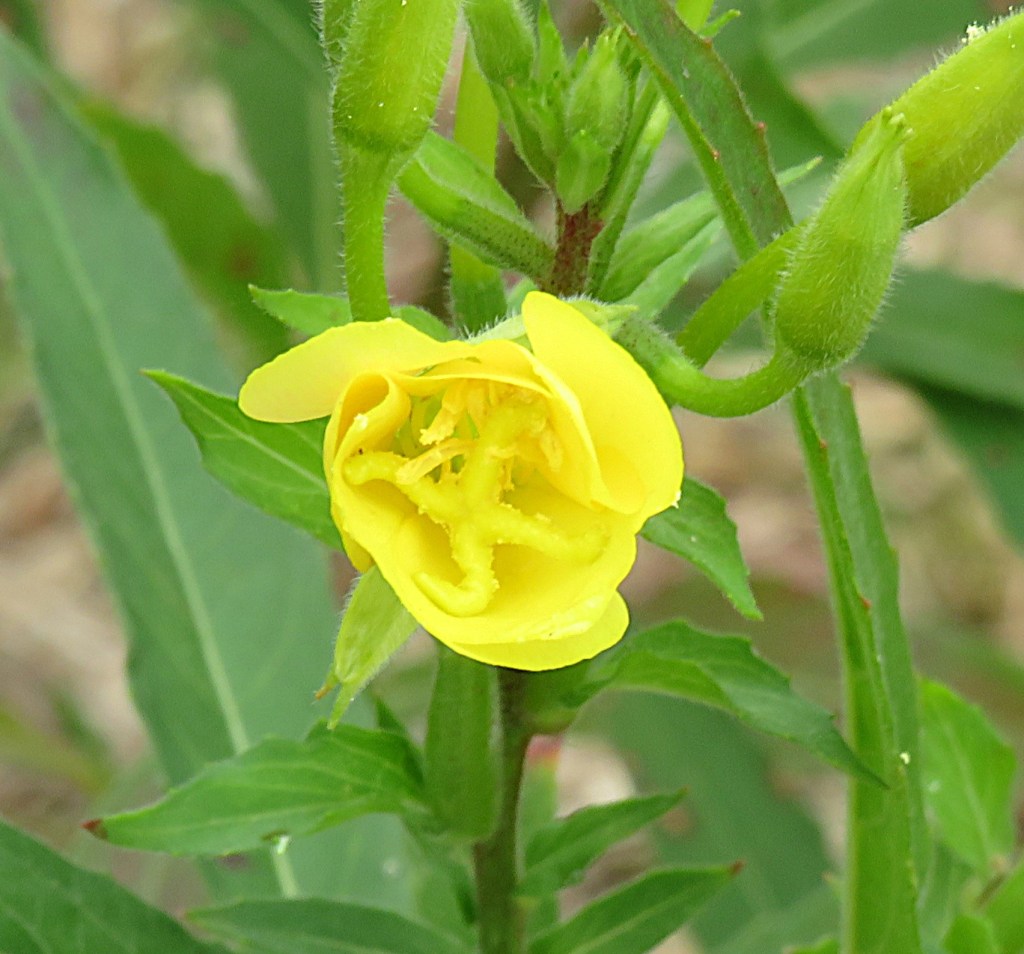
Common Evening Primrose, Oenothera biennis, Mille Lacs Lake, MN. Photo by Danielle, August 2025.
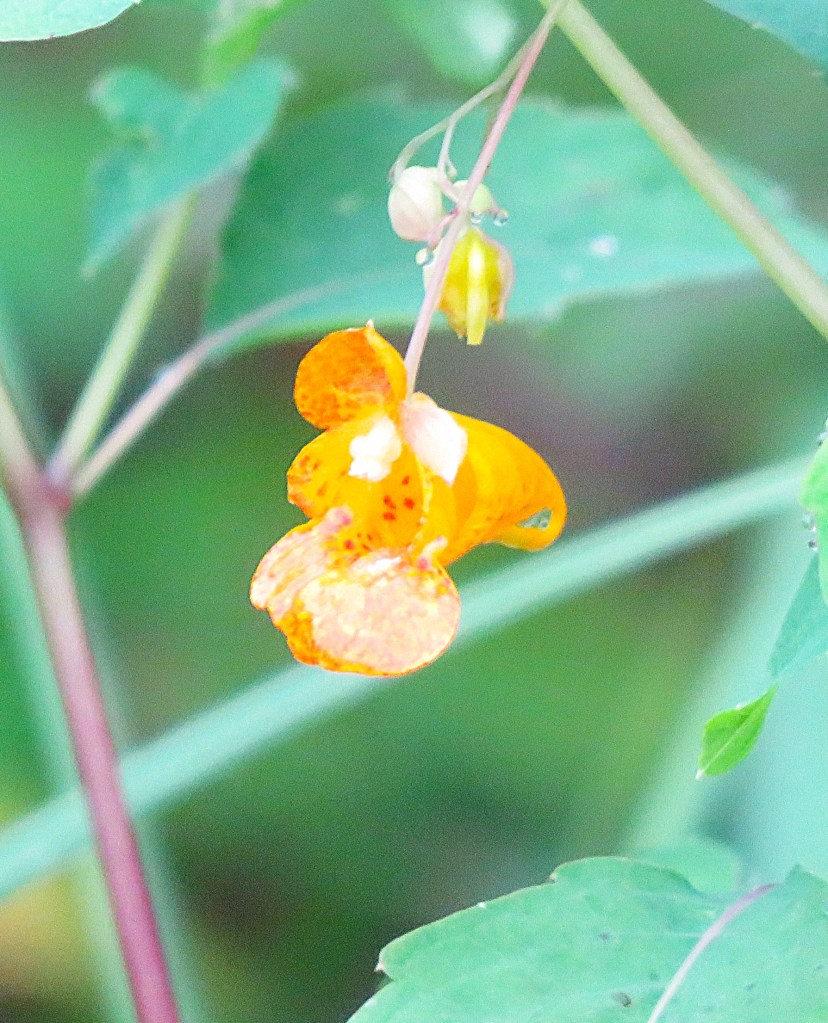
Spotted Touch-me-not, Impatiens capensis, Mille Lacs Lake, MN. Photo by Danielle, August 2025.
Arriving at Crow Wing State Park near Brainerd, we listen to the radio as J.J. McCarthy takes the field for the Minnesota Vikings in a pre-season game. My husband wears his Vikings shirt as we venture down into the park with our hound. Mosquitos descend. I’m excited to see Rough Blazing Star, Liatris aspera, another variety of Liatris. The shapes of the flower heads and the orientation of the flower heads to the stem help me differentiate these from other Liatris. We take a short trail to a point overlooking the Mississippi River. On a sandy beach on the opposite shore, an enormous Common Snapping Turtle, Chelydra serpentina, basks at the edge of the river. It’s perhaps the largest turtle I’ve ever seen. I look away from the camera and see something else, another large turtle. With the second turtle only a few feet away from the first, two differences stand out: the Snapping Turtle is quite a bit larger, and the other turtle has a pale, soft shell. I feel the joy of discovery: it’s a Spiny Softshell Turtle, Apalone spinifera, one of two softshell turtles in Minnesota.

Rough Blazing Star, Liatris aspera, Crow Wing State Park, MN. Photo by Danielle, August 2025.

Spiny Softshell Turtle, Apalone spinifera (left), and Common Snapping Turtle, Chelydra serpentina (right), basking on the banks of the Mississippi River. Crow Wing State Park, MN. Photo by Danielle, August 2025.
We dream in pictures. The glossy, 4×6″ drugstore photos printed in only an hour, warm in their paper envelope. Seeing a new turtle, the Spiny Softshell, feels like nature whispering something into my ear: a secret. As the Terrance Mann (James Earl Jones) character says in the 1989 movie Field of Dreams, “there comes a time when all the cosmic tumblers have clicked into place–and the universe opens itself up for a few seconds to show you what’s possible.” A boat cruises past, and the turtles retreat into the river. I imagine a cosmic tumbler filled with a nutty, black coffee. A ride on a shooting star. The hopeful feel of a wish captured in the ink of a rubber stamp or a tuft of indigo feathers.


 Danielle Dreams in Wildflowers
Leave a comment