I’ve been paying more attention to insects. Like snakes, insects are often misunderstood. Wilco’s song “Misunderstood,” has always resonated with me. I used to listen to it a lot in the old Monte Carlo. I’m an introverted person. Maybe somewhat reclusive. Like a Wood turtle, Glyptemys insculpta, or Emily Dickinson. Sometimes misunderstandings result from how we see things. Some see a ditch of weeds where others see coveted wildflowers. Silence is a problem for some. For others, like me, it’s a form of peace and resistance.
Earlier this summer, I saw something large on the side of the shed in our backyard. I count what resemble eight legs; it could be a daddy long-legs spider from the Pholcidae family. But the body is long, almost like a dragonfly. And this thing has wings, tucked in against its body. The pictures I take with my phone emphasize how the creature’s legs blend in with the cracking paint on the shed. I’ve discovered a crane fly. A member of Tipuloidia, the crane fly is often mistaken for a giant mosquito or spider.
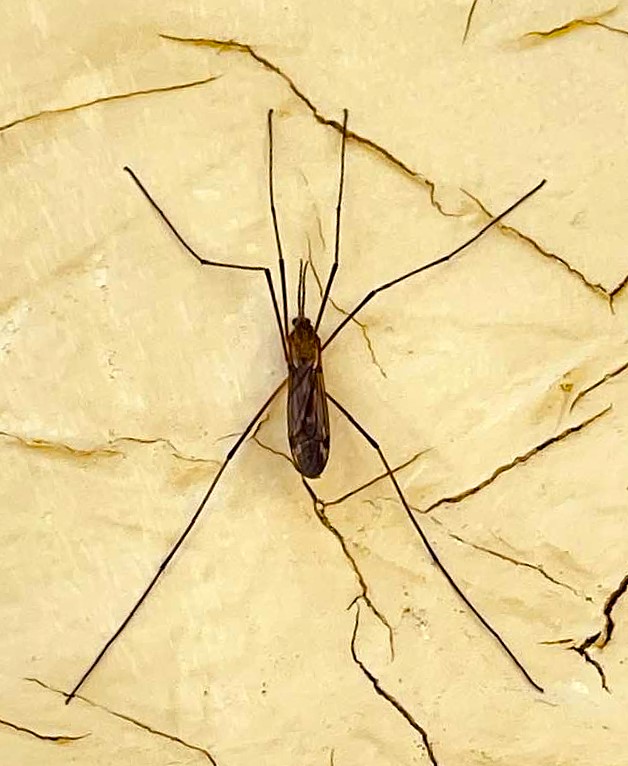
Crane fly, member of Tipuloidia, Polk County, MN. Photo by Danielle, May 2025.
This is the time of year when attention turns to another insect, the Monarch Butterfly, Danaus plexippus. I’ve seen hundreds of Monarchs this summer, but I haven’t yet snapped an ideal picture. Several years ago, I photographed a Monarch caterpillar on a plant I now recognize as milkweed. The first time I heard the word “milkweed,” it was in reference to the highly regarded literary press in Minneapolis: Milkweed Editions. I had no idea milkweed was a type of plant, and until last summer, the abundant and varied types of milkweed that grow throughout Minnesota were just generic “plants” or “flowers.” The Milkweed Editions website explains how the press aspires to encourage “metamorphosis” in literature in the same way the plant is linked to the metamorphosis of the Monarch Butterfly. While poisonous to humans and animals, milkweed plants are the only food source for Monarch caterpillars (saveourmonarchs.org).

Monarch caterpillar on Common Milkweed, Asclepias syriaca, Bayfield, WI. Photo by Danielle, July 2019.
Of course, butterflies are linked to metamorphosis: the transformation from egg to caterpillar, caterpillar to pupa, pupa to butterfly. While “metamorphosis” is often used in figurative and metaphorical ways to describe various types of change and transformation, a literal metamorphosis is a biological phenomenon. Franz Kafka‘s 1915 novella, The Metamorphosis, features a protagonist, Gregor Samsa, who wakes up one morning as an insect. The unexplained, seemingly random metamorphosis significantly alters Gregor’s life, which isn’t surprising. Insect Gregor struggles to fit in, among other things. Gregor’s shift is sudden and weird. But it shows how an inexplicable change–something shocking that we don’t understand–can be incredibly hard to cope with.
Gregor’s transformation is arguably the most famous biological metamorphosis in literature. But the image of a caterpillar and its transformation into a beautiful butterfly is a common way artists working in all mediums, including writing, capture themes including the evolution of the self, the transience of life, the fragility of beauty, and many others. Subsequently, milkweed plants sprout in many literary works, like Bradford Tice’s 2013 poem “Milkweed,” which captures the enchanting, mysterious aura of nature and what it might mean.
I believe most people have been fortunate enough to have a powerful experience with nature. Maybe something simple, like seeing a bear or swimming in the ocean. A nuzzle from a hound. I like visiting with my students about their favorite parks or places in nature. Powerful nature moments can happen anywhere. So can creative inspiration. “The Crane Fly” would make a great title for a short story. The milkweed plant’s striking features and its relationship with butterflies inspire creativity. In my role as a writing teacher, I work with a lot of students in their first year of college. For nearly all of them, it’s a time of excitement and change. They’re undergoing a kind of metamorphosis. Transforming is difficult. It takes courage to scrawl a haiku on a fast food napkin.

Common Milkweed, Asclepias syriaca, Winona, MN. Photo by Danielle, July 2025.
The Flower Chasers blog maintained by Phyllis Root and Kelly Povo documents fourteen species of milkweed as native to Minnesota. Right now, I’m seeing milkweed all over the place. Common Milkweed, Asclepias syriaca, blooms all summer, from June through August. The flowers extend both upward and downward, with a “five-parted crown and five downward-curved petals” (Minnesota Wildflowers). Until I got close to Butterfly Weed, Asclepias tuberosa, earlier this summer, I didn’t notice the downward part of the milkweed flowers. The downward flower conceals the stem, like a daring skirt in a shade of dusty rose. The upward part of Asclepias is called a “corona.” Wikipedia emphasizes the complexity of milkweed flowers, comparing them to orchids.
Other types of milkweed showcase different colors and characteristics. This summer, I spotted my first examples of Showy Milkweed, Asclepias speciosa, a gorgeous variety with flowers that look like pink starfish. Western Minnesota is a good place to look for Showy Milkweed. The photo below was taken just a few weeks ago, on our visit to Buffalo River State Park. I’ve since seen it here in Polk County. The size and shape of the flowers is the most obvious distinguishing characteristic between Common Milkweed and Showy Milkweed. I can picture a Showy Milkweed blossom as a topper for our Christmas tree, mingling with silver tinsel. Swamp Milkweed, Asclepias incarnata, is another type of milkweed with prominent pink flowers. However, the leaves of Swamp Milkweed are quite narrow compared to the others. The flowers are rich in a hue of magenta, and I often identify Swamp Milkweed with ease as it rises up from the wetlands and sloughs. Its deep color sets it apart from the others.
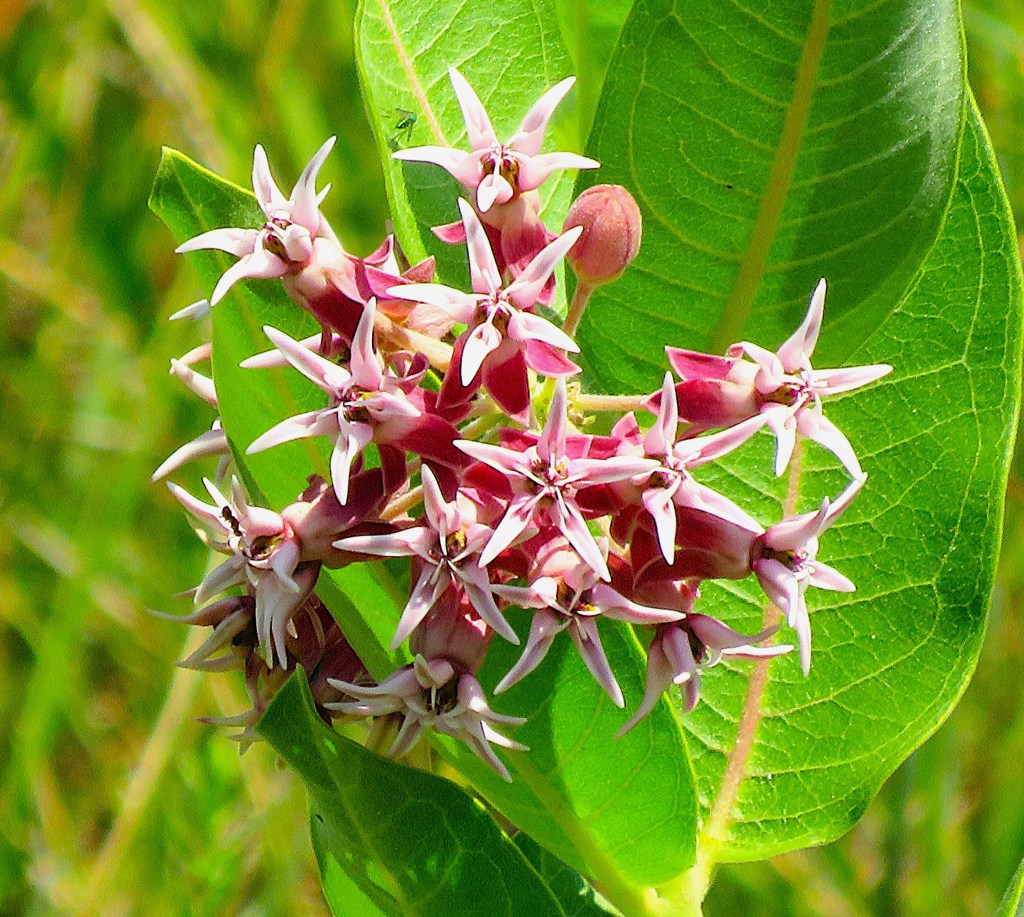
Showy Milkweed, Asclepias speciosa, Buffalo River State Park, MN. Photo by Danielle, July 2025.

Swamp Milkweed, Asclepias incarnata, Winona, MN. Photo by Danielle, July 2025.
Insects appear in a palette of seductive hues. I discover the Red Milkweed Beetle, Tetraopes tetrophthalmus, hanging out on Butterfly Weed. I like its antennae and the red-orange shell. Out on the prairie, I see a butterfly with a standout pattern. I take about ten pictures, and one comes out crisp and focused. Later, I learn its a fritillary butterfly, perhaps an Aphrodite fritillary, Speyeria aphrodite. Its shade of orange reminds me of Texas Longhorn burnt orange, but the fritillary is brighter, like a lightly burnt orange! Another fritillary, the Great Spangled Fritillary, Speyeria cybele, is larger than the Aphrodite, but looks very similar. Some Internet research reveals that the word “fritillary” comes from the Latin term for “chessboard.” “Fritillary” would make a good fit for the fast food napkin haiku.
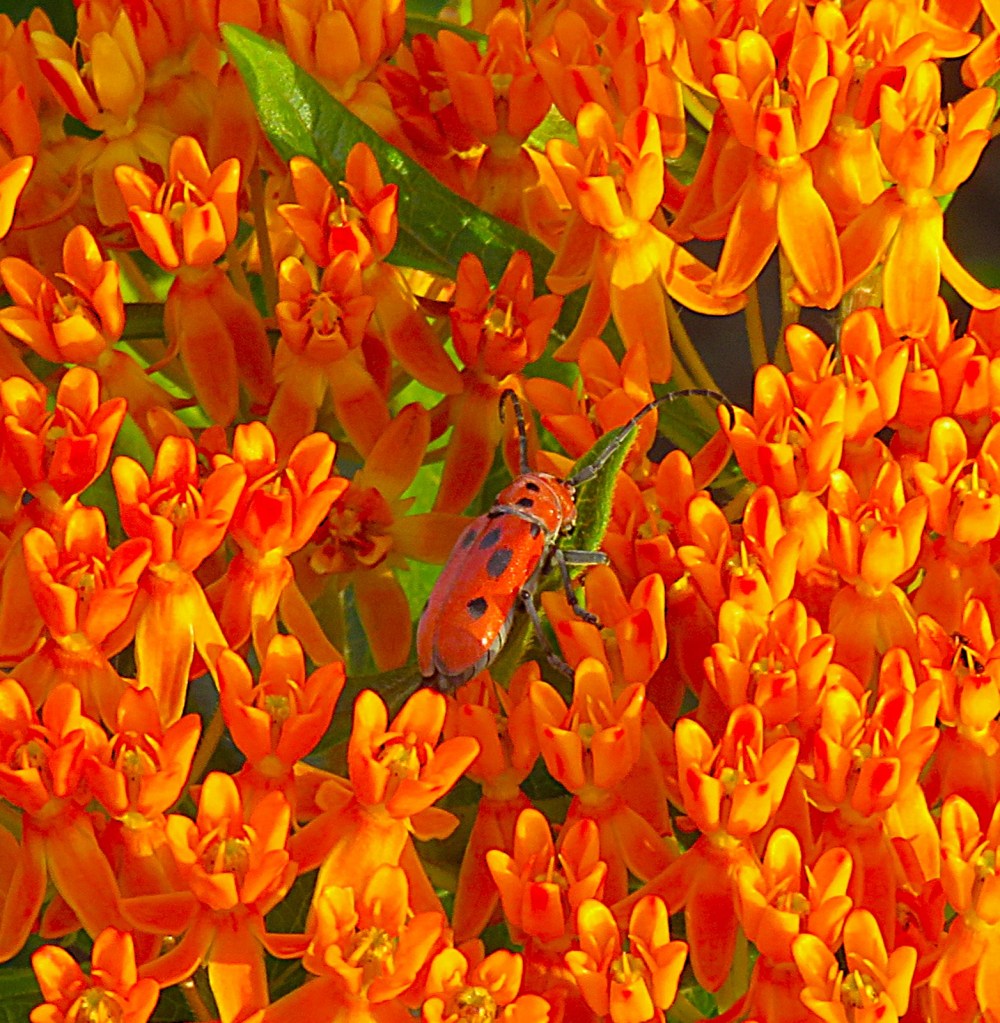
Red Milkweed Beetle, Tetraopes tetrophthalmus, Winona, MN. Photo by Danielle, July 2025.

Fritillary butterfly, perhaps Aphrodite Fritillary, Speyeria aphrodite, Glacial Ridge National Widlife Refuge, MN. Photo by Danielle, July 2025.
This summer, flowering has transformed me. I have a tan. I’ve brushed a few ticks from my ankles. I’ve filled my brain with flowers: their names, their shapes, their identities. There’s no space left for the toxics or the invasives. I don’t know a lot about Kafka, but I know he was hard on himself as a writer. Flowering is a gift to myself. A few nights ago, I did something I’ve never done before. After going to bed, a few lines of writing came to me. I had a notebook next to my bed. I found my pen and there, in the dark, I blindly wrote the lines down in the notebook. They had nothing to do with flowers. It was an image of a flannel shirt and growing up in the 90s. Lots of ideas drift around when I’m trying to sleep. I’ve never reached for my pen in the dark before. Like Gregor, I guess I’ve changed.
 Danielle Dreams in Wildflowers
Leave a comment