We spend Independence Day weekend in the Driftless region of Minnesota. This southeastern part of the state, through the valley of the Mississippi River, features rocky bluffs, hardwood forests, and impressive views of The Great River. The swampy shores of the Mississippi carol and dance with songbirds and shorebirds. The Great River Road, which follows the path of the river all the way to New Orleans, overlaps with historic Highway 61. We take the highway to Winona, a city situated on a sandbar between Lake Winona and the Mississippi River.
This part of Minnesota, nearly seven hours from our home in Polk County, always makes me reflect on the size and diverse ecological gifts we enjoy in the North Star State. Common Milkweed, Asclepias syriaca, thrives along the shores of Lake Winona. I’ve seen hundreds of Common Milkweed plants, but still, I can’t help but take pictures. The flowers remind me of of the intricate Lego flower sets. I imagine assembling the blossoms, snapping together the petals, over and over again. I find some familiar vegetation: purple coneflowers, possibly Echinacea augustifolia, and Wild Bergamot, Monarda fistulosa.
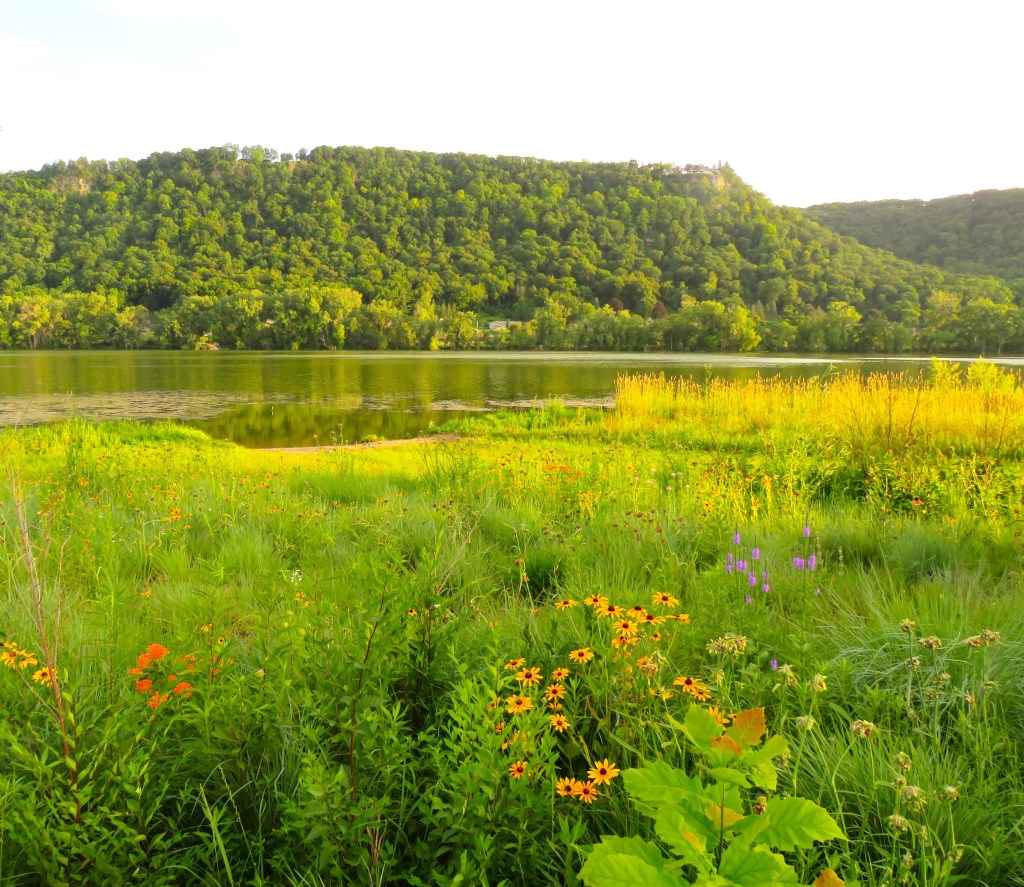
Lake Winona, Winona, MN. Photo by Danielle, July 2025.
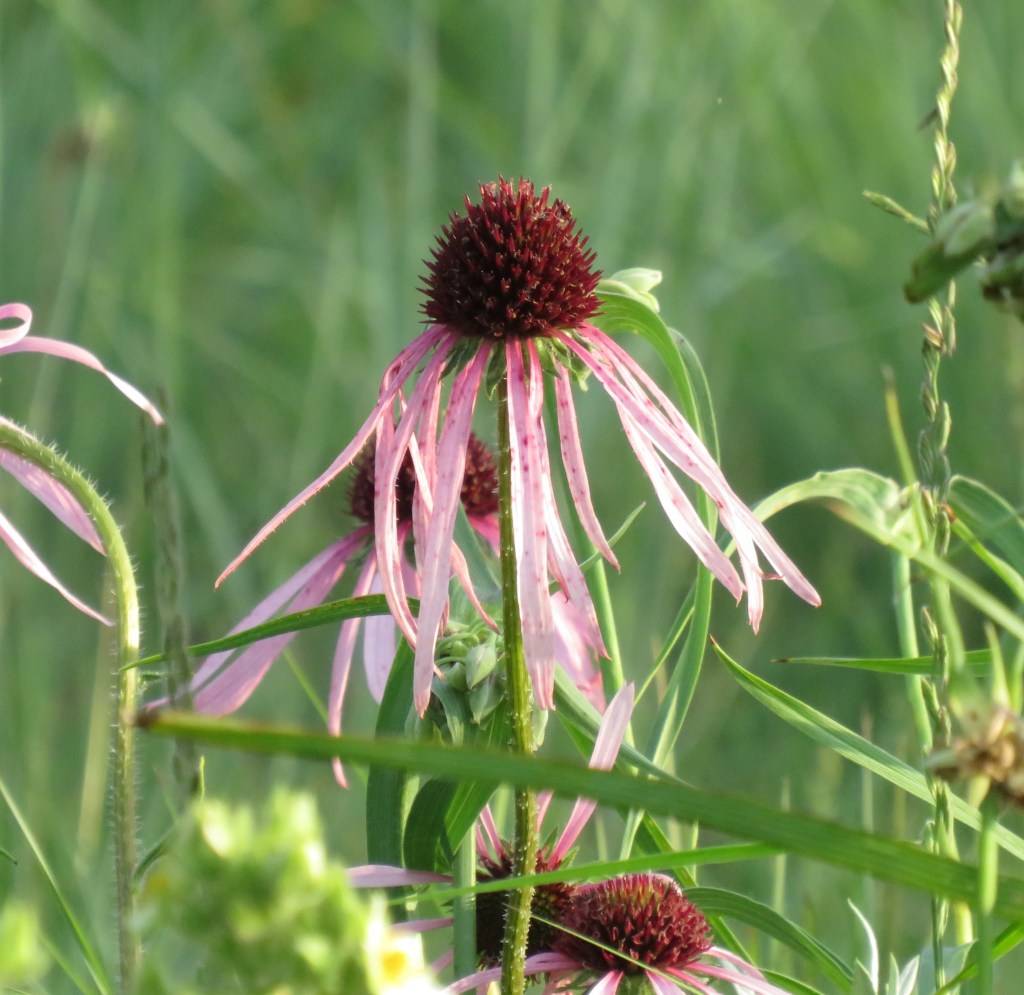
Purple Coneflower, possibly Echinacea angustifolia, Winona, MN. Photo by Danielle, July 2025.
The first week of July feels like the heartbeat of summer in Minnesota. In winter, we dream of these truly hot days when the heat is sublime. The word “sublime” captures the simultaneous feeling of awe and fear we might experience when peering over the edge of a cliff. The sun glows both wonderous and terrifying. We wander the banks of the Mississippi at Winona. I photograph thousands of lily pads. In ultra bright sun, sometimes it’s hard to tell a leaf from a petal. But I see something yellow and delicate, back in the weeds, drooping somewhat on its stalk. The flower is large and has the shape of a violet. Fringed Loosestrife, Lysimachia ciliata, grows in watery environments throughout Minnesota. This is my first encounter; it’s a light and attractive flower. I see a few plants, tall, with most of the blossoms facing away from me. I find one in the lens of my camera. Its stamens curl inward like the legs of an insect flipped on its back.

Fringed Loosestrife, Lysimachia ciliata, Winona, MN. Photo by Danielle, July 2025.
Temperatures reach the 90s at Frontenac State Park near Lake City, MN. Lake City is right on Lake Pepin, a natural lake on the Mississippi. Across the river from Lake City is Pepin, Wisconsin, a town near the birthplace of Laura Ingalls Wilder. I grew up in South Dakota, about 30 miles west of DeSmet, the “Little Town on the Prairie.” My mom read my brother and me the entire Little House series when we were kids. Caroline Fraser’s Pulitzer Prize-winning book, Prairie Fires (2017), presents an irresistible biography of Ingalls Wilder. Fraser describes Lake Pepin as a “legendary” place “where the Mississippi swallows the Chippewa” (27). The Ingalls daughters played on the shores of the lake, collecting rocks, exercising their imaginations (Fraser 28).
An Eastern Chipmunk hangs out near the Frontenac State Park welcome sign. We water our hound and take a short trail to a panoramic overlook of the Mississippi River and Lake Pepin. I see an informational sign about Timber Rattlesnakes, Crotalus horridus. I learn that they’re one of two kinds of venomous snakes in Minnesota, and that purposeful harm from humans has been a major factor contributing to the decline of the snakes in Minnesota. The Minnesota Department of Natural Resources reports that the Timber Rattlesnake has been listed as threatened in Minnesota since 1996. I’ve never harmed a snake or wished for their widespread destruction. But others have. A phobia many humans share has endangered the snake’s existence.
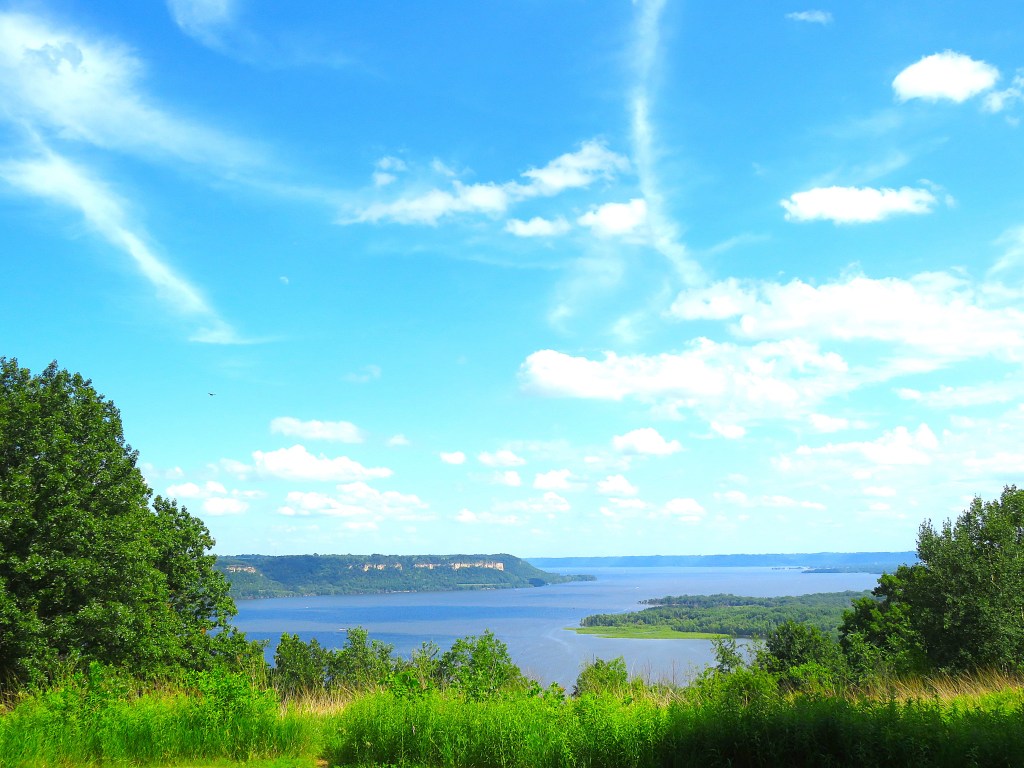
Frontenac State Park, MN. Photo by Danielle, July 2025.
We reach the scenic overlook: it’s the place featured on the park’s entrance sign. The view of the Mississippi and Lake Pepin to the south feels like a live photograph, stretching across the entire valley below. A single picnic table rests at the edge of the overlook. Our hound poses for a photograph. Every winter, he’s the star of our holiday cards. We share our lives with plants and animals. Tornadoes and water. Viruses and invertebrates. E.O. Wilson’s concept of “biophilia” theorizes that humans instinctively gravitate toward nature–specifically, life. The idea of “oneness” with nature is central to many indigenous cultures. I remember N. Scott Momaday‘s The Way to Rainy Mountain (1969), which I read while in graduate school in Arizona. Momaday’s book includes the story of how the Kiowa people were born from the Earth, emerging from its depths through a hollow log.
Throughout the park, I see Butterfly Weed, Asclepias tuberosa, with bright orange flowers the color of garden carrots. I’ve seen Butterfly Weed growing in ditches as we’ve traveled south from our home in Polk County. The colors blaze like little fires. At Frontenac, I get close to the plants, admiring the upper and lower petals. I recognize Blue vervain, Verbena hastata. A tall plant with spikes of small, purple flowers, Blue vervain is a native flower that grows wild throughout most of Minnesota. It’s a meaningful plant that’s also edible. I try to imagine the taste of verbena vinaigrette. I learn that the group of spikes on the plant–the way the flowering part is arranged–is called an inflorescence.
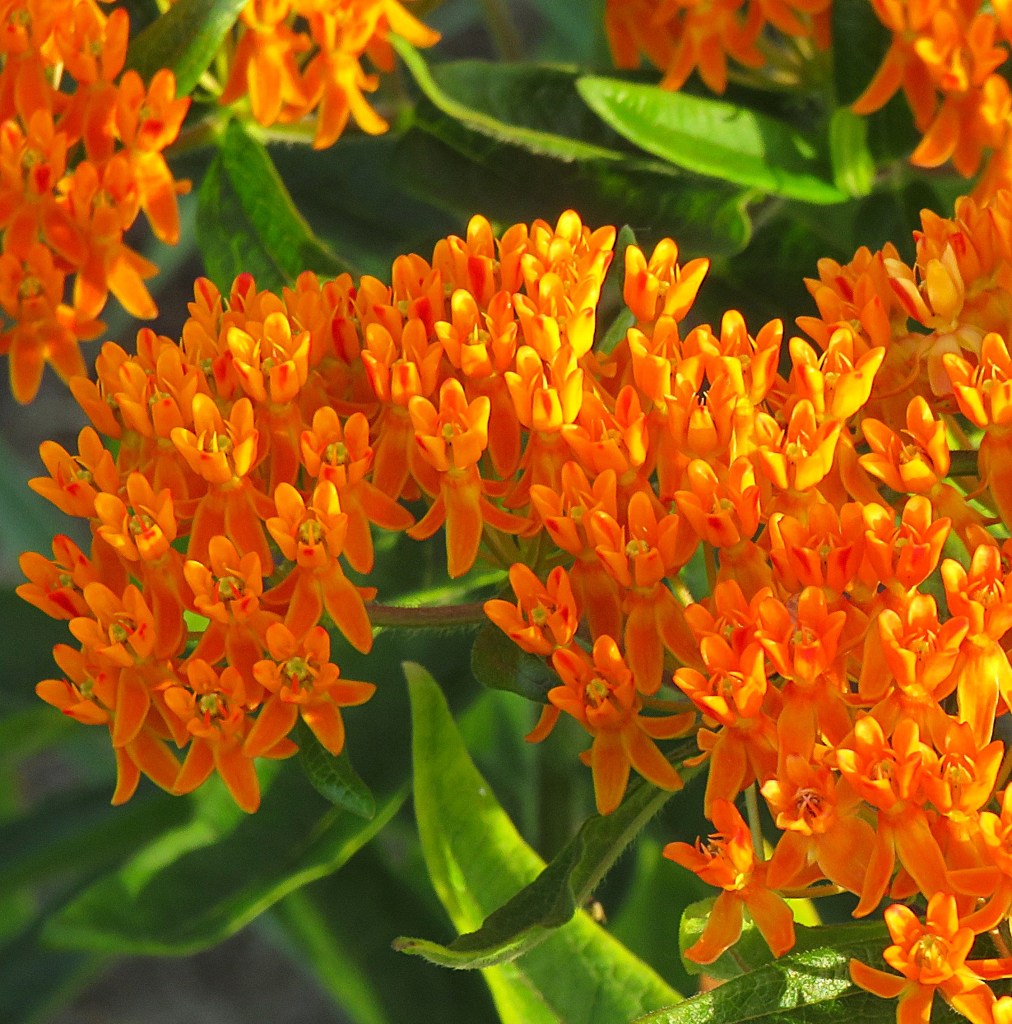
Butterfly Weed, Asclepias tuberosa, Frontenac State Park, MN. Photo by Danielle, July 2025.
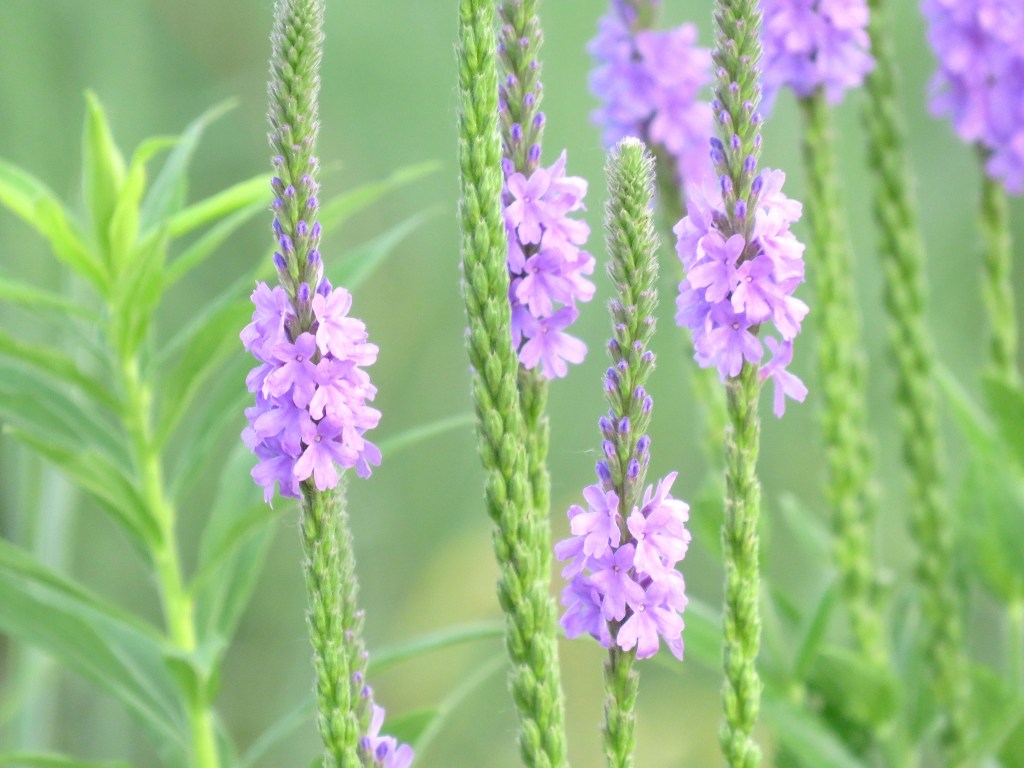
Blue Vervain, Verbena hastata, Frontenac State Park, MN. Photo by Danielle, July 2025.
So many lovely flowers seem to share the shade of purple I observed in Verbena hastata. In college, I bought a hyacinth plant, Hyacinthus orientalis, at the grocery store and kept it near my desk for awhile, doing my best to take care of it. At random times in my life, I’ve been drawn to certain plants. A few years ago, it was a coral-colored hanging garden geranium that “spoke” to me at the greenhouse. The grocery store hyacinth was one of the first flowers I inspected and loved for its beauty. The starry shapes of the flowers, in lilac, heightened my senses. It’s funny–the hyacinth smelled like flowers. The little Blue vervain flowers take me back to that hyacinth. A plastic pot wrapped in gold foil. Inspiring a young English major. I like how the Blue vervain flowers burst out from the spikes in seemingly random places. Something about the spikes makes me think of Rapunzel’s braid. Since ancient times, cultures worldwide have celebrated verbena for its supposedly cleansing and curative properties. For many, this is a sacred herb linked to relief and protection.
Shells protect turtles. We see a big, mud-slicked shell at Whitewater State Park. The shell looks just like the rocks around it, providing camouflage for the dino-like creature it houses. It’s a Common Snapping Turtle, Chelydra serpentina, basking on a log at the edge of the Whitewater River. I point it out to my husband. He knows I like turtles and tortoises. He bought me a turtle necklace for my thirtieth birthday. In Mario Kart, my favorite driver is Bowser, the powerful, villainous “Koopa” turtle and arch-rival to the lead character, Mario, and his brother, Luigi. I’m more introverted than Bowser, and hopefully more approachable. But sometimes I retreat to the safety of my own metaphorical shell: the interior world of an introvert. Oblivious to the turtle and the Canada Geese floating past, our hound rolls around in the grass to cool off. The turtle slips off the log, disappearing.
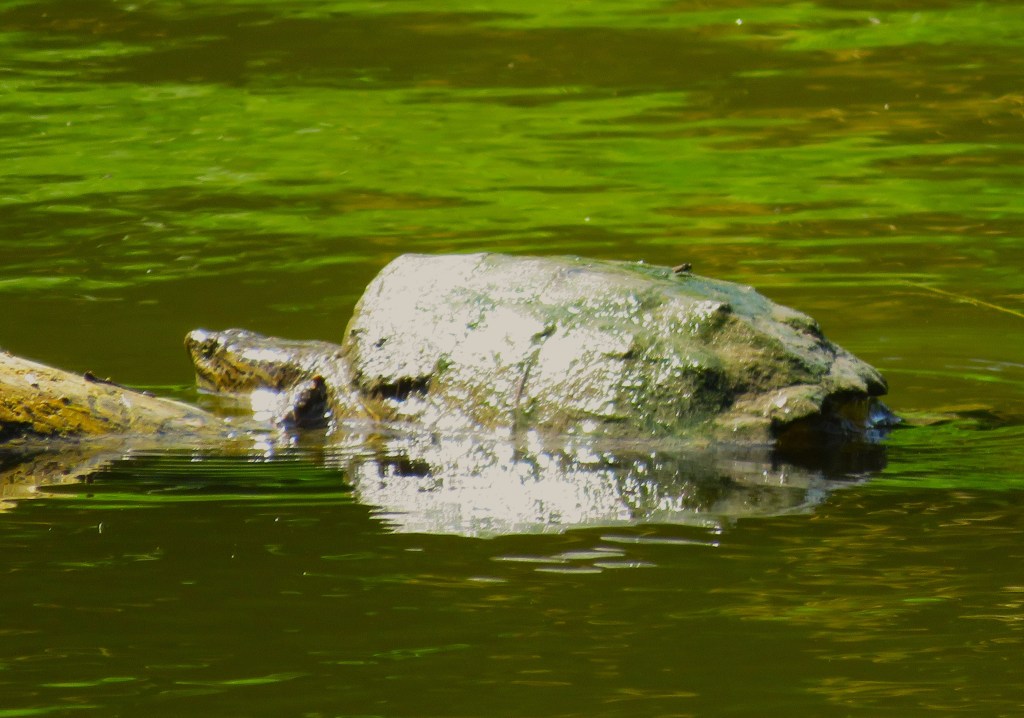
Common Snapping Turtle, Chelydra serpentina, Whitewater State Park, MN. Photo by Danielle, July 2025.
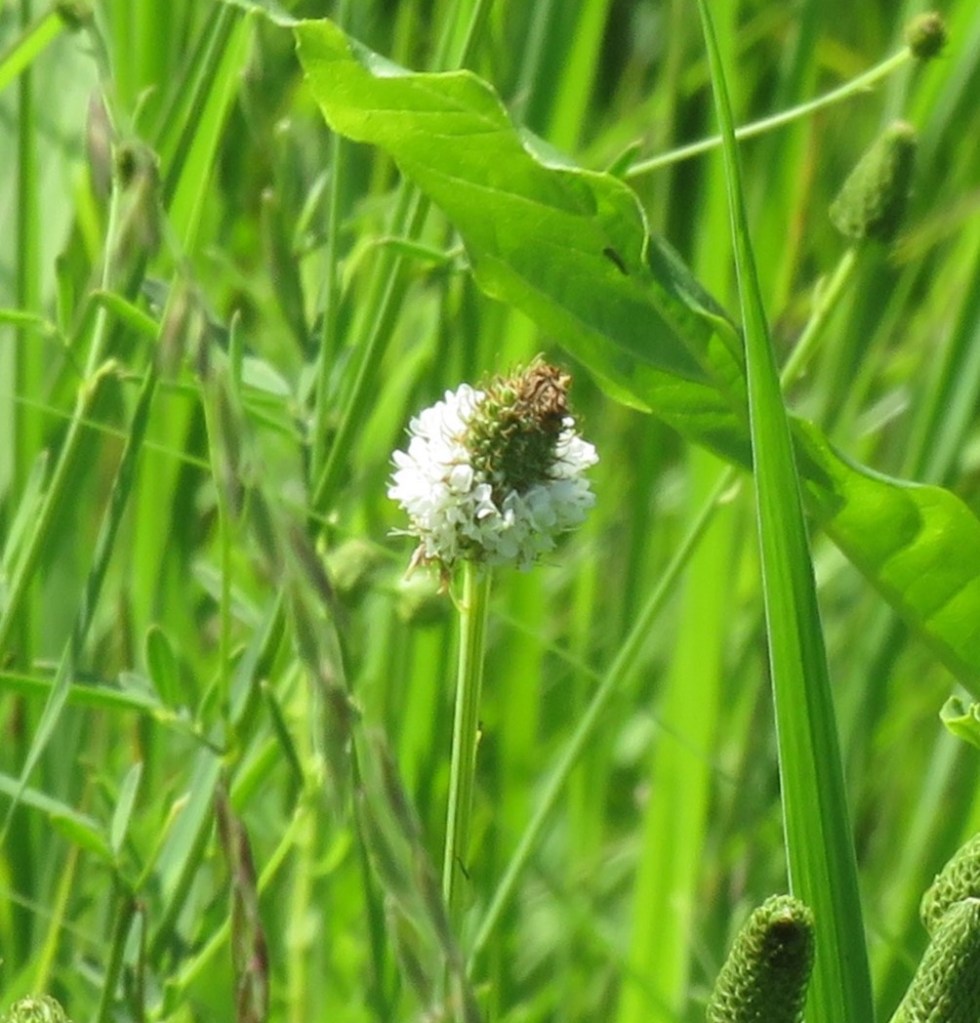
White Prairie Clover, Dalea candida, Whitewater State Park, MN. Photo by Danielle, July 2025.
I like words: biophilia, chipmunk, inflorescence, loosestrife, rattlesnake. I often encourage my students to think critically about definitions. Burrowing into the depths of chipmunk is the right intellectual path for someone out there. Defining “nature” is worthwhile brainwork for students. What are nature’s opposites? Where do humans fit in? Is the cactus you keep in your dorm room an example of nature? I’ve been casually reading a book by by Yasmine Ostendorft-Rodriguez: Let’s Become Fungal! (2023). It’s about how to live our lives through the lens of fungi and mycelium. I consider what it might mean to live my life through the lens of a flower. A pixie, dandelion haircut. Eyelashes like sepals. I don’t feel very green. What is my inflorescence? I’d wish for a structure the shape of a shell, carapace, roaring with the fires of Bowser, bursting in blossoms of butterfly weed.

 Danielle Dreams in Wildflowers
Leave a comment