I learned about bogs from two wise sources: poet Seamus Heaney and the instinctual memory of my ancient Danish ancestors. These wisdoms come together in Heaney’s “bog poems”: poems inspired by the eerily preserved bodies of ancient people “buried” in the peat bogs of Denmark. Although Heaney was famously Irish, he wrote several poems about the “bog bodies,” expressing how the bodies seemed to resonate with themes of history, violence, and memory.
We talked about Seamus Heaney in my undergraduate 20th century British Literature class. I picked up one of his books, Opened Ground: Poems 1966-1996 (1998), which I often read in my early twenties. One of his poems, “Song,” begins with the following line: “A rowan like a lipsticked girl”. It’s another one of my favorite lines; an unforgettable simile where the bright fruit of the rowan tree resembles a bold shade of lipstick. Heaney’s bog poems are haunting. Many of the bog people died by violence. In “The Tollund Man,” the bog body recovered after thousands of years has taken on the physical characteristics of the bog. The head of the body that lends its name to the poem–that of The Tolland Man–is on display today at the Silkeborg Museum in Denmark.

Big Bog Boardwalk, Big Bog State Recreation Area, MN. Photo by Danielle, July 2024.
According to the Oxford English Dictionary, a “bog” is a “piece of wet, spongy ground consisting chiefly of decayed or decaying moss and other vegetable matter; too soft to bear the weight of any heavy body upon its surface.” I often use forms of “bog” figuratively. I’m bogged down by stress. My students are bogged down by homework. Sometimes I’m even bogged down by my own ideas, growing out of control.
We’ve now lived in Minnesota for thirteen years, and we have some magical bogs here. In 2015, we discovered Big Bog State Recreation Area near Waskish. We spent a memorable night camping there, in a tent, during a mild thunderstorm. Big Bog is an awesome place, intense with life and remarkable flora. On our most recent visit in 2024, I photographed Fireweed, Chamaenerion angustifolium; Common evening-primrose, Oenotherabiennis; Purple pitcher plant, Serracenia purpurea; American White Water-lily, Nymphaea odorata; White Water Crowfoot, Ranunculus aquatilis.

American White Water-lily, Nymphaea odorata, Big Bog State Recreation Area, MN. Photo by Danielle, July 2024.
Another Minnesota place where bog dreams come true is Lake Bemidji State Park. About 90 minutes from our home, the park has been one of our favorite destinations since moving to Minnesota. We typically take the paved Paul Bunyan Trail from the main parking lot before turning off on a dirt path to Sundew Pond Overlook. The forest, as big as Paul Bunyan, gives shade to our hound on hot summer days. Birds flicker and sing in the treetops. A short boardwalk leads through the bog to the pond, named for carnivorous sundew (Drosera) plants.
At the end of June 2025, the park re-opened after sustaining major damage due to derecho winds on 21 June. Polk County experienced thunderstorms and high winds that same night. Parts of Bemidji saw devastation. We visited the park the weekend before the derecho. Our hound was a celebrity, greeting parkgoers and attracting attention. Other dogs trotted past, introducing themselves, touching noses. Our hound is always very alert to the rustle of Eastern Chipmunks. His ears perk up when he hears the call of a Blue Jay.
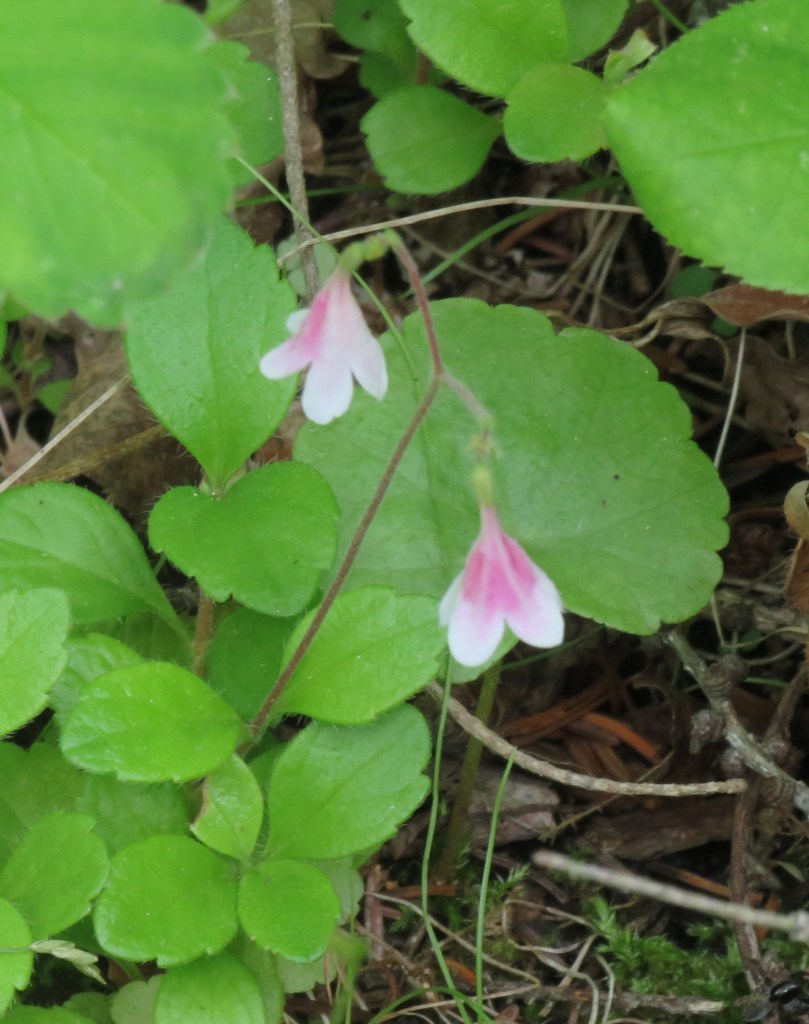
Twinflower, Linnaea borealis, Lake Bemidji State Park, MN. Photo by Danielle, June 2025.
The trail takes us through the forest. I see something new: it’s Twinflower, Linnaea borealis. I love the charmed aspects of small, bell-shaped flowers. The flower’s common name captures what makes it special: the duo of blossoms, twins, these in shades of pink and white. They dangle like pendants on an antique floor lamp.
Last year, after I started flowering, I was scrolling through old nature photos on my computer. For years, I’ve taken pictures of flowers and plants without thinking to identify them. In an old folder from a trip to Bemidji, I find a single photo of a Harebell, Campanula rotundifolia, one of my favorite flowers. I like the delicate stems and lavender blossoms. A forgotten photo of something lovely takes on new meaning: now it has a name. Recently, I saw the first few Harebells of my summer off a dirt road in Polk County. Since then, I’m seeing them everywhere.
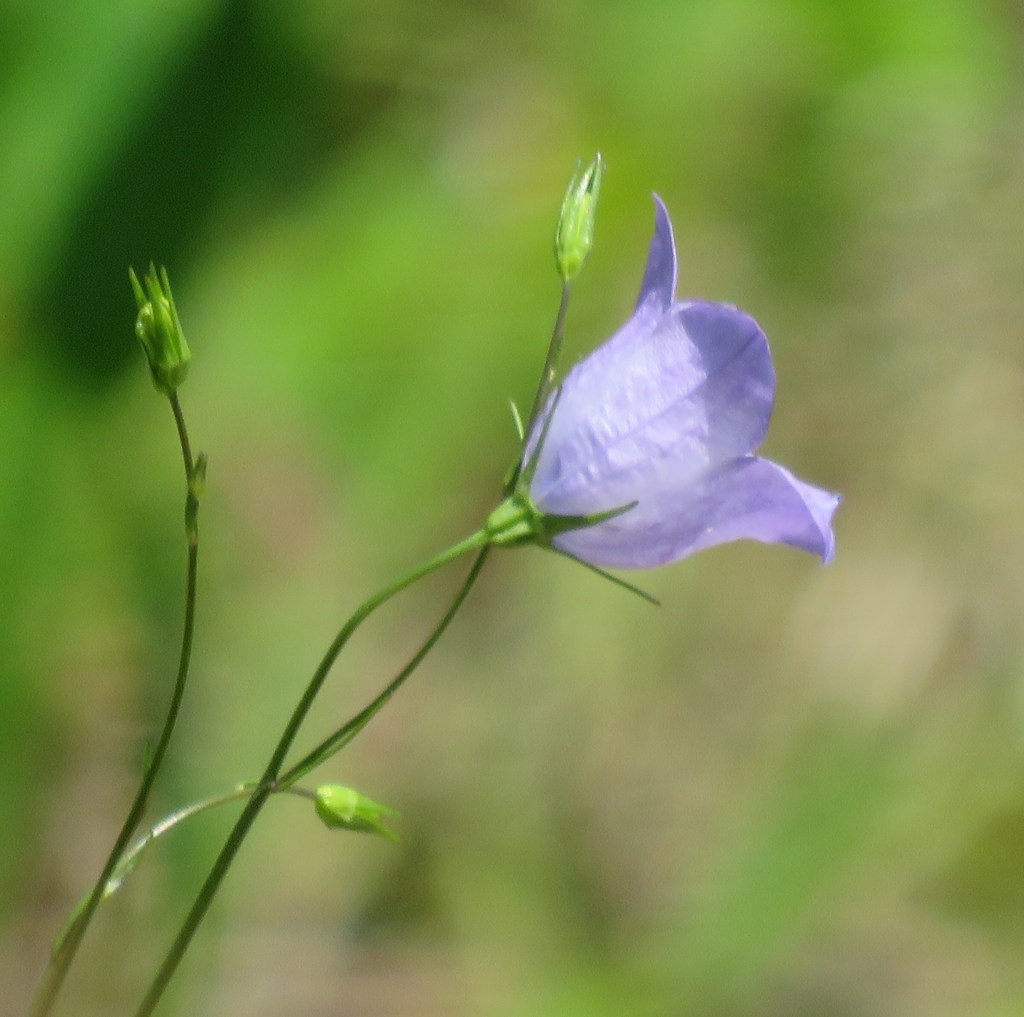
Harebell, Campanula rotundifolia, Polk County, MN. Photo by Danielle, June 2025.
The Sundew Pond boardwalk cuts through the bog. Each time we visit, the weather is hot. Humidity makes dewy sweat on my cheeks. I absorb sunrays. The bog plants are so unique. I remember the definition; the bog won’t support most humans. It takes time to see things. The spectacular blossoms of Purple Pitcher Plant, Sarracenia purpurea, emerge like crimson lollipops. Fat magics of color on sticks. The blooms are abundant, some nodding, on long, simple stems. These plants are dramatic, not only in appearance, but also in their carnivorous properties. The leaves of the plant form a cylindrical, natural vase where water collects. According to Minnesota Wildflowers, digestive enzymes mix with the water. Insects enter the water. Like Audrey II in Little Shop of Horrors, the plant then eats the insects.
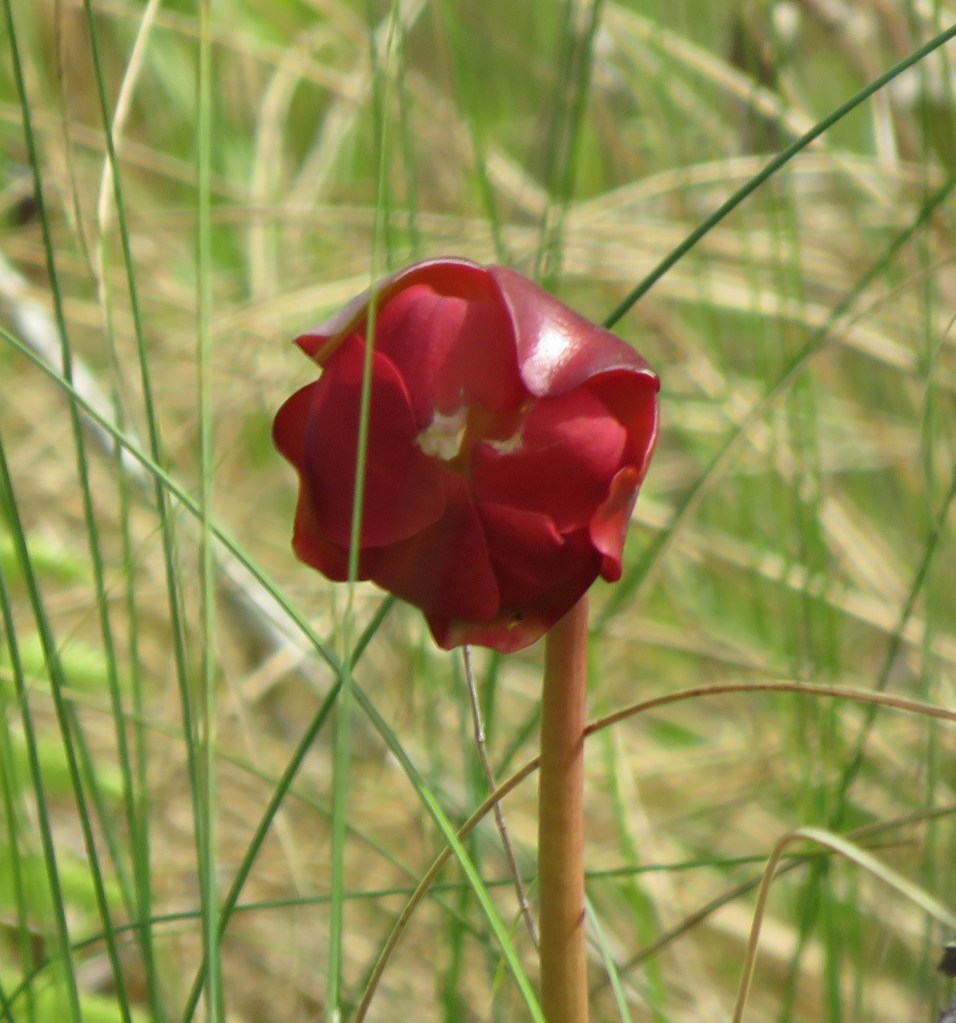
Purple Pitcher Plant, Sarracenia purpurea, Sundew Pond, Lake Bemidji State Park. Photo by Danielle, June 2025.
Wild things grow through the wooden planks of the boardwalk. I see something that looks like a rose bud, nearly in bloom. I notice its serrated leaves, outlined in raspberry. I’m grateful to see it. Later, I complete the discovery: Marsh Cinquefoil, Comarum palustre, part of the rose family. I won’t see it bloom this year, but we’ve been introduced, like possible friends. I remember the derecho, Spanish for “direct.” Nature’s example of “direct communication.” I often wonder about how the plants I see experience weather, like high winds and thunderstorms. I picture the Comarum palustre flowering full and in color, released from its roots and flying away in the straight-line winds. Like a lost balloon on a reddish green string.

Marsh Cinquefoil, Comarum palustre, Sundew Pond, Lake Bemidji State Park, MN. Photo by Danielle, June 2025.
I turn back on the boardwalk, toward the trail. There, to my right, I see two fuchsia flowers growing out from the bog. They’re orchids. I crouch, doing my best to position the camera for an acceptable picture. In my mind, I know it’s the “dragon” orchid, but I can’t recall the full name. The flowers are smaller than I would have imagined; I could have easily missed them. There’s a photo on the cover of my Orchids of the North Woods field guide (Risen & Risen, 2010). Named for a mythological Greek water nymph, it’s considered one of the most beautiful flowers in all of North America: the Dragon’s Mouth Orchid, Arethusa bulbosa. Wow.

Dragon’s Mouth Orchid, Arethusa bulbosa, Sundew Pond, Lake Bemidji State Park, MN. Photo by Danielle, July 2025.
Minnesota Wildflowers describes its color as “hot pink,” and I agree. Its shade is electric, like the chubby highlighter markers from the 1980s. I figured it might take years to find some of these flowers. Maybe even a lifetime. Risen & Risen (2010) explain that the Dragon’s Mouth “is considered rare over most of its range,” growing in bogs, fens, and sedge meadows (Orchids of the North Woods 28). The National Audubon Society’s Wildflowers of North America reports that “overcollecting” of the beautiful flower has contributed to decline, further noting that the plant is difficult to revive in the wild after disruption (65).
I’ve noticed a lot of my flower books comparing flowers to gemstones. Risen & Risen describe the Dragon’s Mouth as an “exotic looking jewel” (28). We often look for gemstones and gold in the ground: those deep places, below the surface, where things exist, living and dead. Even the lifeless things remain. Like the mummified head of the Tollund Man, the thriving Dragon’s Mouth Orchid rises up from the bog in shocking silence. Like artwork, and paper, and books, flowers are taking up space in my mind.
The bogs of Minnesota are far from the bogs of Denmark featured in Heaney’s poems. I imagine writing a story. The heroine travels to Denmark, to observe the Tollund Man on display in Silkeborg. She strolls past the exhibit and sees a single Arethusa bulbosa sprouting from the Man’s head. Raising her camera to take a picture, she hears the wind growing stronger outside the Museum. A siren sounds in the distance. The flower comes into focus and then disappears. The heroine walks back to her hotel alone, against the winds of a thunderstorm, thinking she must have imagined the flower growing up from the Tollund Man’s head. In the morning she wakes to find it, perfect and dried, in an envelope under her hotel door. The envelope smells of the boggy perfumes of summer in Minnesota.
 Danielle Dreams in Wildflowers
Leave a comment