We spend a few days on the Bayfield Peninsula across from the North Shore on Lake Superior. We’ve been here before, near the Apostle Islands National Lakeshore and Chequamegon Bay. An exceptional place in this region is Chequamegon Books, a truly incredible bookstore in Washburn, WI. We discovered Chequamegon Books in 2019, while staying in Ashland. Bookshelves reach the ceiling. Staircases lead to vintage Beat literature and rows of eclectic books on literary criticism. We made two trips to the store in 2019. I found some nerdy treasures: Richard Brautigan books, old copies of City Lights Journal, a scholarly book about vampires with one of the coolest book jackets I’ve ever seen.
On this trip, we’re staying in Cornucopia. “Corny” is a tiny town of about 100 people, right on Siskiwit Bay of Lake Superior. Directly across the lake, on the Minnesota side, lies Two Harbors. There’s not much cell phone service in Corny. The fresh whitefish sandwiches are cheap and delicious. We’ve been sucked into the horn of the cornucopia, and it’s a delightful place. Our hound loves running along the sandy shores of Cornucopia Beach. His ears blow back in the sea breeze. I take a few pictures of American Beachgrass, Ammophila breviligulata.

American Beachgrass, Ammophila breviligulata, along Lake Superior, Cornucopia Beach, Wisconsin. Photo by Danielle, June 2025.
This stretch of Wisconsin lakeshore features more sandy beaches than the stretch along Highway 61 in northern Minnesota. The Minnesota Department of Natural Resources Rare Species Guide lists American Beachgrass as “threatened” in Minnesota. Only a sandbar near Duluth, Minnesota Point, features the dune environment necessary for growth of Ammophila breviligulata. The sandy beaches of Wisconsin remind me of the Pacific Ocean. I take off my shoes and bury my feet, then wade into the lake up to my ankles. I’m so adventurous.
Nearby Meyers Beach on the Apostle Islands National Lakeshore offers views of the islands and sea caves. This is one of the better places to see the sea caves from land. The National Parks Service website reports that sometimes, in the dead of winter, people can walk across the frozen lake from Meyers Beach to the sea caves. A few years ago, we took a ferry from Bayfield to Madeline Island. The area is rich in indigenous and fur trading history. Today, tourists zoom around the Madeline Island on mopeds and visit Big Bay State Park. I read about the Apostle Islands sea caves, a popular destination for kayakers. A Historic Resource Study of the region by Jane C. Busch Ph.D. explains that evidence of Paleo-Indian peoples present in the Chequamegon region around the Islands and Bayfield dates to c. 11,000 B.C.E.
I find an eccentric mix of flowers throughout the peninsula. I photograph escaped garden plants, colorful invasive species, and hundreds of Large-leaved lupine, Lupinus polyphyllus, in a spectrum of ombre shades ranging from white to pink to purple to indigo. I’ve learned a lot about lupine. Wild Lupine, Lupenis perennis, is native to the Lake Superior region. Flowers of Wild Lupine appear in shades of blue. Large-leaved Lupine, Lupinus polyphyllus, is an invasive species. This means the plants are not native to the area where they’re growing. Many times, the non-native plants absorb resources needed by native plants, threatening the native plants. Large-leaved Lupine is larger and taller than Wild Lupine and appears in a range of colors. Most of the enchanting plants growing along the Lake Superior shores are invasive Large-leaved Lupine.
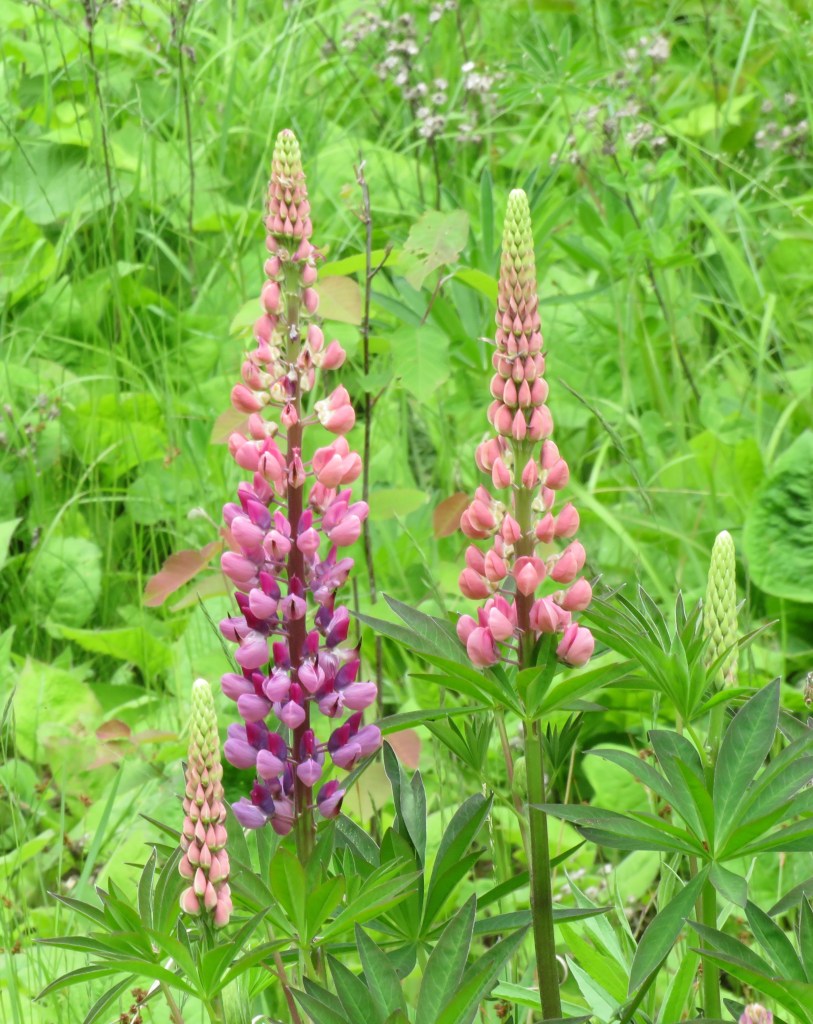
Large-leaved Lupine (invasive), Lupinus polyphyllus, Bayfield County, WI. Photo by Danielle, June 2025.
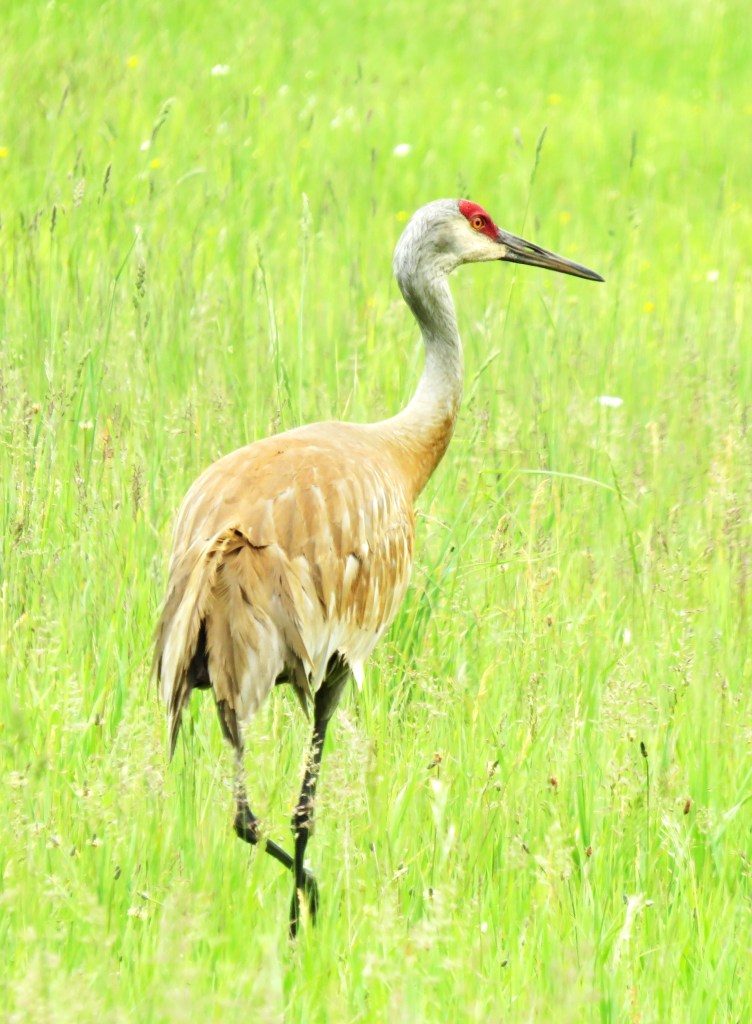
Sandhill Crane, Bayfield County, WI. Photo by Danielle, June 2025.
In the woods near Lost Creek Bog State Natural Area, we find more Pink Lady’s Slippers and Yellow Pond-lilies. A pair of Sandhill Cranes stroll through a meadow. On a bog boardwalk near Russell, I spot Ohio Spiderwort, Tradescantia ohiensis. Most of my flower resources use photos of blue Ohio Spiderwort flowers. Reading more, I find out that this plant can flower in pink, but that it’s unlikely to be growing naturally in this part of Wisconsin. I wonder if these are cultivated.
Back in Corny, I see an explosion of Siberian Chives, Allium nutans, overtaking a backyard clothesline. At first, they look like thistle. I find myself overwhelmed by the many varieties of thistle. But my photographs of the Chives reveal a big cluster of flowers with six striped petals each, forming the dome. Even from a short distance, the Chives look like pom-poms, happy on leafless stems. With the perfect variegated yarn and some basic floral supplies, I could make some Chives in my craft room.
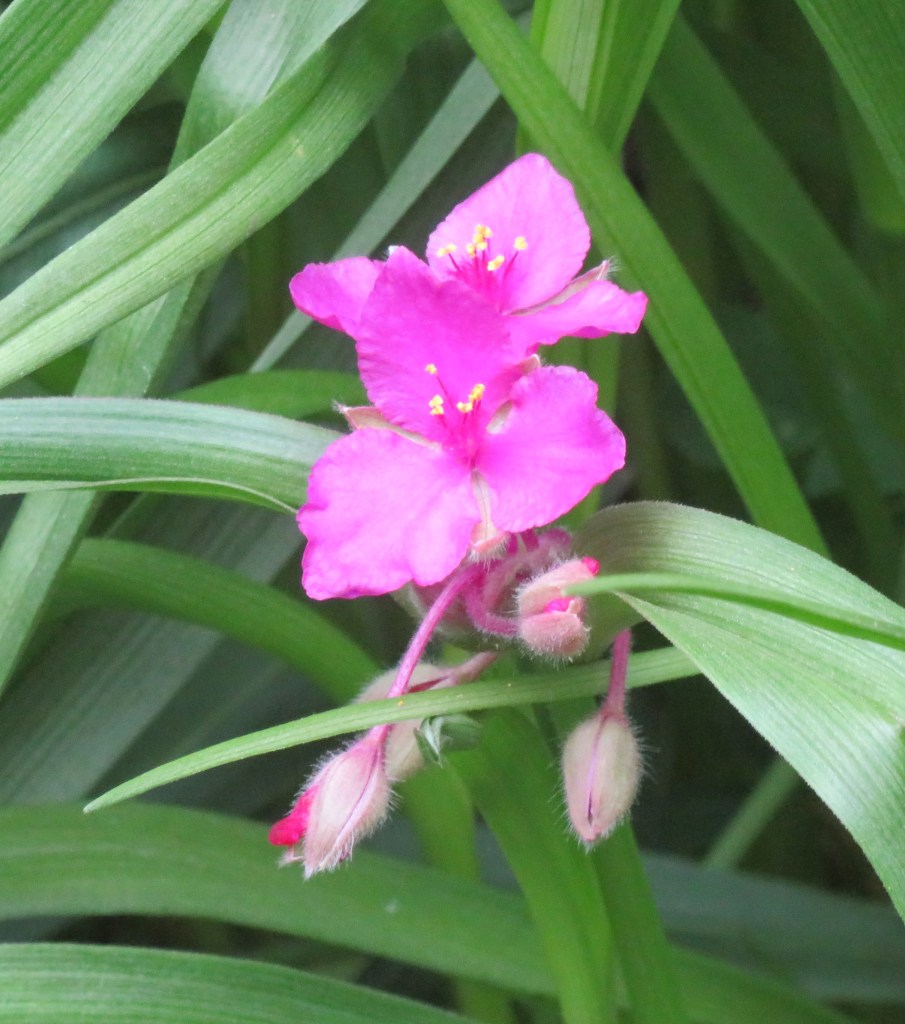
Ohio Spiderwort, possibly cultivated, Tradescantia ohiensis, Bayfield County, WI. Photo by Danielle, June 2025.

Siberian Chives, Allium nutans, Cornucopia, WI. Photo by Danielle, June 2025.
Most of the things I’m drawn to in life are curiosities. If I discover a topic or thing of fascination, I’m often obsessed. I encourage my students to research and write about truly interesting things–the most unexpected topics and research questions usually yield standout results. I’m learning a lot out here, flowering. Hundreds more plants live on my camera. Some are too blurry to publish. Others’ identities escape me. So many yellow flowers are some kind of goldenrod. I worry I might misidentify something. Or worse, fall in love with a horrible weed.
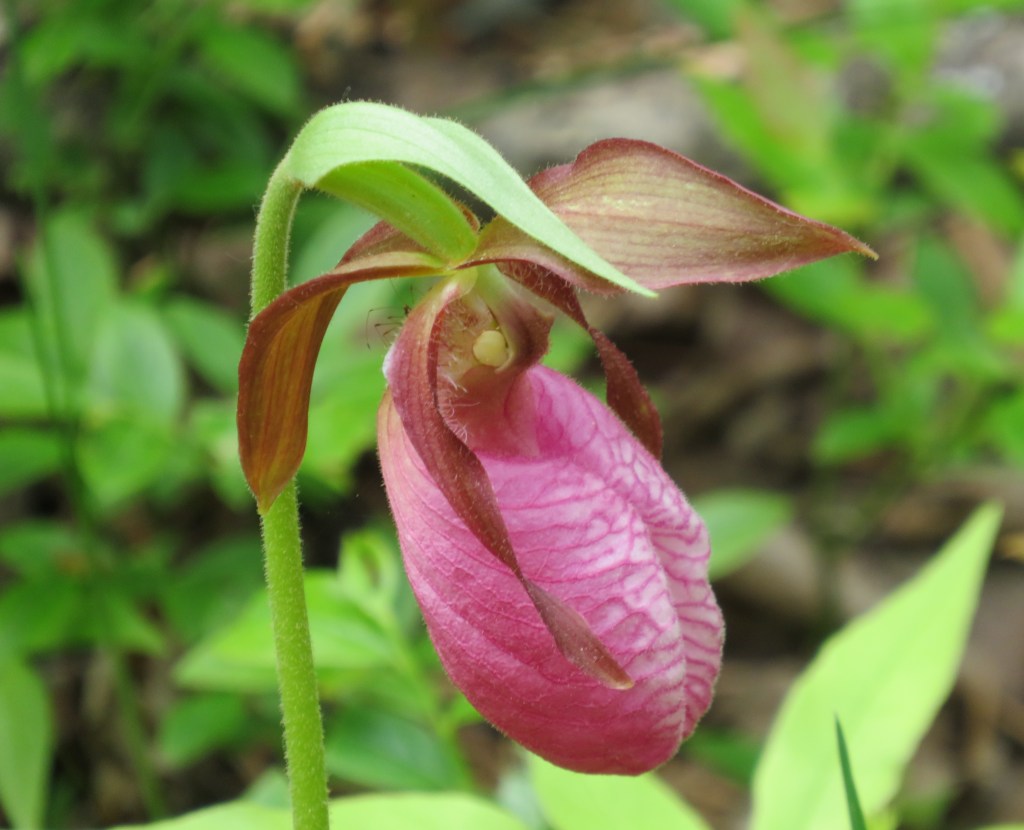
Pink Lady’s Slipper, Cypripedium acaule, Bayfield County, WI. Photo by Danielle, June 2025.
Every time I learn a new flower feels like finishing a book or discovering a new vocabulary word. I remember discovering the word acquiesce as a teenager. I liked the sound of the word and tried to use it in sentences. On this visit to Chequamegon Books, I find The History and Folklore of North American Wildflowers by Timothy Coffey. There’s an entry on spiderwort and a simple illustration. The book says “Spiderwort” takes its name from how the plant’s leaves resemble a spider, or from the way the sap oozes in ways that resemble a spider’s web (292).
I picked up a stack of Loren Eiseley paperbacks at Chequamegon Books. In The Unexpected Universe, he talks about spiders and they way they represent humans “in miniature.” Of humans, Eiseley writes, “Knowledge has given him the memory of earth’s history beyond the time of his emergence” (53). This sentence captures my love of learning. Knowing a book, or a word, or a flower, or the history of the sand along Lake Superior adds intricacies to my personal web. I remember the words E.B. White’s spider used to describe her pig buddy Wilbur in Charlotte’s Web (1952): “some pig,”; “terrific”; “radiant”; “humble.” I wonder what spiders live on the islands and sea caves. The caves might smell musty, not unpleasant. A damp, woody whiff like the pages of a used book, pulled from the shelf, in bloom.
 Danielle Dreams in Wildflowers
Leave a comment