In myths and legends of the Great Lakes, fog looms. The stories of Lake Superior are deep and often mysterious, with tales of ghost ships conjuring images of disappeared vessels coming “back from the dead.” A well-known ghost ship legend is based on a true story. In November 1902, the SS Bannockburn vanished on Lake Superior in snowy conditions. Neither the wreck nor any bodies were found. Stories emerged, claiming the ghost of the ship would appear on the lake in foggy conditions.
My favorite ship from literature is the Pequod from Melville’s Moby-Dick (1851). Nathaniel Philbrick’s nonfiction book, In the Heart of the Sea (2000), tells the incredible story of the whaleship Essex; the story of the Essex likely inspired some of Melville’s tale. I imagine the Pequod as a whispery ghost ship, emerging from the fog. An ephemeral Starbuck moaning and pacing along the deck. Calling out for Stubb and Captain Ahab. It’s haunting: the stuff of nightmares.

Fog over Lake Superior near Lutsen, MN. Photo by Danielle, June 2025.
In June, fog is common on Lake Superior. The National Weather Service reports that “lake fog” or “sea fog” is a type of fog present over water, including the oceans and Great Lakes. The fog sneaks inland, making it hard to see. In fog, we sometimes get lost or disoriented. In college, I’d often drive back to Huron, South Dakota mid-week to attend my brother’s basketball games. I’d spend the night at home and get up early the next morning to make the 75-minute drive back to Brookings in time for my 8am British Literature class. Most of those mornings were foggy. I’d drink my gas station cappuccino, watching the dashboard clock, wondering if I’d make it in time for the Beowulf lecture. I knew the highway well and never took any chances.
Last week, we went for a walk in the Superior National Forest near Lutsen, MN. I’ve visited this place before, but never for flowering. That’s how I’ve started to think about going out looking for flowers: I’m flowering. We walk in a foggy mist. Plants feature fresh rain drops. My husband says our hound has something to show me. We take a dirt path through the forest. I’m surrounded by wildflowers.

Northern Bluebells, Mertensia paniculata, Cook County, MN. Photo by Danielle, June 2025.

Starflower, Lysimachia borealis, Cook County, MN. Photo by Danielle, June 2025.
The blossoms are lovely and bathed in raindrops. Northern Bluebells, Mertensia paniculata, chime in my favorite jewel-tones. At first, they look like Creeping Bellflower, Campanula rapunculoides, an attractive but invasive species I’ve photographed before. But these bells on the North Shore are smaller and hang down from the stem in bunches rather than creeping along one side.
Some of the Northern Bluebells bud in fuchsia, but most are a rich shade of indigo. The dark sepals remind me of birds’ feet. Sandra Kynes explains the legends linked to bluebells and the presence of fairies and magic (49). I’m overjoyed to see Starflower, Lysimachia borealis. I’ve always loved stars. These stars are small and difficult to photograph, but they’re everywhere, twinkling among the Bunchberry and Wild Strawberry. I like the symmetry of the petals. Canada Mayflower, Maianthemum canadense, blossoms are star-shaped too. The soles of my showy sneakers are dirty. I’m seeing stars everywhere.
My husband stops and nods toward something on the hillside. “There’s two of them,” he says. I see the a pair of fabulous lady’s slippers, Cypripedium acaule, Pink Lady’s Slipper. Also known as the Stemless Lady’s Slipper or Moccasin Flower, this type of orchid features a dramatic labellum where bees enter through a slit in the front. According to the North American Orchid Conservation Center, the flower pouch traps the bee, forcing it to escape through an act that might lead to pollination. I imagine climbing the stem and crawling into the flower. It might feel homey, like our hound’s velvety ear flaps.
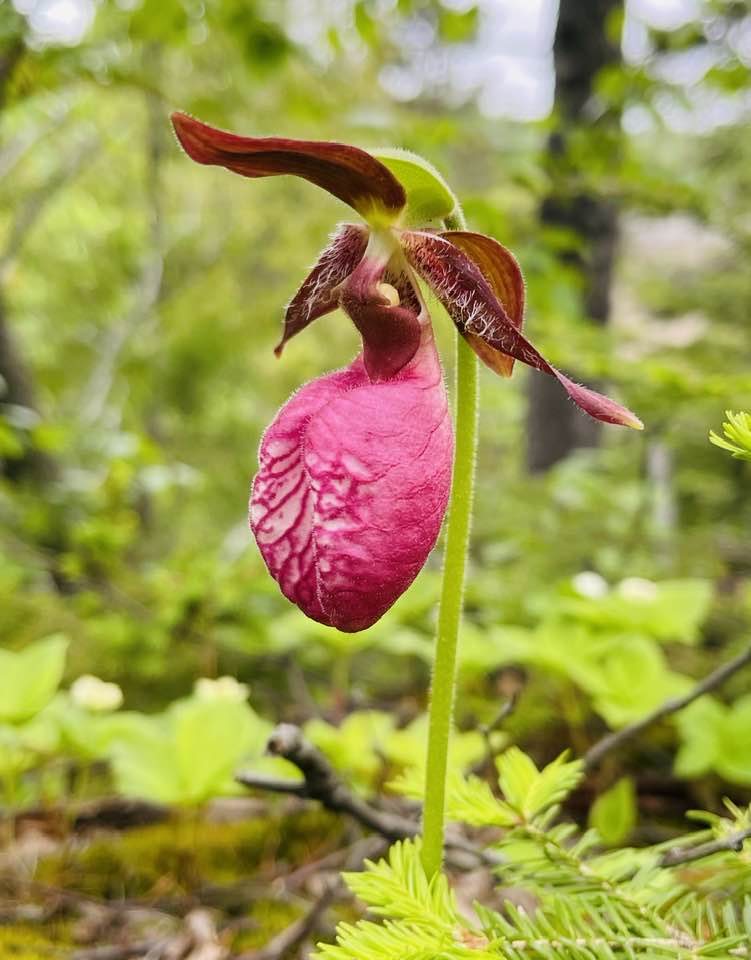
Pink Lady’s Slipper, Cypripedium acaule, Cook County, MN. Photo by Danielle, 2025.
The raspberry color strikes me. One of my favorite poems is Ezra Pound’s “In a Station of the Metro” (1913): “The apparition of these faces in the crowd:/Petals on a wet, black bough.” Two simple lines stay with me forever. I’ve always pictured those petals in some intense shade of rose, against a dark tree. The hue of the Moccasin Flower pretty much captures it. One year ago, I would have declined a chance to go flowering deep in the woods. The thought of seeing a snake overcomes me. I’d stay in the car, or take a few steps into the woods only to retreat to my comfort zone. Maybe a bench in the parking lot, where I might see a cool bird perch on the lid of a trash can. But out in the woods, Ezra Pound’s petals come to life. I’m face-to-face with the hue I’ve always imagined.
On the way back to the trailhead, I see one of my current favorites, Wild Sarsaparilla, Aralia nudicaulis, thriving along the path. There’s nothing dramatic about this plant. I see peace and serenity. The three space-age chandelier clusters chill under their leaf canopy. The zen-like leaves and flowers emit a harmonious energy. The stems have no leaves except for the big ones shading the flowers. I’d like to curl up next to one of the clusters, reading a book and drinking a root beer slush.
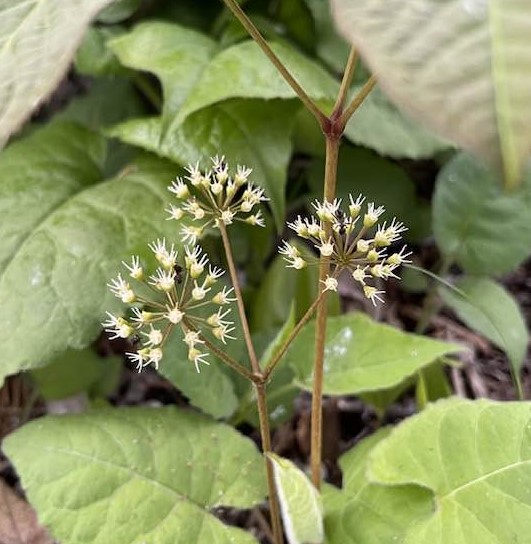
Wild Sarsaparilla, Aralia nudicaulis, Cook County, MN. Photo by Danielle, June 2025.

Old tree trunk, Cook County, MN. Photo by Danielle, June 2025.
I stop to look at the trunk of an old, dead tree. The tree has a face and it’s staring at me. I see two eyes, a wavy mouth, and a hollow place for a nose like a skeleton. I get closer. Now one of the bulging eyes looks like a head. The wavy mouth face seems gentle and funny, like Groot, with a jagged haircut. The little heads that protrude from the eye sockets look more disturbing. Like friends of the tormented figure in Edvard Munch’s 1893 painting The Scream. A red squirrel barks. I take a few pictures.
Sometimes, on those tired mornings piloting my white Monte Carlo through the fog back to school, I’d see things. A deer on the highway. A time-traveling car with no headlights. A groggy raccoon. Last night, I had a dream. A stranger at a surreal dinner gathering asked me if I knew the book Henderson the Rain King (1959) by Saul Bellow. I’ve never read the book, but I love the Counting Crows song “Rain King.” Hearing it transports me back to those thick fog mornings driving east on Highway 14. The acoustic version of “Rain King” lifted me to a serene place I now see in Wild Sarsaparilla. I would listen to it in my lofted twin bed, counting sheep, trying to access a star from which I could dream.
I tell no one about the tree with the faces. Not everyone sees the ghost ships. The tree hasn’t frightened me, but I will remember it. Memories seem to have souls of their own, whatever that means. Later, I click through the photographs on my camera. The tiny hairs on the Moccasin Flower come through in spectacular detail. I have a warm blanket and a strawberry slush. Tonight I’ll imagine driving the old Monte Carlo, my late 90s tunes murmuring out from the dashboard. I fall asleep at the wheel, counting Bunchberry.

 Danielle Dreams in Wildflowers
Leave a comment