The North Shore of Lake Superior is as old as the Earth itself. In their incredible book North Shore: A Natural History of Minnesota’s Superior Coast (2015), Chel Anderson and Adelheid Fischer write that the rocky north shore of Lake Superior, part of the Canadian Shield, is around 2.5 billion years old (3-4). The rocks embody earthliness. The North Shore is a wild and wonderous place. Among the many ecological jewels of Minnesota, the edge of Lake Superior is rich and precious.
The Minnesota length of the shore runs from Duluth to the Canadian border at Grand Portage. High Falls, at Grand Portage State Park, is the tallest waterfall in Minnesota, roaring down from the Pigeon River right at the Canadian border. We recently visited Grand Portage State Park while spending some time near Lutsen, MN. The weather around the lake the Ojibwe call “gitchi-gami” was cool with clouds and some light rain. Fog puffed through the streets of the little shore towns. At times, the inland sea blended with the sky above, erasing the horizon. I feel good in cloudy weather. I sometimes wear a necklace with a tiny dark cloud and a thunderbolt.

Yellow Pond-lily, Nuphar variegata, Grand Portage State Park, MN. Photo by Danielle, June 2025.
Grand Portage feels like an ancient place. A couple of years ago, I taught a class on ancient literature from around the world. Ancient literature is not my area of expertise, and I studied a lot of history while preparing to teach the class. Having a sense of the grand historical timeline puts a lot of things in perspective. The earliest forms of human writing, cuneiform and Egyptian hieroglyphics, emerged around 3,500 B.C. Writing is relatively new on the timeline of life on Earth. The Minnesota State Archeologist reports that people have lived in present-day Minnesota for more than 12,000 years.
Plants have lived here for hundreds of millions of years. Ferns are among the oldest plants on Earth. I look for a few common ferns as we walk through the mixed hardwood-conifer forest. The floor layer plants glisten with raindrops; I’m happy in my ruffled black rain coat. A Ruffed Grouse hangs out on a log, blending in with the tree trunks. Our hound scares up a Pileated Woodpecker.
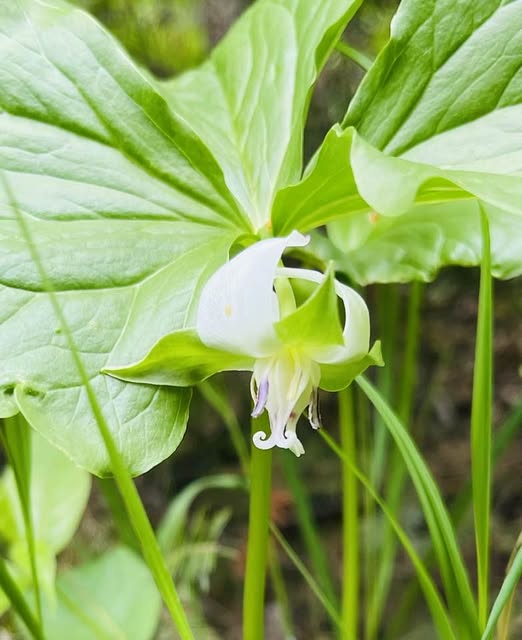
Nodding Trillium, Trillium cernuum, Grand Portage State Park, MN. Photo by Danielle, June 2025.
I’m so lucky: I see Nodding Trillium, Trillium cernuum. The flower has lily-like qualities, with its petals turned back, exposing six stamens, each with a purple anther. I love everything about this flower. Its delicate colors. The lettuce-y leaves that shade and conceal the blossom. The way the blossom expresses itself.
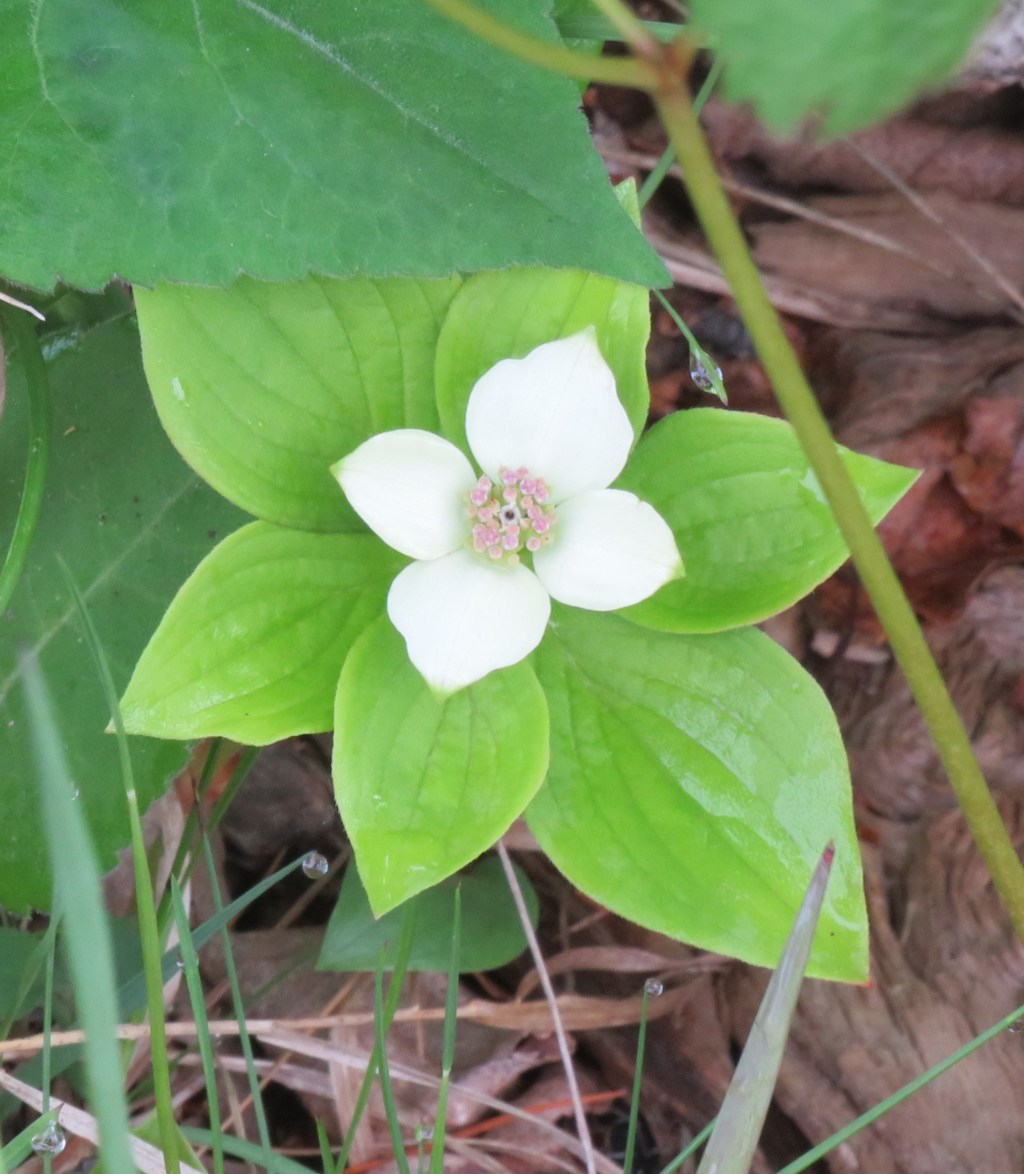
The forest floor is thick with thousands of Bunchberry, Cornus canadensis, and Bluebead lilies, Clintonia borealis. The word “borealis” is Latin for “northern.” I appreciate the simple beauty of Canada Mayflower, Maianthemum canadense, another member of the lily family. I notice something that looks like Lily of the Valley, but the flowers look airbrushed with speckles of pink. Like the Nodding Trillium, the petals curl back toward the stem. Also known as Rosybells, Rose Twisted-stalk, Streptopus lanceolatus, grows in the shady, moist woods. So many flowers remind me of lampshades. I imagine a pendant light with a Rose Twisted-stalk shade, suspended above the blue wingback chair in my bedroom.

Bunchberry, Cornus canadensis, Cook County, MN. Photo by Danielle, June 2025.
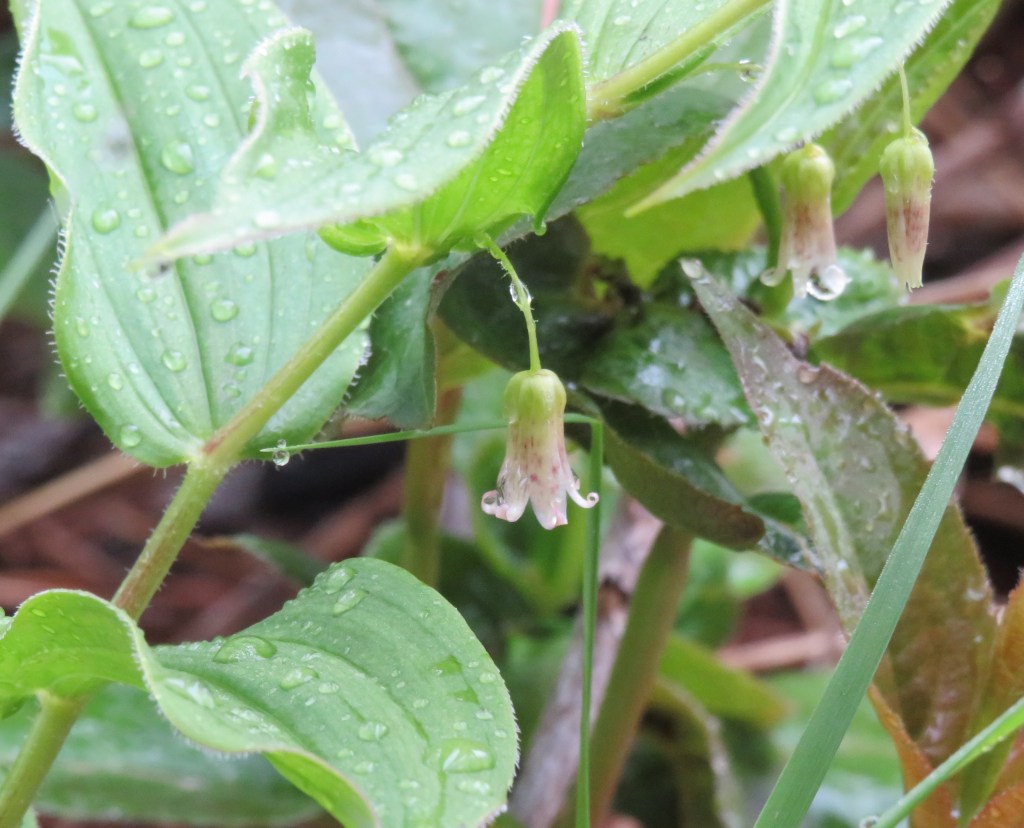
Rose Twisted-stalk, Streptopus lanceolatus, Grand Portage State Park, MN. Photo by Danielle, June 2025.
We reach High Falls and feel the mist on our faces. The Falls are spectacular–perhaps second only to Yellowstone Falls in my catalogue of waterfall memories. The Pigeon River showers over the cliffs here at the international border, and the 8.5 mile “grand portage” served as a terrestrial passageway for hunters and traders, but also for the Anishinaabe Ojibwe people thousands of years ago. They needed a way to bypass the Falls. I find this neat historical study by Alan R. Woolworth. On page 3 of the study, clearly written with a typewriter, Woolworth discusses a portage trail as an example of how a landscape results from interactions between humans and their environments. For thousands of years, people have passed through this place and paused here to consider the Falls.
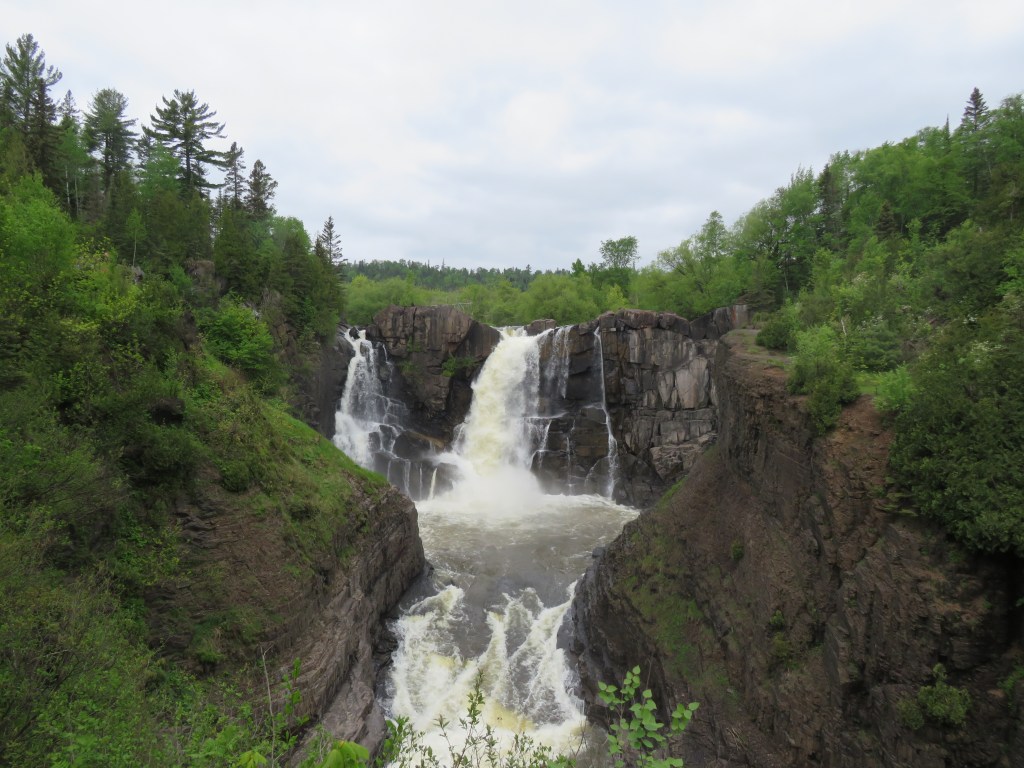
High Falls, Grand Portage State Park, MN. Photo by Danielle, June 2025.
Incredibly, I have portaged. The summer before seventh grade, I went with my aunt, uncle, brother, and cousin to a remote Canadian cabin on Willard Lake, Ontario. We spent a week fishing, at times portaging the boats small distances from one small lake to another. It was a serious wilderness experience for me as a tentative nature enthusiast.
Some of my favorite myths about waterfalls represent waterfalls as portals to different realms or spiritual worlds. The space behind the falls is often one of mystery, protection, or magic. The chaotic, reliable water rumble is a comforting sound for many of us. A powerful waterfall epitomizes the sublime: awe-inspiring beauty synthesizes the overwhelming power of nature.
Driving through the Columbia River Gorge in 2022, from Hood River to Portland, Oregon, we saw many elegant falls shower down from the forest and into the canyon. But those falls were distant. Feeling the vapor condense on my cheeks seems to mean something. Last week, I saw the shape of a Sperm Whale in clouds just south of our town in Polk County. I think about what Joni Mitchell said about “cloud illusions.” Being among the Bunchberry and Rose Twisted-stalk, getting lost in the clouds, I’m daydreaming.

Bluebead, Clintonia borealis, Cook County, MN. Photo by Danielle, June 2025.

Strawberry Moon over Lake Superior, Lutsen, MN. Photo by Danielle, June 2025.
I stop in the Visitors’ Center to buy a sticker and patch for our hound. He’s collecting mementos from all the Minnesota state parks he’s visited. I’m proud of myself for climbing the rocks of the North Shore. I feel far from home here. But I’m still in Minnesota. Later that night, near Lutsen, I go out to see the Strawberry Moon over Lake Superior. My camera has always captured the near side of the Moon in remarkable detail. I’ve never been to the Moon, but I know it’s a silent, lifeless place. I think about Wild Strawberry, Fragaria vesca, and the reclusive Ruffed Grouse from earlier. The clouds dissipated. Maybe he’s drumming his wings in the strawberry moonlight.
 Danielle Dreams in Wildflowers
Leave a comment