Wild roses are blooming. I believe there are four native wild roses found in Minnesota: Smooth Wild Rose (Rosa blanda); Prairie Rose (Rosa arkansana); Prickly Wild Rose (Rosa acicularis); and Wood’s Wild Rose (Rosa woodsii). Last July, I photographed some gorgeous wild roses along a dirt road not far from our house. At first, I thought they were Prairie Roses. But now I’m not sure.
My National Audubon Society Wildflowers of North America book doesn’t have much information on the dirt road roses. The roses section includes a lot of surprises. Wild strawberries come from the rose family. I learn about nettles and bog hemp.

Wild rose, perhaps Smooth Wild Rose, Rosa blanda, Polk County, MN. Photo by Danielle, July 2024.
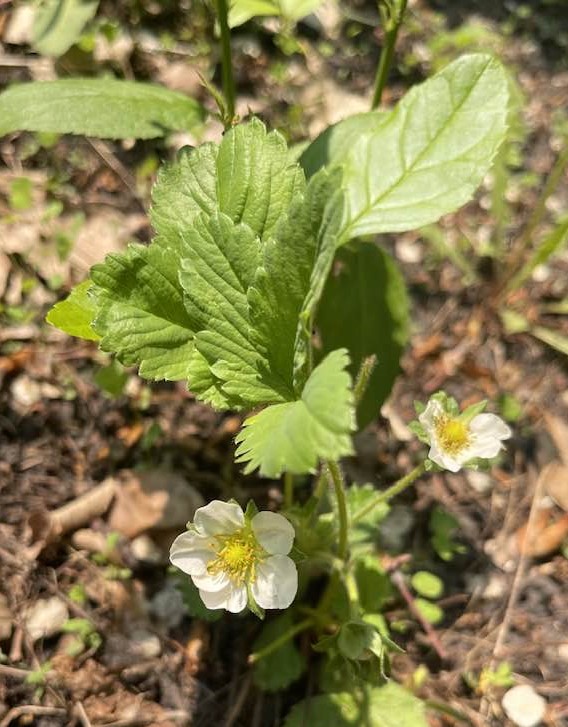
Wild Strawberry, Fragaria virginiana, Polk County, MN. Photo by Danielle, May 2025.
Three of the four rose varieties grow in Polk County, and the fourth, Prickly Wild Rose, grows in a neighboring county. A few days ago, I noticed a few blooms in the grass along Highway 75, like friends returning home after being away for the winter. I find more, in faint shades of pink. Some grow in bushes. Others seem more isolated, closer to the ground.
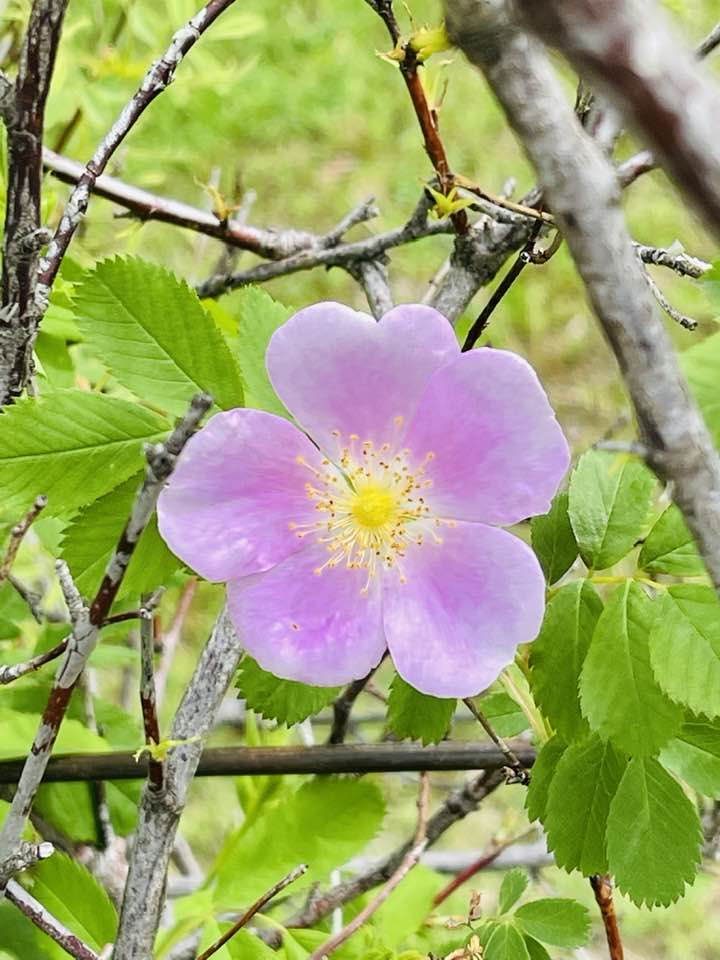
Wild rose, perhaps Smooth Wild Rose, Rosa blanda, Polk County, MN. Photo by Danielle, June 2025.
I reach for another book, The World Encyclopedia of Wild Flowers & Flora (Lavelle & Walters, 2020). It features an entry on Swamp Rose, Rosa palustris, which also grows in Minnesota: “Swamp rose forms a small hummocky bush in wet areas. It has many arching branches” (286). “Hummocky” is a word I’ve never seen before. I find myself browsing the online Oxford English Dictionary. I do my best to excite my students about the OED. They can use the OED when they want to impress people! It’s hard to top the specificity of the OED: “A protuberance or boss of earth, rock, etc., usually conical or dome-shaped, rising above the general level of a surface; a low hillock or knoll.” The definition reads like a poem written by a geologist.
I ask OED about “rose.” Flowers of Rosa are large–often colorful, of many petals, and pleasantly fragrant. Five petals adorn wild roses. I’ve noticed that around here.

Wild rose, perhaps Prairie Rose, Rosa arkansana, Polk County, MN. Photo by Danielle, June 2025.
When I think about Shakespeare’s roses, I picture the long-stemmed mystery of tightly wrapped, infinite petals bestowed upon a lover on Valentine’s Day. The American Shakespeare Center reports that Shakespeare likely gained his knowledge of plants from his own “flower books,” as more information on various topics of interest was becoming increasingly accessible.
Writers seem to love roses. Roses thrive in literature from around the world. One of my favorite writers for her innovative and perplexing uses of language is Gertrude Stein, American author and friend of Pablo Picasso. In “Sacred Emily” (1913), Stein famously writes, “Rose is a rose is a rose is a rose.” Gertrude’s work is nothing like Shakespeare’s. But she too writes of branches, and apples, and pears. And cauliflower. And berries.

Wild rose bud, perhaps Smooth Wild Rose, Rosa blanda, Polk County, MN. Photo by Danielle, June 2025.
The roses on the dirt road have me thinking new things. In one line from “Sacred Emily,” Stein simply writes, “A very reasonable berry.” I wonder, what berry is reasonable? I have a poster of Gertrude up in my office. She looks intimidating and serious. The poster is from a portrait of Gertrude made by Picasso. The Met says he painted her during his “Rose Period.”
I haven’t reflected on Gertrude Stein in years. Have I ever truly reflected on roses? They’re one of my favorite wildflowers. I want to roll the tip of a wild rose bud onto my lips like lipstick. They’re out there tonight, whipping around in the thunderstorm. I turn the page in my flower book, perusing the Cucumber family. A quick flash of lightning lights up the birdfeeder. I imagine Shakespeare, dreaming in wildflowers.
 Danielle Dreams in Wildflowers
Leave a comment