We spent Memorial Day weekend in Minneapolis. A few years ago, I started reading more about the history of Minnesota. We live about 90 miles from the headwaters of the Mississippi River, which trickles out from Lake Itasca near Park Rapids, MN. By the time it reaches Minneapolis, the Mississippi has widened, spilling over St. Anthony Falls, the only natural waterfall on the river. Most trips I’ve made to the Twin Cities have been during the summer. As kids, my brother and I rode The Wave and The Corkscrew at Valley Fair near Shakopee. The deluge from The Wave cooled us off on hot days of vacation. Sometimes my husband and I go to Twins games, eating ice cream from little bowls shaped like batting helmets. By night, we dream of Prince and Kirby Puckett.
We take our hound to Minnehaha Park. It’s my first time at the park and I’m looking for flowers. The park’s main attraction is Minnehaha Falls, a waterfall of some renown that inspired Henry Wadsworth Longfellow‘s 1855 poem “The Song of Hiawatha.” The lengthy poem references many aspects of indigenous culture and history from the Lake Superior region. The title character, Hiawatha, falls in love with a woman named Minnehaha. In Dakota, “Minnehaha” means “waterfall.”

Minnehaha Falls, Minneapolis, MN. Photo by Danielle, May 2025.
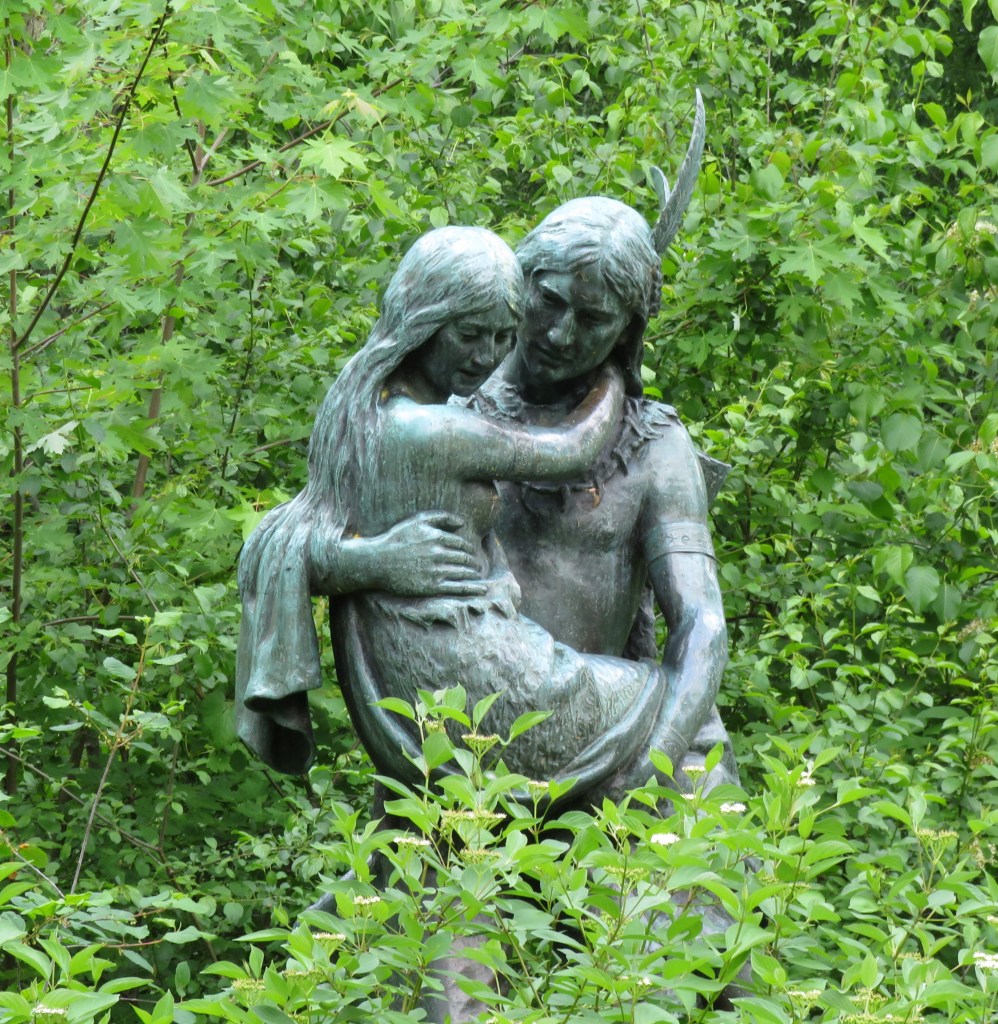
Hiawatha and Minnehaha by sculptor Jacob Fjelde, originally created for the 1893 World’s Fair in Chicago. The sculpture was later cast in bronze and displayed at Minnehaha Park, near the Falls, where it has been since 1912. Photo by Danielle, May 2025.
I see a few flowers near the water at the base of the falls, not far from the statue of Hiawatha and Minnehaha. I always notice the colors first. These flowers remind me of butter: the faintest shade of yellow. I count five perfect petals circling a cluster of stamens. Stamens remind me of tiny matchsticks. I find myself drawing flowers like this: symmetrical petals like teardrops surrounding a colorful center. It’s the shape I picture when thinking about a “flower.” I add a simple stem and a couple of cartoon leaves. Even as a crude ballpoint pen sketch, something about it says “beauty.”

Canada Anemone, Anemone canadensis, Minneapolis, MN. Photo by Danielle, May 2025.
Later, my flower books tell me I’ve seen a Canada Anemone, Anemone canadensis. It’s part of the Buttercup (Ranunculaceae) family. The petals are actually sepals. I learn that sepals can sometimes resemble petals, but petals and sepals serve different purposes. I’m picking up more terminology.
I wonder about this flower. The Swiss psychologist and thinker Carl Jung argued that certain concepts resonate with all of humanity. According to Jung, these concepts take shape in the world in ways that ultimately trace back to those fundamental concepts. This forms the basis of Jung’s concept of archetypes. While flowers are physical things and not concepts, I think about how the perfect anemones might resonate with all of humanity. Roses symbolize beauty. For me, a lilac bush makes me think of my grandma.
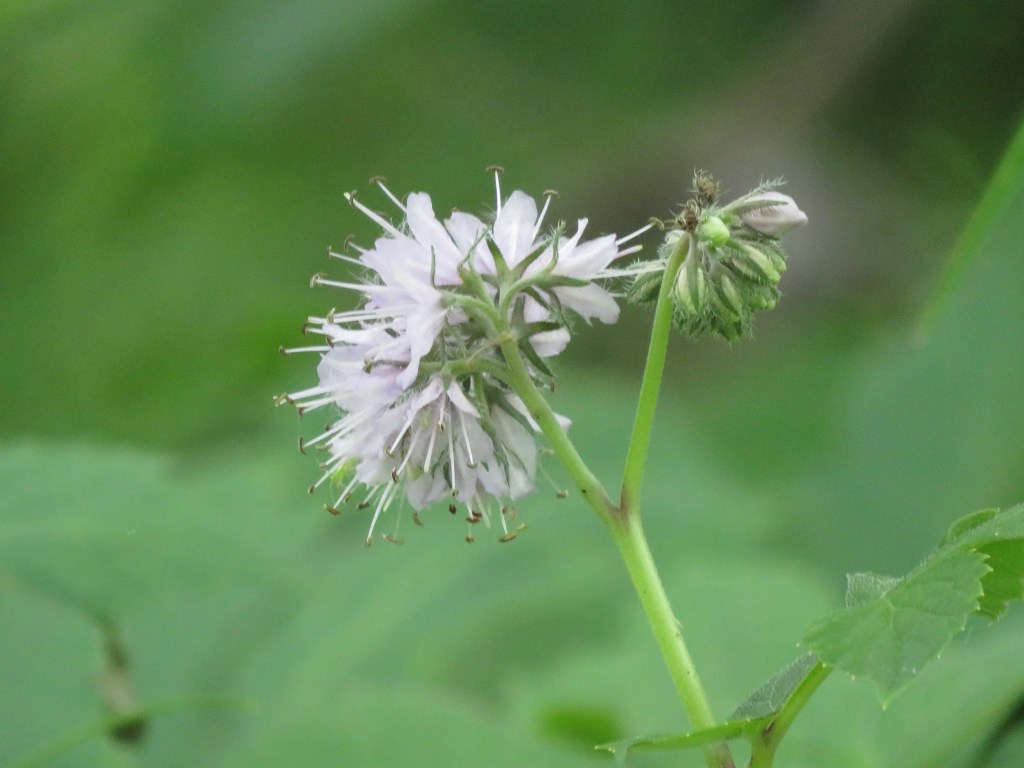
Aniseroot, Osmorhiza longistylis, Minneapolis, MN. Photo by Danielle, May 2025.
Leaves are part of the language I try to decipher when figuring out what a flower might be. I notice something that looks like Prairie Onion, Allium stellatum,–a firework of blooming clusters in shades of pale violet. I struggle when photographing these kinds of flowers. The tiny blooms don’t always come into focus, especially in bright sun or a breeze. I examine leaves. The characteristics of leaves help me distinguish similar plants from one another. These have what my favorite website calls “toothed edges” and leaves in threes: Aniseroot, Osmorhiza longistylis.
I see something else. It looks like Small Sundrops, Oenothera perennis. They grow in Hennepin County. I notice the four golden petals with wavy edges. Every part of the flower is some shade of yellow. I see only one blossom, tall and assertive, a standout. The leaves that surround it don’t seem to go with this flower. The bloom is all I can access.

Small Sundrops, Oenothera perennis, Minneapolis, MN. Photo by Danielle, May 2025.
Longfellow never visited Minneapolis or saw Minnehaha Falls. Was “The Song of Hiawatha” inspired by some kind of human urge, like Jung’s archetypes? I tell my creative writing students it’s hard to write well about places and things we haven’t experienced firsthand. I ask them to picture a place they’ve never visited and consider whether they could accurately capture that place in a poem or story. Most times, it will be hard to pull off. The students’ eyes grow big, prepared for the challenge, their fingers cranking out typewritten tales set in exotic places or even the Moon. They want to imagine the things and the places they’ve not yet seen. That’s part of the joy of writing. I’ve been drawing tiny anemones all my life, in the margins on notebooks, on post-it notes in my office. But I’d never actually seen one. Where did my sense of a flower shape come from?
Back home, I sit in my lawn chair, reading a book I picked up at Half Price Books in St. Paul. It’s Jung’s The Archetypes and the Collective Unconscious, first published in 1959. A sentence stands out to me: “The archetype is essentially an unconscious content that is altered by becoming conscious and by being perceived, and it takes its colour from the individual consciousness in which it happens to appear” (5). I underline the sentence and pencil a little blossom into the margin. I hear something and look up from the book. The rabbit that lives in our yard hops toward me, eating a dandelion.
 Danielle Dreams in Wildflowers
Leave a comment