Some of my favorite flowers from art are Vincent van Gogh’s sunflowers. Vincent’s sunflowers look so bright and wild and dreamlike. The sunflowers capture the color of the sun, our greatest star. The sun means more to me each summer. Winters are long here. By the end of April, I feel like I’m a cell phone with no charge left. I’m barely there and I need to be plugged in.
The sun always returns. I went through an ancient Egypt phase in junior high. Ra, the sun god, is one of my favorite gods from the ancient world. Many cultures and belief systems see godliness in the sun. I often tell my students about how, in works from ancient Greece, the sun symbolizes the truth. The prisoners in Plato’s cave are finally liberated from the shadows and led to the light. I have a stuffed Socrates doll in my office, perched in the windowsill. I tell the students he likes to sit in the sun.
And so do I. Sitting in my backyard lawn chair on a warm day, the rays feel incredible. The birds sing and the red squirrels jump, like skydivers, from the fence to the crabapple tree. Sometimes I read a book. Our basset hound sniffs a rogue daisy.
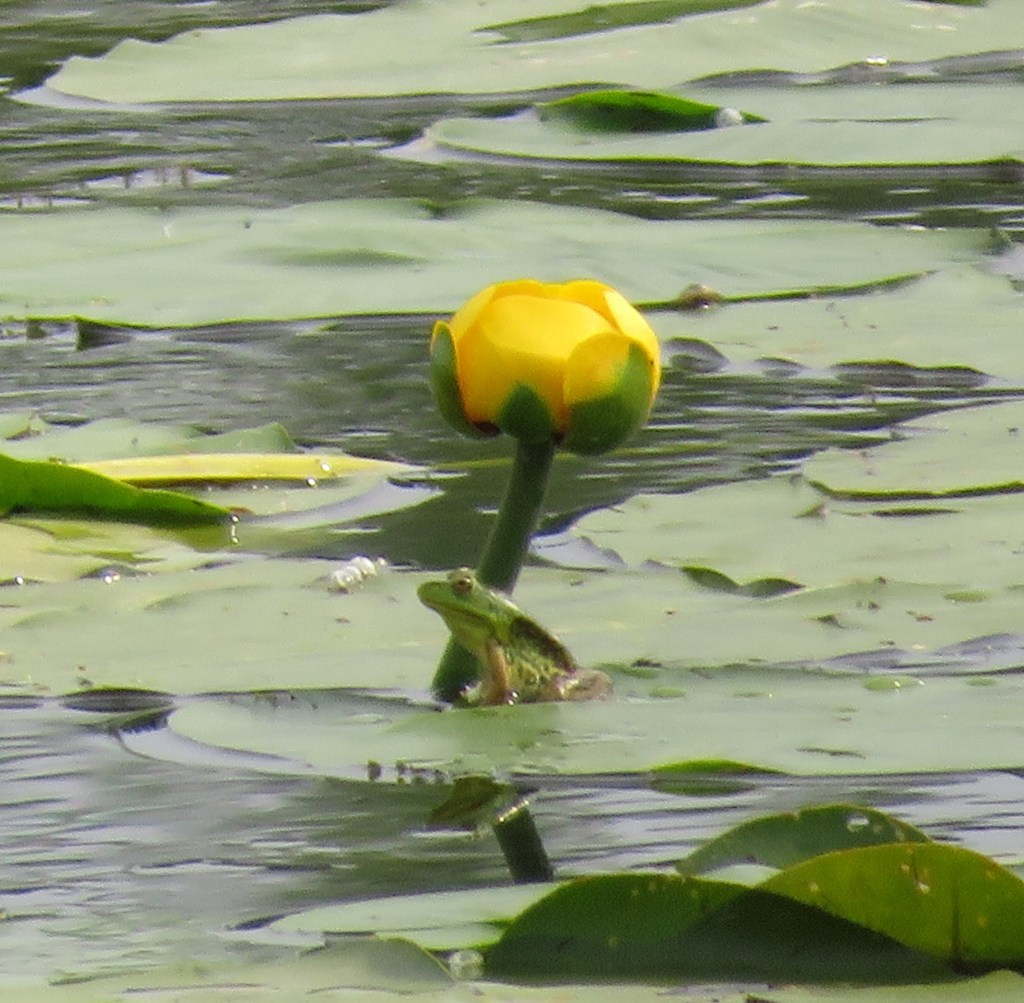
Frog with Yellow Pond Lily, Nuphar lutea, Polk County, MN. Photo by Danielle, July 2024.
The photo I took of the frog with the pond lily captures a happy, peaceful vibe. I see the same joy in yellow flowers. One of the first flowers I saw this spring was a Large-flowered Bellwort, Uvularia grandiflora, at Itasca State Park. The petals dropped toward the ground, twisted, like ropes of yellow licorice. Marsh marigolds, Caltha palustris, blossom along little creeks—low, upbeat bushes of five-petaled flowers. I feel relaxed in the forest. A sunray streams through the canopy.

Large-flowered Bellwort, Uvularia grandiflora, Itasca State Park, MN. Photo by Danielle, May 2025.

Marsh marigolds, Caltha palustris, Itasca State Park, MN. Photo by Danielle, May 2025.
In Otter Tail County, I see my first Lady’s slipper. It’s yellow and bold. I get close, trying to find the best camera angle. The flower is big and mysterious, with long, twisted sepals on either side of the pouch. This particular plant will remain where it’s rooted–unlike birds and other animals, plants don’t move. Plants don’t have brains, either, but fields like critical plant studies have started to expose how plants communicate in fascinating ways that can expand how we think about intelligent life.
I read about slipper orchids. The US Forest Service says these types of orchids bloom in the spring and thrive in cooler temperatures. I learn that the genus name, Cypripedium, is partially derived from the Greek word for “sandal” (US Forest Service). The pouch, or labellum, looks like a slip-on shoe.

Yellow lady’s slipper, Cypripedium parviflorum, Otter Tail County, MN. Photo by Danielle, May 2025.
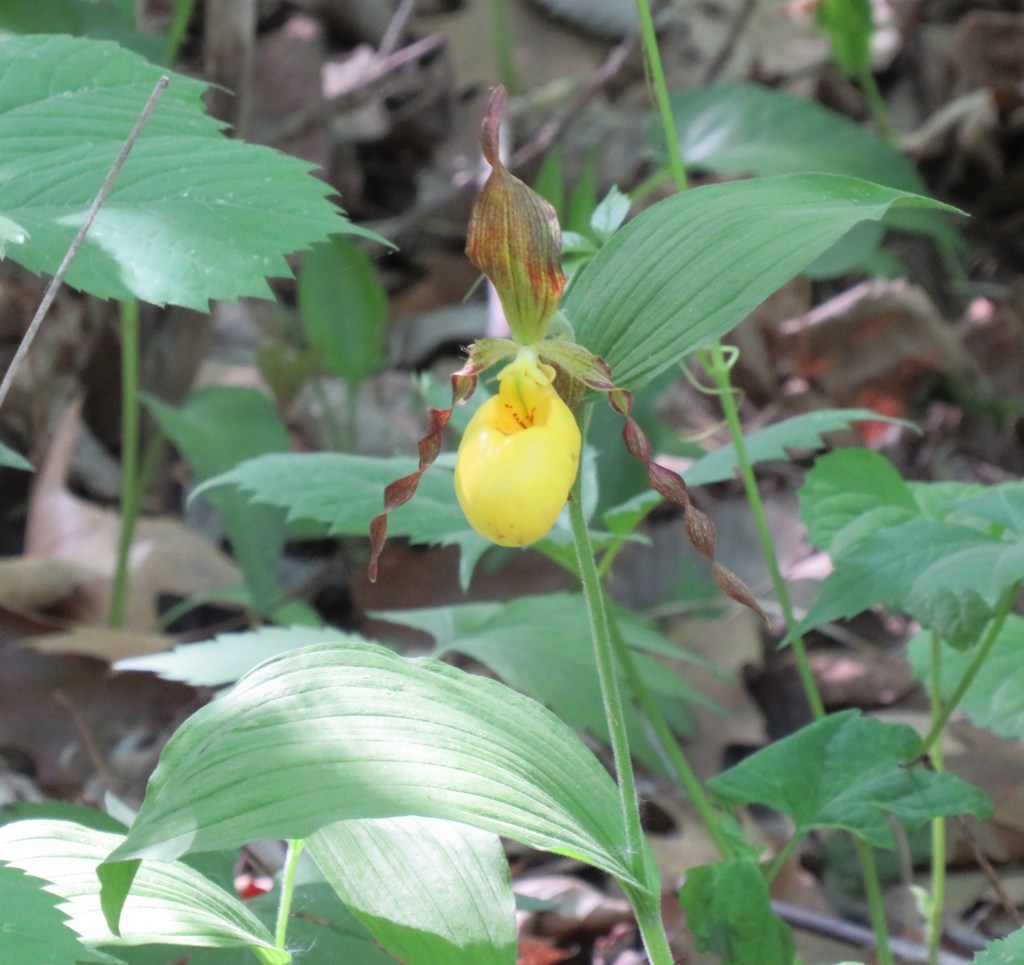
Yellow lady’s slipper, Cypripedium parviflorum, Otter Tail County, MN. Photo by Danielle, May 2025.
In a museum, visitors know what works of art they’ll encounter. It’s different in the forest. A careful glance might reveal something thrilling and beautiful. I wonder how many wildflowers I’ve encountered in life, not even knowing or seeing them. I think of our time living in Arizona and our drives through Oak Creek Canyon north of Sedona. Farther south, the sun grows hotter. I dream of saguaros and cactus flowers.
I have places I can go to feel the sun. Some places are easy and real, like Socrates’s seat in my window. I listen to Tom Petty while cropping and labeling photographs. I zoom in on Golden Alexanders, Zizia auria, looking for clarity.

Golden alexanders, Zizia aurea, Lake Maria State Park, MN. Photo by Danielle, May 2025.
 Danielle Dreams in Wildflowers
Leave a comment